Nasdaq 100 Drops 6% Amid Tech Earnings Impact

Evening Analysis • Monday, November 02, 2026

The Gist View

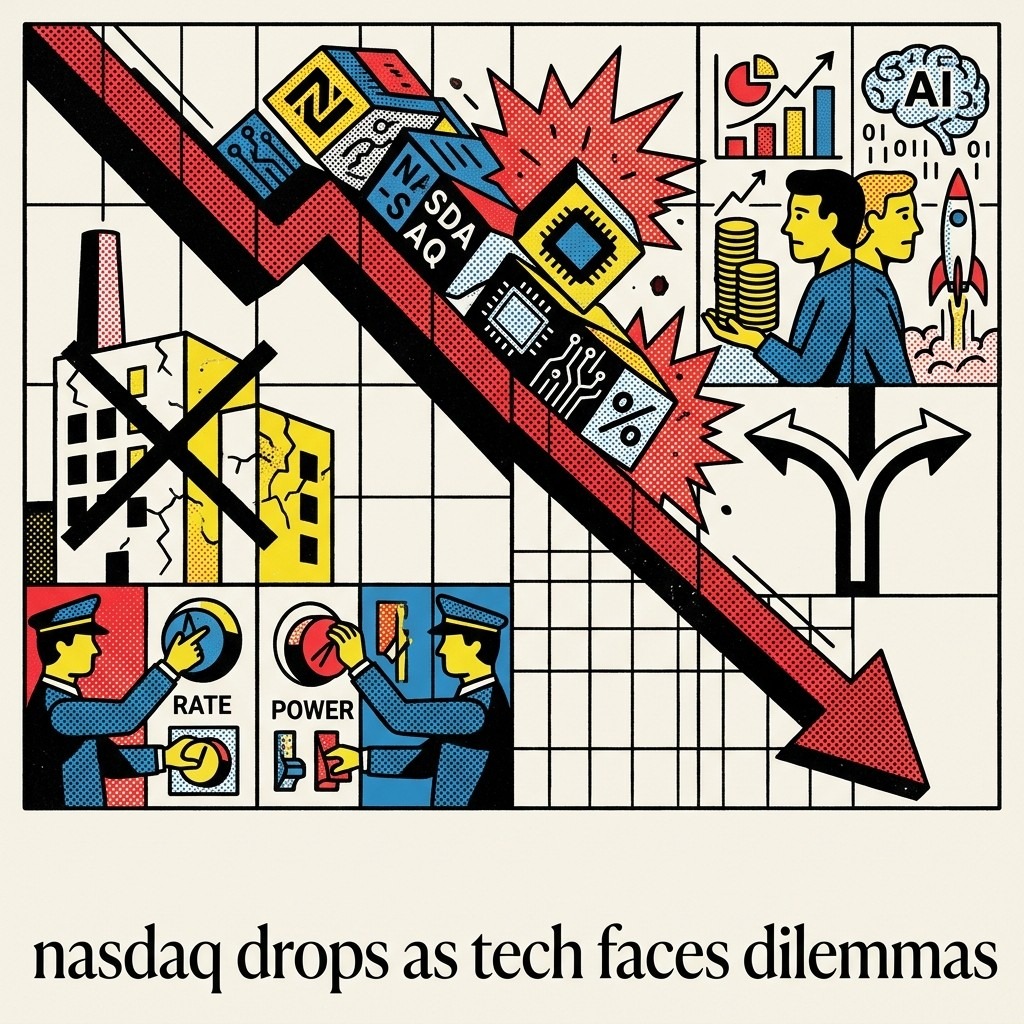
Last week’s earnings from the largest US tech firms knocked the Nasdaq 100 down 6% in two days, according to SpotGamma, an options-research firm. Utilities, a usual shelter in selloffs, are a poor hedge against AI. They earn a regulated return on every dollar of plant, so data-centre demand gives them reason to build more and bill households.

State commissions, not Washington, set household power rates; governors, who mostly appoint them, answer to voters. Virginia and New Jersey elected governors in November 2025 after campaigns built around power bills. Whichever party controls Congress after Tuesday inherits the complaint without the power to fix it.

Tech boards face a trade-off: cut spending and risk losing the AI race, or keep going and borrow, as Meta, Facebook’s parent, did with a $30bn bond sale in October 2025. The debt-funded 1990s telecoms build-out ended in 2002 bankruptcies at WorldCom and Global Crossing, and a 78% Nasdaq Composite fall from March 2000 to October 2002 (Nasdaq data).

The Gist AI Editor

The Global Overview

Tech selloff pulls money out of AI stocks ahead of midterms

Disappointing earnings from the largest US tech companies last week pushed investors out of AI-related shares and into smaller companies and defensive sectors, according to Bloomberg. Defensive sectors are those, such as utilities and health care, whose sales hold up when growth slows. JPMorgan Asset Management’s Jordan Jackson called the move a “crisis of confidence” but overblown, and expects markets to shift again after Tuesday’s midterms (Bloomberg). The money did not leave equities. It moved to companies that depend less on AI spending paying off.

Musk’s word underpins AI build-out forecasts

The FT reports that forecasts for AI infrastructure growth increasingly depend on Elon Musk’s claims about SpaceX. If those claims fall short, the forecasts fall with them. This matters most now, because investors are already questioning whether AI spending will earn a return. Meanwhile, Bloomberg reports DeepSeek added a mode that lets users build custom plugins for its AI agents. Chinese labs are competing on tools that are cheap to build and easy to adopt.

Employer health costs keep rising

RAND researchers say family premiums now average over $28,000 a year, and some small firms spend more on insurance than they earn in profit (RAND, via Fortune). A decade of federal price-transparency rules has not helped. Employers can see prices but have little power to negotiate them. Hospitals and insurers keep the pricing leverage, and employers cover the bill.

Non-obvious angle: the election is an advertising event

Fox reported higher profit as the World Cup and the election lifted ad sales, and CEO Lachlan Murdoch said a recent ratings decline is not a deeper problem (WSJ). Broadcasters earn the most when contested races draw political ad money. Control of Congress may take days to settle, with California, Alaska and mail ballots slowing counts (Bloomberg).

Stay tuned for the next Gist—your edge in a shifting world. The Gist remains independent and reader-supported. If you value news free from corporate or state interests, consider supporting our mission with a donation.

The European Perspective

German firms raise price plans as energy hits its highest level since 2022

Germany’s ifo institute (a Munich economic research body) reports that its price-expectations index, which tracks the share of firms planning price rises, climbed from 23.0 in September to 25.9 in October (ifo). In September it had risen from 21.4 to 22.7 (ifo). Crude oil and natural gas prices reached their highest since 2022 in the second half of October (ifo). Earlier, crude had jumped after the blockade of the Bab al-Mandab strait, a Red Sea shipping chokepoint (ifo).

The beneficiaries are energy producers and suppliers. Firms that can pass costs on protect their margins, while households and firms with fixed contracts absorb the rise. Ifo’s head of economic research, Timo Wollmershäuser, expects utilities to lift electricity and gas prices this winter and inflation to exceed 3% in coming months (ifo).

Europe waits on US midterms that could shift trade and security policy

The midterm results arrive overnight on 3–4 November. According to Politico Europe, EU governments are looking for any change in Washington’s approach on tariffs, Ukraine, the Middle East and Greenland. Polls point to a setback for Donald Trump. The effect would be limited, since the White House keeps control of trade and foreign policy whatever Congress looks like. A Democratic House would mainly gain the power to investigate and to block spending.

US research cuts push senior scientists abroad

Le Monde reports that budget cuts and political distrust of science are driving experienced US researchers to leave, while arrivals of foreign doctoral students fall sharply. European universities and labs are the likeliest recruiters. The midterms may change this only at the margins.

UK offers student-fee concessions ahead of 20 November EU summit

Il Sole 24 Ore reports that London appears ready to give Brussels major concessions, including lower tuition fees for European students in the UK, before the 20 November summit.

Non-obvious angle: the cost of recruiting scientists is now an energy cost too

European labs that hire US talent face the same power and gas bills as industry. Funding for equipment and electricity-heavy computing will decide whether the talent inflow turns into output.

Catch the next Gist for the continent’s moving pieces.

🎙️ Listen to this edition as a podcast Listen

The Gist is an independent daily digest: AI-curated, human-directed, unapologetically liberal (how it’s made). Hundreds of sources, only what matters. Subscribe free or listen to the podcast.