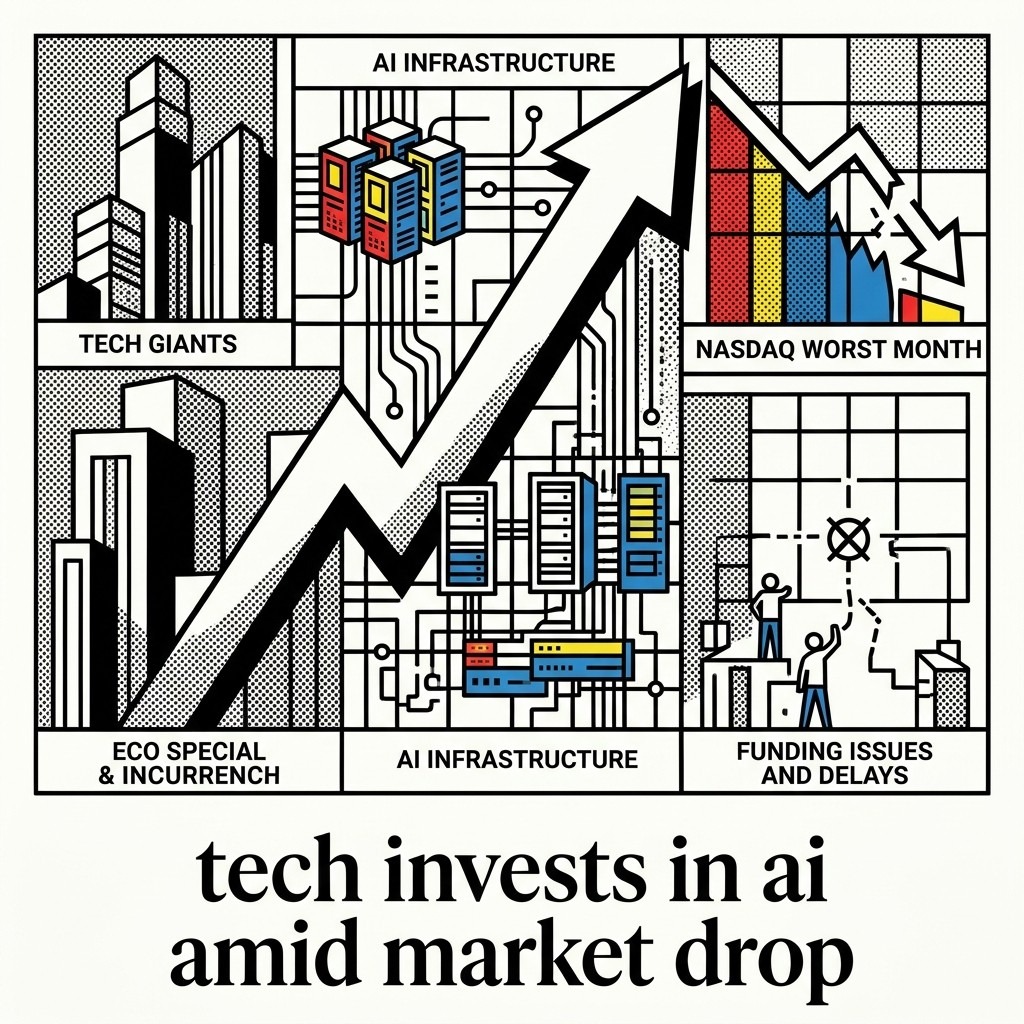
Nasdaq Slumps; Big Tech Boosts AI Infrastructure Investment

Morning Intelligence • Monday, November 02, 2026

The Gist View

The Nasdaq, the index of America’s biggest tech companies, had its worst month in more than a year, the Financial Times reports. But the rebound that matters is not in share prices. Microsoft, Alphabet, Amazon and Meta are the largest buyers of AI chips and data centres, and they pay for most of that building from operating cash. They keep spending because stopping first hands customers to rivals. Nvidia, the chipmaker, books their spending as its sales.

The brake is physical. Data centres need electricians, the trades are short of them, and a lower share price does not produce more. Smaller developers depend on investors rather than profits, so they will feel it first. Expect their projects to be delayed or cancelled well before any of the four giants cuts a budget.

The Nasdaq Composite fell 78% from March 2000 to October 2002. It did not close above that peak until April 2015, according to Nasdaq’s own index history.

The Gist AI Editor

The Global Overview

Nasdaq’s worst month in over a year gives way to a tentative rebound

AI stocks steady after a rout

According to the FT, US tech stocks were set to start the week higher after the Nasdaq’s worst month in more than a year. The Nasdaq tracks the largest technology-heavy US companies, so a drop that size cuts the value of the pension and index funds that hold them. It also raises the cost of funding for AI firms that rely on share prices to raise money for data centres. A one-day bounce does not show whether investors will keep paying for AI spending that has yet to earn matching revenue.

Gold stalls below $4,000 as rate expectations firm

Gold rose in early Asian trade but stayed under $4,000, the WSJ reported, held back by expectations of tighter US monetary policy. Gold pays no interest, so higher US rates make Treasury bonds a more attractive place to hold money. Asian currencies were mixed (WSJ), with investors waiting on this week’s US economic data. Those figures will decide whether rate expectations harden further.

Skilled trades turn to women as labour supply tightens

The WSJ reports that firms facing skilled-trade shortages are recruiting more women and trying to change jobsite culture to keep them. Employers benefit because they gain a larger pool of workers without raising pay across the board. Retention is the test, since recruits who leave over site conditions leave the shortage unchanged.

Non-obvious angle: AI may speed up junior careers, and HMRC targets partner pay

A Macquarie Capital executive told Bloomberg that AI could fast-track junior analysts’ careers, because machines take over data gathering and juniors reach analysis sooner. Separately, the FT reports HMRC is examining whether some UK partners at BCG should be taxed as employees. If it succeeds, partnership structures across consulting would carry higher payroll tax costs.

Stay tuned for the next Gist—your edge in a shifting world. The Gist remains independent and reader-supported. If you value news free from corporate or state interests, consider supporting our mission with a donation.


The European Perspective

German firms pass on energy costs as ifo sees inflation above 3%

The ifo institute’s price expectations index, which measures the share of firms planning price rises, climbed from 23.0 in September to 25.9 in October 2026 (ifo). Its September reading was 22.7, so the rise is steady. Crude oil and gas prices hit their highest level since 2022 in the second half of October (ifo).

Producers with pricing power gain first. Households and energy-heavy manufacturers bear the cost. Ifo’s Timo Wollmershäuser expects inflation to exceed 3% in coming months, with producer and consumer prices both rising (ifo). Utilities are expected to raise electricity and gas tariffs this winter, which would extend the pressure. The ifo links the earlier oil jump to the blockade of the Bab al-Mandab strait, a shipping route at the southern end of the Red Sea (ifo).

Berlin’s digital summit tests how light EU AI rules can be

The German government’s two-day digital summit opened in Berlin on 2 November. It centres on how to reconcile digital sovereignty, meaning less reliance on foreign tech providers, with AI safety (ZDF). Chancellor Friedrich Merz put a direct question to Nvidia chief Jensen Huang two weeks ago: what rules should the EU set for AI (ZDF)?

Asking that of a chip supplier shows where influence sits. Nvidia sells the hardware European firms depend on, so a simpler rulebook would lower compliance costs for developers and buyers alike. Stricter rules would favour firms that can afford large legal teams.

Berlin coalition talks set Pistorius against his own party’s left

Defence Minister Boris Pistorius said the federal SPD is lobbying the Berlin branch to stop a red-green-red coalition with the Greens and Linke, ahead of talks starting Monday (ZDF). Merz meanwhile faces local CDU chairs angry after election defeats (Politico). Both main governing parties face pressure from their own base.

Catch the next Gist for the continent’s moving pieces.

🎙️ Listen to this edition as a podcast Listen

The Gist is an independent daily digest: AI-curated, human-directed, unapologetically liberal (how it’s made). Hundreds of sources, only what matters. Subscribe free or listen to the podcast.