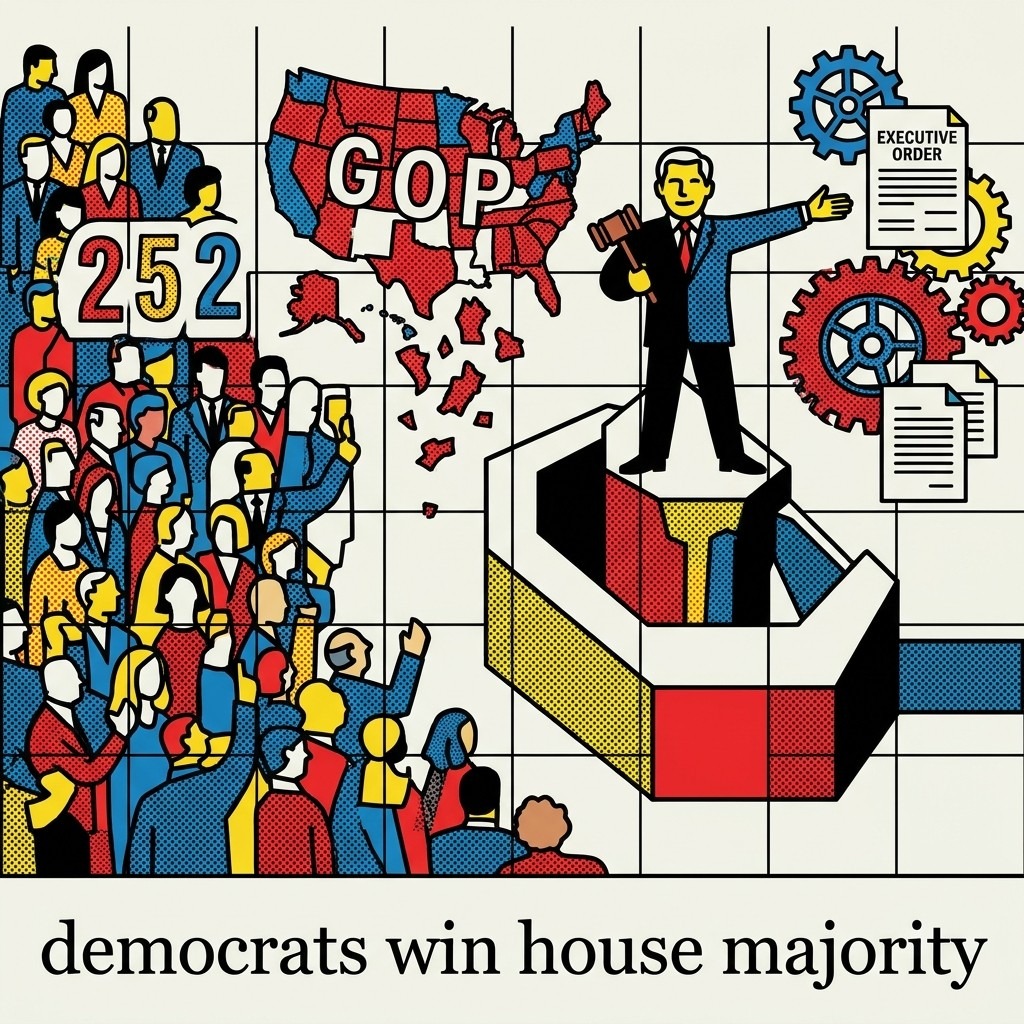
Democrats Secure US House Majority with 252 Seats

Morning Intelligence • Wednesday, November 04, 2026

The Gist View

Democrats won the US House, with NBC News projecting at least 252 seats against the 218 needed, even though Republicans redrew maps in several states over 18 months to protect their majority. Thin margins were the flaw. Mapmakers win the most seats by spreading their voters across many narrow victories, which works only if opinion stays still. It did not: CNN reported that at least three Florida seats redrawn for Republicans went Democratic.

Hakeem Jeffries, the House Democratic leader expected to become speaker, gains more from subpoenas and public fights with the White House before 2028 than from deals. President Trump, unable to pass bills, gains from governing by executive order, which the House alone cannot reverse.

In 2018, Democrats gained at least 32 seats, their best midterm since 1974, according to Yahoo News. NBC’s projection implies roughly 38 more than the 214 seats they held, Northeastern University reported.

The Gist AI Editor

The Global Overview

Democrats gain in the US midterms, and markets price in a split government

Stock futures edged lower as investors weighed Democratic gains, and Nasdaq futures pared their losses, according to the WSJ. Bitcoin slipped. Oil also fell in early Asian trading as results came in (WSJ). A Congress divided between the parties makes large tax or spending bills harder to pass. Companies that depend on federal contracts, tariffs or subsidies now face more uncertainty about what policy will hold.

AMD and Super Micro show where AI money is going

Wedbush analyst Matt Bryson told Bloomberg that AMD’s earnings “met the bar.” Its revenue forecast still exceeded analysts’ estimates. Bryson called Super Micro’s outlook strong. He said the open question is whether AI spending will last, because Super Micro sells heavily to “neocloud” firms, which rent out AI computing power and are where investor worry is highest (Bloomberg). Those customers need steady demand to pay for the servers they buy. If their demand weakens, the hardware makers feel it first.

Brussels slows Ukraine’s EU path while speeding Moldova’s

The European Commission is drafting a more cautious accession roadmap for Ukraine, with limited targets for 2027. Its roadmap for Moldova is far more ambitious, according to Politico. Ukraine’s membership would require EU decisions on farm subsidies and budget shares. Moldova is much smaller, so admitting it costs far less.

Canada keeps Russia out of an Alberta hockey tournament

Prime Minister Mark Carney said Canada will not admit Russian athletes to the tournament starting next month. That rejects a sports tribunal’s ruling (Bloomberg). The decision shows a national government overriding an international sports body on visas.

Stay tuned for the next Gist—your edge in a shifting world. The Gist remains independent and reader-supported. If you value news free from corporate or state interests, consider supporting our mission with a donation.

The European Perspective

Supermarket fridge hacks hit Belgium’s Delhaize, with Russia the main suspect

Two major cyberattacks on European supermarkets in a matter of weeks have disabled refrigeration systems. Empty fridges were photographed at a Delhaize store in Boortmeerbeek, Belgium, on 2 November (Politico). Experts quoted by Politico say the attacks may belong to Russia’s hybrid warfare against Europe. Nobody has been formally identified as responsible.

The costs fall first on retailers, who lose stock. Insurers and cybersecurity vendors stand to gain, because food chains are now treated as critical infrastructure. Their refrigeration controls were not built to that standard, and upgrading them will move spending toward industrial-security suppliers.

Democrats win the US House, and the Senate looks likely

Democrats took the House in the 3 November midterms, and a Senate win is probable (Politico). Trump has reacted angrily, according to Politico. A Democratic House can block spending bills and open investigations. That raises the odds of budget standoffs and gives European governments a counterpart to lobby on tariffs and Ukraine funding. Expect companies exposed to US trade policy to hedge against delays.

Spain’s transport minister quits after the Urda crash killed 69

Óscar Puente resigned almost a week after two high-speed trains collided in Castilla-La Mancha, which killed 69 people (ZDF, Il Sole 24 Ore). He also gave up his place as Socialist list leader for Valladolid in the 29 November general election. This is Spain’s second rail disaster this year (ZDF). The campaign will now centre on rail maintenance and safety spending.

Non-obvious angle: Europe funds research that US start-ups monetise

The ifo economic institute’s president, Clemens Fuest, and more than 50 scientists argue in Science that publicly funded European research often feeds US start-up patents (ifo). They want grants steered toward work with a clear path to market. The gain would go to European firms. At present, the returns go to American investors.

Catch the next Gist for the continent’s moving pieces.

🎙️ Listen to this edition as a podcast Listen

The Gist is an independent daily digest: AI-curated, human-directed, unapologetically liberal (how it’s made). Hundreds of sources, only what matters. Subscribe free or listen to the podcast.