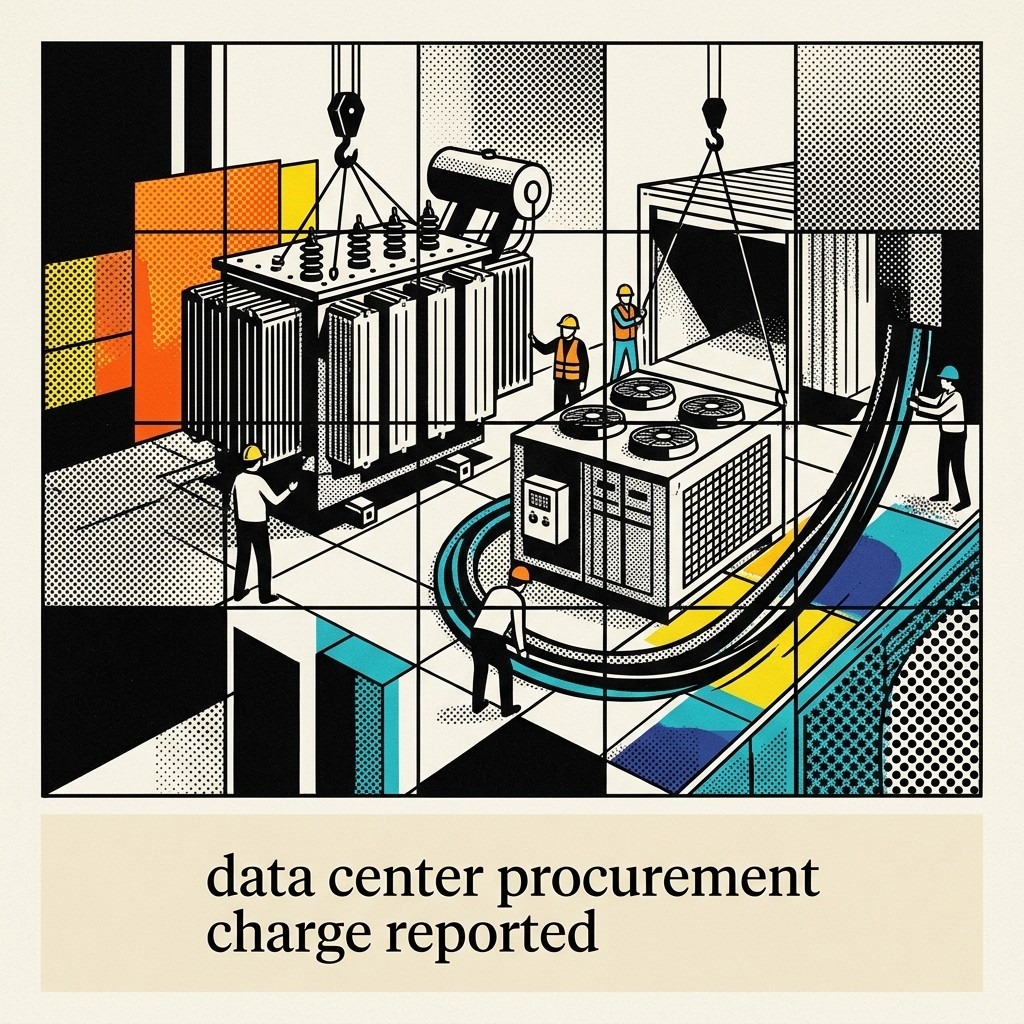
SoftBank Takes $3.7bn Hit on Data Center Equipment Charge

Morning Intelligence • Wednesday, November 11, 2026

The Gist View

SoftBank, the Japanese tech investment group led by Masayoshi Son, booked a $3.7bn charge on 10 November. The cause is a procurement contract, not weak AI demand: it prepaid suppliers, with no refund, for power equipment for data centres serving OpenAI, the maker of ChatGPT, and then changed its buildout plan.

Suppliers could demand such terms because buyers were queuing for scarce equipment, and a buyer afraid of missing out accepts deposits it cannot recover. The liability therefore sits in the deposits rather than the data centres, and any AI builder that paid early for scarce inputs carries the same hidden exposure.

SoftBank’s management says data-centre supply remains far short of demand and the Ohio project is not being scaled back, so this may be a one-off fix. Yet its own executive’s phrase, “bridge investments in advance” (CNBC), concedes the trade: a hedge bought at the seller’s price, now booked as a loss.

The Gist AI Editor

The Global Overview

SoftBank books first quarterly loss in almost two years on US data-centre prepayments

SoftBank Group, the Japanese tech investment conglomerate led by Masayoshi Son with a large stake in OpenAI (the US maker of ChatGPT), reported on 10 November a net loss of ¥1.12 trillion (about $7.1bn) for July–September, and its shares fell as much as 11% in Tokyo on 11 November (Bloomberg). The loss includes $3.7bn on nonrefundable advance payments for power-generation equipment for its 8-gigawatt Ohio campus and other US AI data centres (Bloomberg, CNBC). A gigawatt is a unit of power capacity, and 8 GW is roughly the output of several large power stations. SoftBank has a 20-year lease with OpenAI for that capacity (CNBC), and a SoftBank executive said it made “bridge investments in advance” in anticipation of a shortage (CNBC). Advance payments for the Ohio project and other sites totalled $9.5bn, leaving $6.6bn after a $2.9bn loss on that line at 30 September (Quartz). The stock has more than halved from its June peak (WSJ). Because interest costs were among the cited loss drivers, a rate rise by the Fed, the US central bank that sets the benchmark interest rate, could make each prepaid data-centre commitment that is not yet earning money costlier to hold.

US House kills Hegseth impeachment bid with a procedural vote

The House voted 211–204 on 10 November to refer Republican Thomas Massie’s impeachment resolution against Defense Secretary Pete Hegseth to the Judiciary Committee, which effectively kills it (CBS News). Massie was the only Republican to vote against the referral, and 11 Democrats were absent, while newly elected members do not take their seats until January (ZDF).

Asian bond yields rise as traders price a Fed rate hike next month

Hotter-than-expected US inflation data and hawkish comments from Fed officials raised the chances of a rate increase next month, and Asian bond yields rose on 11 November (WSJ). Yields are the return investors demand for holding a bond, so higher yields mean governments and companies in the region pay more to borrow.

Gaza storms hit tents while 150,000 shelters wait for Israeli approval

About 150,000 new shelters are held outside Gaza awaiting Israeli approval to enter, while more than 940,000 displaced people live in flood-prone areas (Guardian, 11 November). At least four Palestinians, including children, died in weekend storms that flooded fragile tents (Guardian).

Stay tuned for the next Gist—your edge in a shifting world. The Gist remains independent and reader-supported. If you value news free from corporate or state interests, consider supporting our mission with a donation.

The European Perspective

EU’s Digital Fairness Act targets subscriptions that are easy to join and hard to leave

The European Commission presents its Digital Fairness Act on 11 November, a plan for stronger online consumer protection, according to ZDF’s morning newsletter. ZDF’s example is the gym or streaming subscription that takes a minute to start, while the way to cancel sits in fine print and endless submenus. Firms keep those hurdles because every customer who gives up on cancelling keeps paying, so the friction produces revenue. Making cancellation as easy as signing up is also a competition rule, because it lowers the cost of switching and rewards companies that keep customers with a better product instead of with inertia. The test is whether the law stays a narrow right to exit or grows into a wide mandate on how interfaces must be designed. The strongest objection is that broad EU rules carry fixed compliance costs that large platforms absorb more easily than start-ups, and that existing consumer law already covers misleading terms, so a new law could add mostly paperwork. Separately from the act, US-mediated talks on the Ukraine war continue today in Abu Dhabi (ZDF), and whether Europeans get a seat at them is still unanswered.

France’s Calvados fossil-collecting ban goes before the Conseil d’État

Between Villers-sur-Mer and Houlgate in Calvados, the Vaches noires cliffs shed fossils onto the beach below. A new nature reserve now bans amateurs from collecting them, and the decision is being contested before the Conseil d’État, France’s top administrative court (Le Monde, 11 November).

Europe’s big infrastructure projects run late and over budget

Major European infrastructure projects are expected to improve mobility and competitiveness, but rising costs are contributing to significant delays (FT, 11 November).

Catch the next Gist for the continent’s moving pieces.

🎙️ Listen to this edition as a podcast Listen

The Gist is an independent daily digest: AI-curated, human-directed, unapologetically liberal (how it’s made). Hundreds of sources, only what matters. Subscribe free or listen to the podcast.