Ukraine Hits Russian Refineries; Europe Energy Costs Rise

Morning Intelligence • Tuesday, November 17, 2026

The Gist View

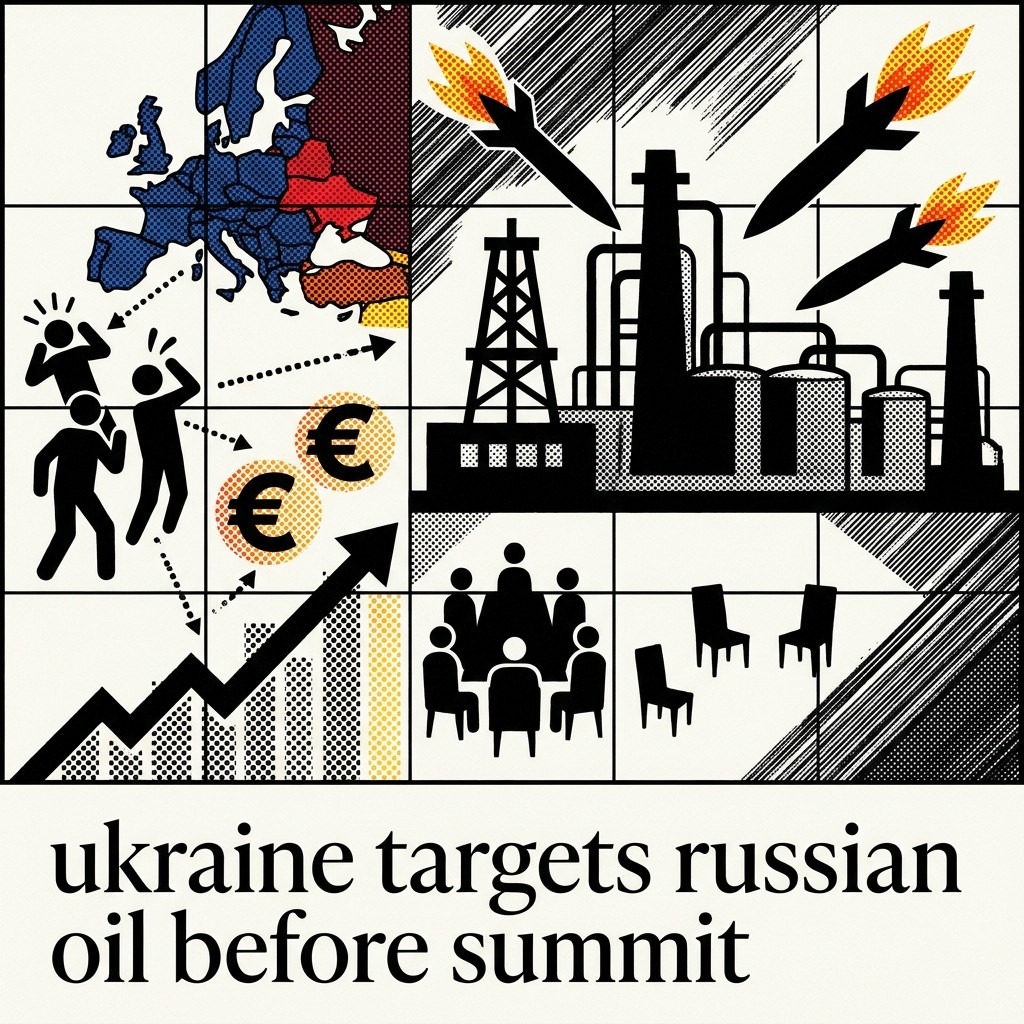
Ukraine has hit nine of Russia’s 35 major refineries in a week, ZDF reported on 17 November, two days before Putin, Trump and Xi meet in Shenzhen without Ukraine or Europe present. The timing follows from Kyiv’s position. Drone strikes on refineries need no US permission and no Chinese broker, so they are the one bargaining chip Ukraine holds that does not depend on a seat at that table.

Others pay for the leverage. Refineries can be rebuilt quickly and Russia can export crude instead of fuel, so the damage may be real but temporary, while the loss of diesel supply still lifts fuel prices worldwide. Europe, which is excluded from the talks, bears much of that cost through its energy bills and any Russian retaliation. The question nobody has stated is whether Washington will let Kyiv keep going while an oil shock is already under way.

Germany shows what is at stake. Timo Wollmershäuser, chief economist at the ifo institute, Germany’s main economic research body, said on 30 September that German inflation would climb above 3% in the coming months. A tighter diesel market would make that forecast harder to miss.

The Gist AI Editor

The Global Overview

Russian aircraft probe South Korea, Japan and Taiwan

Le Monde reported on 17 November that South Korea scrambled fighter jets after a Russian intrusion into its air-defence zone. Taiwan said it detected two Russian military aircraft near the island, while Japan said two suspected Russian aircraft violated its airspace and lodged a “very strong protest” with Moscow.

Ukraine hits nine of Russia’s 35 big refineries in a week

ZDF reported on 17 November that nine of Russia’s 35 major refineries were hit or had operations disrupted within one week, and that an export port was also struck. The strikes come two days before Putin meets Trump and Xi on Thursday 19 November in Shenzhen, China, on the sidelines of APEC (Asia-Pacific Economic Cooperation, a forum of Pacific-rim economies). If the strikes keep removing diesel and other fuel from a market already tight after the blockade of the Bab al-Mandab (the narrow strait between Yemen and the Horn of Africa that carries much of the oil and trade between Asia and Europe), they could also raise fuel costs for German firms. Those firms were already raising prices: the ifo institute, Germany’s main economic research body in Munich, said on 30 October that crude oil and gas prices hit their highest levels since 2022 in the second half of October, and its price-expectations index rose to 25.9 from 23.0.

Anthropic’s IPO becomes the test for AI’s payoff

Bloomberg calls Anthropic’s listing this week a bellwether for OpenAI and other rivals, and a signal of the industry’s health after the Nvidia scandal. The Gist’s call that it prices on 18 November is still open, and the point that dual-class shares limit what outside investors can do with disclosure still stands. Baidu chief Robin Li said on 17 November that AI needs better monetization if heavy investment is to pay off and avoid bubble risk (Bloomberg). The WSJ also reported that Kang Wei, husband of Alice Huang, built a Chinese-state-backed data-centre business while she was involved with Nvidia’s then-CEO.

Virginia’s governor backs out of federal school-choice credit

The WSJ reported on 16 November that Virginia’s Democratic governor, Abigail Spanberger, is withdrawing from the federal school-choice tax credit, a move its opinion page framed as siding with teachers’ unions.

Stay tuned for the next Gist—your edge in a shifting world. The Gist remains independent and reader-supported. If you value news free from corporate or state interests, consider supporting our mission with a donation.

The European Perspective

Spain’s Feijóo ties NATO spending to an audit that comes after the vote

Spain holds a snap general election on 29 November, and Alberto Núñez Feijóo, leader of the centre-right People’s Party (PP), is the favourite to become prime minister (Politico Europe). He told Politico’s Madrid Playbook that Pedro Sánchez’s Socialist government has been fiddling the national accounts. For that reason, he said, he can make no clear defence-spending pledge, and cannot say whether Spain can reach its NATO target, until a full audit after the election. He still promises tax cuts, pensions and housing measures. An incoming government cannot know the true state of the books, so auditing before committing to large spending is defensible for a fiscal conservative. But the audit comes after the vote and so cannot bind him. Defence is the one promise he can postpone without upsetting voters, which makes Spain’s NATO commitment the line that slips if the books prove worse than advertised. He also says he will abide by his deals with Vox, the party he is likely to govern with, and wants to repair strained relations between Spain and Trump (Politico Europe).

Finland’s Stubb urges European leaders to speak to Putin directly

Finland’s president, Alexander Stubb, told the Financial Times that Europe’s leaders should talk directly to Russia’s president, Vladimir Putin, and that it is irresponsible to leave contact with Russia to the US for so long (ZDF, citing FT). He warned that Washington may lean towards dividing Europe into spheres of influence, and said leaders must arrive with one message and a common position. Meanwhile, Politico’s Brussels Playbook is asking whether the EU’s upcoming 22nd round of sanctions on Russia will bite, citing growing questions over how well existing measures are enforced.

Catch the next Gist for the continent’s moving pieces.

🎙️ Listen to this edition as a podcast Listen

The Gist is an independent daily digest: AI-curated, human-directed, unapologetically liberal (how it’s made). Hundreds of sources, only what matters. Subscribe free or listen to the podcast.