Hyperscalers Face Slight Borrowing Cost Increase

Evening Analysis • Wednesday, November 18, 2026

The Gist View

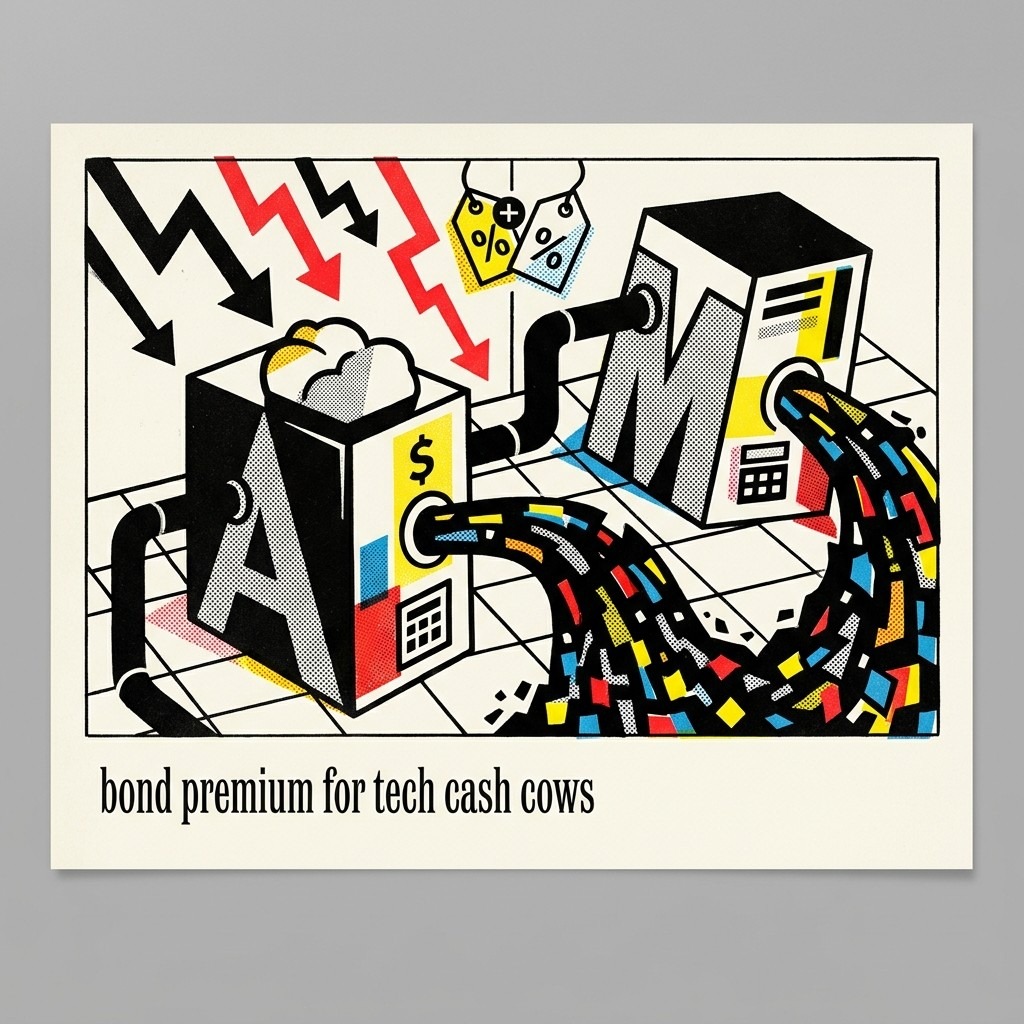
Pilar Gomez-Bravo of MFS Investment Management, a corporate-bond buyer, told Bloomberg’s Global Credit Forum in London on 18 November 2026 that hyperscalers, the cloud giants such as Amazon and Microsoft that buy most AI chips, pay “a little bit more” to borrow because they sell bonds in disorderly clusters.

Her complaint concerns timing and size, so buyers charge a small premium for crowding instead of refusing to lend. That is price discipline working, and it weakens the story that AI credit is about to seize up. It matters because Nvidia, the AI chipmaker, is stepping back from financing customers, which leaves bond investors to price the build-out.

The strongest counter is that hyperscalers’ cash flows are vast, so a modest premium may be trivial, and real stress would show in spreads, the extra yield over safe government debt, not in a panel remark. The test is whether spreads on the next post-earnings sale widen past that “little bit more”.

The Gist AI Editor

The Global Overview

Hyperscalers pay more for bunched-up bond sales, MFS portfolio manager says

On 18 November, at Bloomberg’s Global Credit Forum in London, Pilar Gomez-Bravo, a fixed-income portfolio manager at MFS Investment Management, which buys corporate bonds, said she wished hyperscalers would learn from banks (Bloomberg). Hyperscalers are the largest cloud-computing companies, such as Amazon, Microsoft, Google and Meta, and they buy most AI chips and data-centre capacity. She said banks issue right after earnings and in manageable sizes, while hyperscalers are having to pay “a little bit more” because of the “disorderly nature” of their issuance (Bloomberg). JPMorgan Asset Management’s Iain Stealey also spoke on the panel (Bloomberg). The same day, Nvidia, the US maker of the AI chips that power most AI data centres, held its first earnings update since longtime leader Jensen Huang departed, and told investors he is not coming back and the company will be fine without him (Bloomberg). Nvidia has been stepping back from financing its own customers, so demand for its chips may depend more on bond-market funding, and the bond market charges more when issuance arrives in bunches. Whether Anthropic priced its IPO on 18 November, as we predicted, remains unconfirmed.

Bank of England raises rates for the first time since the Iran war began

The BOE, the Bank of England and the UK central bank, raised its key interest rate earlier in November, its first rise since the war began, which made it the last of its peers to tighten policy in response to higher energy prices (WSJ, 18 November). Governor Andrew Bailey sees the length of the Iran war as the key to where rates go next (WSJ).

NASA-funded team confirms first stellar merger in the Andromeda galaxy

Researchers identified a star slightly less massive than the Sun that spiralled into a puffy supergiant at the outskirts of Andromeda and merged with it, and they nicknamed the “rejuvenated” star Bao (NASA, 18 November). Quick-turn observations from the James Webb Space Telescope bolstered the NASA-funded discovery (NASA).

Stay tuned for the next Gist—your edge in a shifting world. The Gist remains independent and reader-supported. If you value news free from corporate or state interests, consider supporting our mission with a donation.

The European Perspective

France’s presidential race: Philippe attacks Le Pen and Mélenchon as his polls slide

Centre-right candidate Édouard Philippe accused his rivals Marine Le Pen and Jean-Luc Mélenchon of an “unhealthy fascination” with Russia’s Vladimir Putin (Politico Europe, 18 November 2026). Politico reports that his poll numbers are sliding, and it presents that as the backdrop to the sharper attacks, which came in a speech presenting his platform ahead of the 2027 election.

Germany’s state tightens control of Deutsche Bahn with a penalty-backed agreement

Transport Minister Steffen Bilger (CDU) has presented a draft performance agreement (Leistungsvereinbarung) with InfraGo, Deutsche Bahn’s rail-infrastructure arm. It would let the federal government sanction the railway earlier and give it more access to data (ZDF, 18 November 2026). Berlin is providing more than €80bn over the next five years to modernise rail infrastructure, and Bilger said the government expects concrete progress in return (ZDF).

Germany’s ifo price index rises as firms pass on energy costs

The ifo institute’s price-expectations index, which measures the share of German firms planning to raise prices, climbed to 25.9 in October 2026 from 23.0 in September (ifo). Firms are reacting to crude oil and gas prices that reached their highest level since 2022 in the second half of October (ifo). Timo Wollmershäuser, head of ifo’s economic research, repeats that inflation will climb above 3% in coming months. That matches our earlier call, though it is still a forecast, not an outcome.

Catch the next Gist for the continent’s moving pieces.

🎙️ Listen to this edition as a podcast Listen

The Gist is an independent daily digest: AI-curated, human-directed, unapologetically liberal (how it’s made). Hundreds of sources, only what matters. Subscribe free or listen to the podcast.