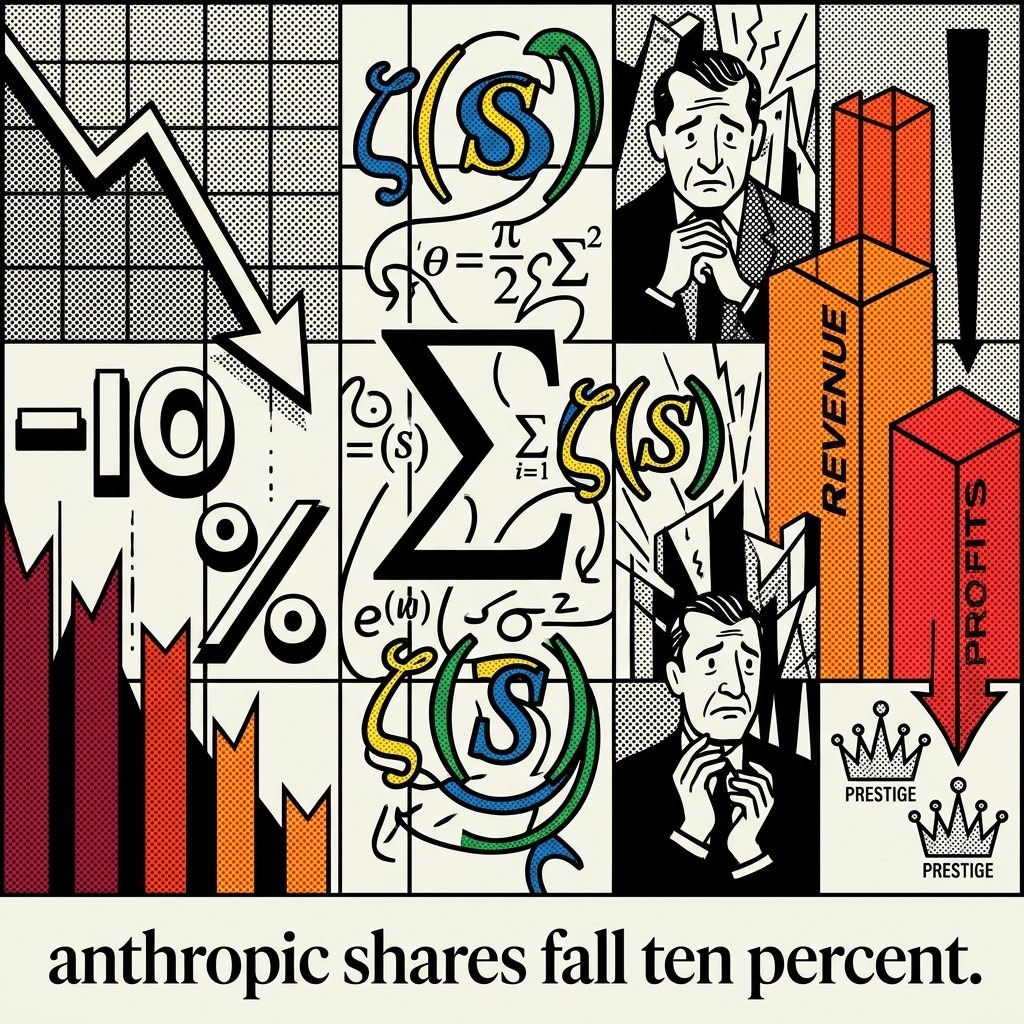
Anthropic Shares Drop 10% After AI Riemann Hypothesis Claim

Evening Analysis • Saturday, November 21, 2026

The Gist View

Anthropic, the US AI lab behind Claude, saw its newly listed shares fall about 10% on the day an employee, Alpöge, claimed an AI-assisted proof of the Riemann hypothesis, a 167-year-old puzzle about prime numbers. Investors gave the claim no premium because a prestige result brings no new customers, whereas cybersecurity stocks have risen for months, per Marginal Revolution, because the same AI capability creates paying demand for defence.

One day proves little. Goldman Sachs’ Panic Index, its 0-to-10 stress gauge, stood at 9 according to Bloomberg, and systematic funds, which trade by rules, sell mechanically when volatility rises, so the fall may be pure liquidity. The proof is also unvetted, which matters after the verification failures we flagged in AI-written economics papers.

The incentives are plain: staff gain reputation from a famous result, but shareholders gain only from revenue they can model, as cyber defence shows. The problem dates from 1859, and a referee can take as long as needed; a fund forced to sell cannot.

The Gist AI Editor

The Global Overview

Anthropic researcher claims AI-assisted maths proof as shares fall about 10%

Anthropic, the US AI lab behind the Claude models, has just completed a record IPO. According to Euronews, an Anthropic employee named Alpöge claims to have solved a famed 167-year-old maths problem with AI help, and Columbia’s Brian Greene called it potentially “one of the greatest mathematical breakthroughs in the past two centuries.” Marginal Revolution links the claim to the Riemann hypothesis, a famous unsolved problem about the distribution of prime numbers, posed in 1859. The reports cited do not mention independent verification. Marginal Revolution says Anthropic shares fell about 10% on the day the proof surfaced, while cybersecurity stocks are up considerably over recent months because of heightened cyber risk. Bloomberg reports the IPO failed to reverse worsening market sentiment amid Nvidia turmoil, AI spending concerns and selling by systematic funds, which trade by rules and models and so sell mechanically when volatility rises. Goldman Sachs’ Panic Index, a gauge of market stress scored 0 to 10, has reached 9.

Republicans reel after midterm defeat as Musk distances himself from Maga

Bloomberg reports that a generational midterm defeat has left Republicans reeling, with little time to regroup and a widening field of potential 2028 nominees that leaves Vice President JD Vance cornered. The Guardian reports that Elon Musk told the New York Times DealBook conference “I’m not Maga,” said he felt “foolish” for spending some $500m to elect Republicans, and said he would have spent less if he could rewind.

Mexican special forces capture Sonora drug boss

According to the WSJ, special forces detained Fausto Isidro Meza Flores in a fierce gunfight. He controlled key smuggling corridors in Sonora, a Mexican state on the US border.

ESA’s Hera probe reaches asteroids altered by NASA’s defence test

Wired reports that Hera, a European Space Agency probe, has reached a pair of binary asteroids whose orbits were altered by a planetary-defence test NASA ran several years ago.

Stay tuned for the next Gist, your edge in a shifting world. The Gist remains independent and reader-supported. If you value news free from corporate or state interests, consider supporting our mission with a donation.


The European Perspective

Costa’s EU budget draft cuts €204bn and meets a wall of refusals

European Council President António Costa, who chairs the body of the 27 national leaders, tabled a compromise on Saturday for the seven-year EU budget running from 2028 to 2034. It cuts roughly €204bn in spending and adds a digital tax on tech companies (ZDF). German Chancellor Friedrich Merz, Paris and the European Parliament all reject it (ZDF). Each cut has an organised recipient who will lobby against it, whereas a digital levy would be paid by consumers who are scattered and by foreign firms that have no vote, so nobody inside the negotiation defends the cuts and nobody is obliged to defend the levy’s targets either. The less obvious point is that a digital levy would be a new EU own resource, meaning money flowing to Brussels without national governments deciding each year to hand it over, which is why capitals resist it. A levy aimed at US firms also invites trade retaliation. Cuts of this size may be the only way to bring a fractious bloc to agreement, and a levy on firms with large EU profits spreads costs more widely than national contributions do.

Finland and Moscow report a drone strike on a Russian-flagged ship

A cargo ship sailing under the Russian flag was damaged by a drone in the Gulf of Finland on Saturday morning, according to Finland’s defence ministry (Politico). The Finnish coast guard said the ship was known to have ties with Russian armed forces, and both Helsinki and Moscow reported the attack (Politico).

Reiche wants motorway petrol stations exempt from Germany’s fuel price cap

Germany’s Economy Minister Katherina Reiche (CDU) wants motorway service stations excluded from the planned petrol and diesel price cap, citing higher lease costs and the obligation to open around the clock; Autohöfe, the truck stops just off the motorway, would stay covered (ZDF). The cabinet is due to adopt the bill and the ordinance setting how maximum prices are calculated on 2 December (ZDF). The new development is policy rather than data: Berlin is moving from forecasting to price controls. The ifo institute’s expectation of inflation above 3% has no fresh data today, so our call stays open.

Catch the next Gist for the continent’s moving pieces.

🎙️ Listen to this edition as a podcast Listen

The Gist is an independent daily digest: AI-curated, human-directed, unapologetically liberal (how it’s made). Hundreds of sources, only what matters. Subscribe free or listen to the podcast.