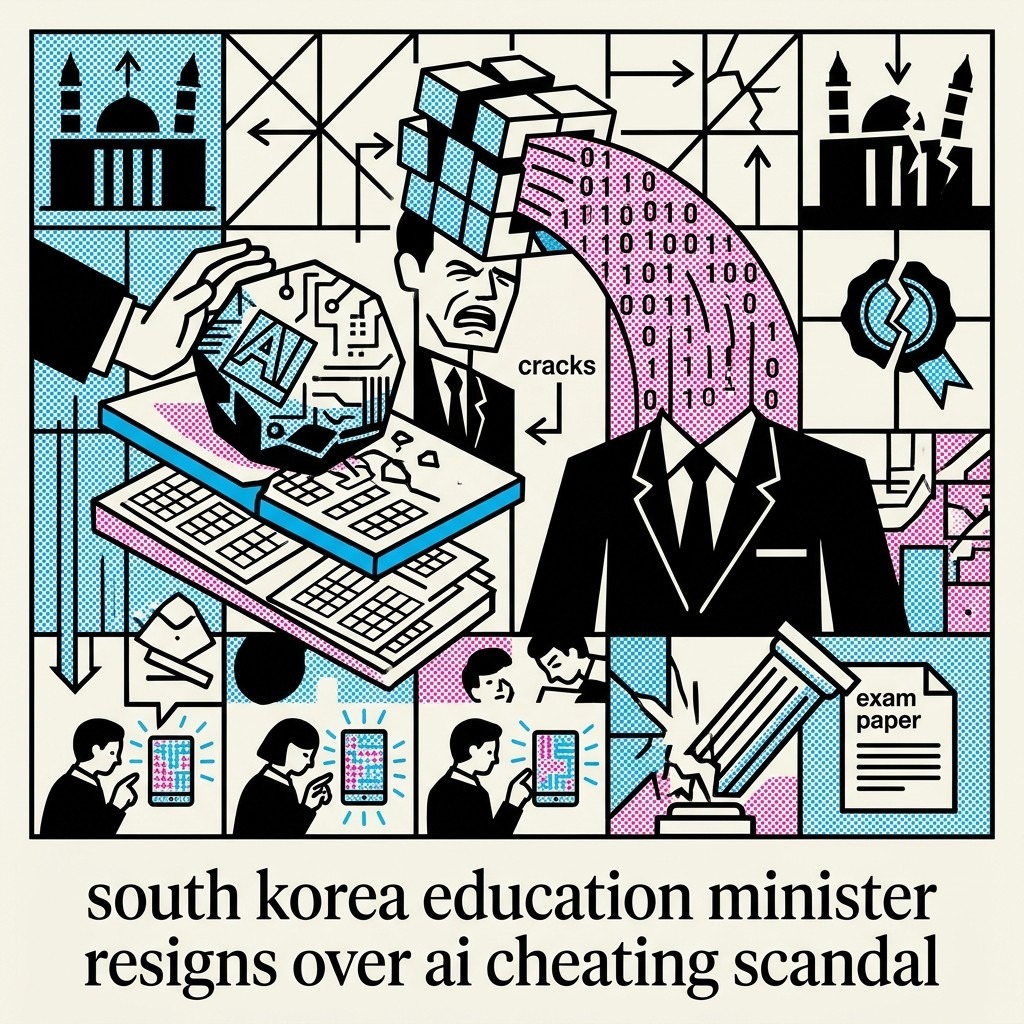
South Korea Education Minister Resigns Amid AI Cheating Scandal

Morning Intelligence • Sunday, November 22, 2026

The Gist View

South Korea’s education minister, Choi Kyo-jin, resigned on 22 November over a cheating scandal that began at a professional tax-accountant exam, just before the suneung, the national university entrance test. His exit punishes one official but leaves the incentive intact: when one sitting decides a career, cheating pays, and AI has made it cheap.

Each countermeasure raises the price of cheating only until cheaper hardware arrives, and the ministry must secure every exam room while a cheater needs to beat just one, so the arms race favours the cheat. A fair critic would answer that the suneung is a public-fairness system where one visible breach can destroy trust, so tight security and ministerial accountability are legitimate.

Our judgment is that the durable fix is assessment design: multiple sittings, or oral and in-person components, shrink the reward from any single successful cheat. The Guardian reports the confession came only four days before the suneung, a window so short that tighter checks were the only option.

The Gist AI Editor

The Global Overview

South Korea’s education minister resigns over AI-assisted exam cheating

South Korea’s education minister, Choi Kyo-jin, resigned on Sunday 22 November after an AI-assisted cheating scandal just before the country’s key university entrance exams (Guardian). The scandal began a week earlier, when the top scorer in a national tax accountant exam confessed to using a miniature camera and a smartphone to get a near-perfect score. That happened four days before the suneung, South Korea’s national university entrance exam, which heavily shapes admissions and careers (Guardian). This year’s suneung banned phones, checked clothing for hidden cameras and had officials block public wifi in testing areas (Guardian). Choi said he “failed to prepare adequately”, and teachers’ unions criticised the government’s response (Guardian).

Ukraine’s defence industry races to avoid stalling

Kyiv is struggling to expand its revived defence industry because Russian bombardment is heavy and the need for capital is dire, the WSJ reported on 22 November. The industry is booming, but financing, not demand, is the constraint on how far it can grow.

California’s $20 fast-food wage: the result depends on the researcher

A CEPR column (the Centre for Economic Policy Research, a European network of economists) published on 22 November ran 1,440 plausible synthetic-control specifications, meaning different ways of building a comparison group for California. More than 96% of the estimates show job losses, though the range is wide. Simple comparisons between California and the rest of the US imply an employment decline of around 3% (CEPR).

Australia’s gas reservation plan faces a vote this week

Australia’s opposition coalition raised more concerns on 22 November about the government’s plan to make liquefied natural gas exporters supply more gas to the domestic market, ahead of a parliamentary vote this week (Bloomberg).

Stay tuned for the next Gist—your edge in a shifting world. The Gist remains independent and reader-supported. If you value news free from corporate or state interests, consider supporting our mission with a donation.


The European Perspective

Heathrow’s biggest investor says the third runway will be built

Ardian, a Paris-based private capital firm and the biggest investor in Heathrow Airport, says it is confident the airport will build a third runway, and it is stressing the benefits of a bigger hub for the UK economy (FT, 22 Nov 2026). Heathrow’s capacity limits are real, and a larger hub could improve connections, trade and growth, while private money rather than taxpayer money would pay for the build. Even so, the useful signal is who is making the case and who would pay. When a private owner publicly promotes the economic argument for a project, that is advocacy from the party with the most to gain, because the owners would collect the concentrated upside while the diffuse costs, such as airline and passenger charges and planning risk, would fall on users and taxpayers. Whether Heathrow recovers its costs through landing charges is a regulatory choice, and this cost-recovery mechanism is our inference rather than something the FT summary states. Ardian’s confidence is therefore best read as a bet on regulated returns.

Ukrainians climb Hoverla, the country’s highest mountain, to escape the war

Many Ukrainians are climbing Hoverla, where the summit is quiet, in search of calm and a break from a war that weighs on them in more than physical ways (ZDF, 21 Nov 2026).

Catch the next Gist for the continent’s moving pieces.

🎙️ Listen to this edition as a podcast Listen

The Gist is an independent daily digest: AI-curated, human-directed, unapologetically liberal (how it’s made). Hundreds of sources, only what matters. Subscribe free or listen to the podcast.