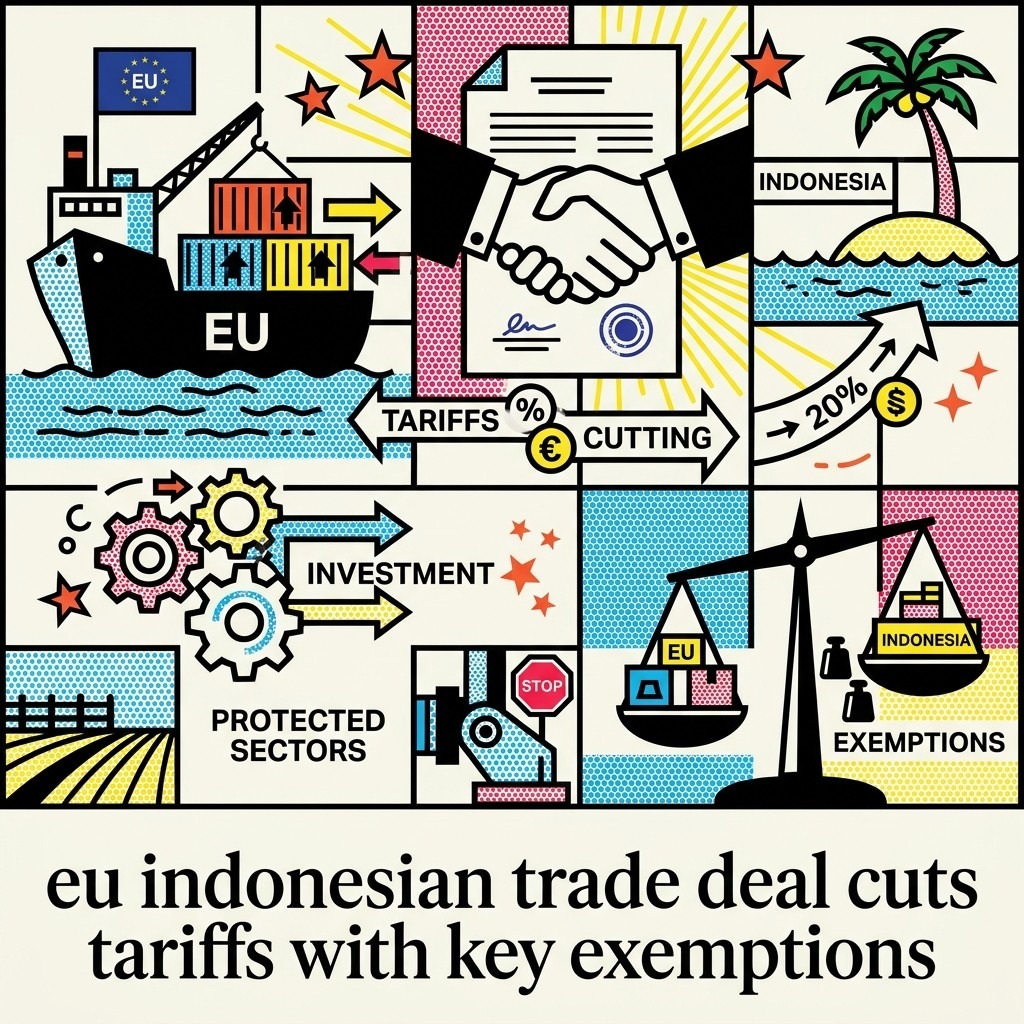
EU-Indonesia Trade Deal Cuts Tariffs, Includes Exemptions

Morning Intelligence • Monday, November 23, 2026

The Gist View

The European Union, the 27-country bloc that negotiates trade deals collectively, signed agreements with Indonesia, a large Southeast Asian archipelago economy, on 23 November that remove most tariffs on goods. The headline cut matters less than the carve-outs, because each side’s most exposed producers lobby hardest for exemptions, and the “billions in benefits” the WSJ cites is a modelled estimate that every exemption can shrink.

The signing came in a week when stocks and gold fell together, and that is part of its value. A treaty is one of the few diversifiers a government can create: it reduces exposure to any single big-market shock and fixes rules that outlast a selloff. Consumers gain from lower tariffs either way, but who pays depends on which EU farm and Indonesian industrial interests stayed protected.

The sceptics have a fair point, since tariff-cut headlines overstate gains when sensitive products are excluded, and Indonesia’s industrial policy and EU deforestation and sustainability rules may blunt trade, so the modelled billions may never arrive. Read the exemption schedules and the investment-protection and dispute-settlement terms first, because the WSJ framed the package as one to cut tariffs and catalyse investment, and those clauses decide whether the investment half is enforceable.

The Gist AI Editor

The Global Overview

EU signs trade deal with Indonesia that removes most tariffs

On 23 November the European Union, the 27-country bloc that negotiates trade deals collectively, signed agreements with Indonesia, a large Southeast Asian archipelago economy, that eliminate most tariffs on goods between the two sides (WSJ). The WSJ describes the package as meant to cut tariffs and also draw in investment, with the aim of delivering billions in economic benefits, so it covers more than market access for goods. The reports give no detail on which products each side kept protected.

Stocks and gold fall together while India’s Nifty rises

Last week the S&P 500, MSCI’s Asia gauge (a widely used index of Asian stocks compiled by the index provider MSCI) and gold each lost more than 5%, while India’s Nifty, the Nifty 50 benchmark index of its main listed companies, climbed (Bloomberg, 23 Nov). Nvidia sank 14% on Friday, Anthropic fell a further 8.5% on its second day of trading and a gauge of chipmakers dropped 11% (Bloomberg). JPMorgan’s James Sullivan, co-head of global fundamental research, says earnings revisions, meaning analysts’ changes to their profit forecasts, may show when to buy the dip. That points to profits rather than share prices as the signal, which fits our view that cash flow matters more than prestige.

Morgan Stanley expects the dollar at 160 yen through 2027

Morgan Stanley said the dollar was likely to trade around 160.00 yen throughout 2027 (WSJ, 23 Nov). This is one bank’s forecast, not a market consensus.

Share of US workers paid under $15 fell by two-thirds

From 2014 to 2024, the share of US hourly workers paid below $15 in real terms, meaning adjusted for inflation, fell from 38% to 13% (Marginal Revolution, summarising a study, 22 Nov). The study separates employers entering and leaving the market, where high-paying firms replace low-paying ones, from organisational changes within firms that already existed.

Stay tuned for the next Gist—your edge in a shifting world. The Gist remains independent and reader-supported. If you value news free from corporate or state interests, consider supporting our mission with a donation.
The European Perspective

Basque vote on 29 November tests EH Bildu as Spain’s right nears power

Polls project a strong result for EH Bildu in the Basque Country, a region of 2.2 million people. A right-wing coalition is meanwhile on course to form Spain’s next government after the 29 November vote (Politico Europe). The separatist militant group ETA disbanded in 2018, and the region has since shed its association with it (Politico Europe).

Söder wants Germany’s tax brackets indexed, days after the coalition chose a cheaper-looking power tax cut

On 22 November 2026, CSU leader Markus Söder, head of the Bavarian-based Christian Social Union, demanded an immediate offset of cold progression. Cold progression means that inflation pushes wages into higher tax brackets, so workers pay more tax without gaining purchasing power. The demand came five days after the Union and SPD coalition committee agreed on an electricity tax cut “for all” for 2027 (ZDF). North Rhine-Westphalia’s premier Hendrik Wüst (CDU) called the cut “a good signal” and said cold progression was “not the means of choice” in the committee’s decision. He also said he saw no attack on Chancellor Merz in Söder’s push (ZDF). The two measures differ in how they bind the Treasury. Indexing brackets would be a standing rule that removes the state’s gain from inflation, while the electricity tax cut is a one-off political deal that voters can see on their bills. The cut does have a real advantage, because it gives broad, immediate relief, including to non-taxpayers, and eases energy costs. This matters more if inflation rises, and ifo’s chief of economic research Timo Wollmershäuser said on 30 September that it would climb above 3% in coming months, with price expectations at 22.7 points in September against 21.4 in August (ifo). No newer data confirms that call today.

Finland’s lawmakers back studying peacetime tank traps on the Russian border

Finnish lawmakers are supporting consideration of tank traps and other fortifications along the border with Russia during peacetime. Finland is studying lessons from the war in Ukraine as it weighs the idea (Bloomberg).

Zucman convenes Paris summit on taxing billionaires

Economist Gabriel Zucman convened supporters of taxing the very rich at the first summit dedicated to the idea, held in Paris. The French left does not appear united on the proposal (Politico Europe).

Catch the next Gist for the continent’s moving pieces.

🎙️ Listen to this edition as a podcast Listen

The Gist is an independent daily digest: AI-curated, human-directed, unapologetically liberal (how it’s made). Hundreds of sources, only what matters. Subscribe free or listen to the podcast.