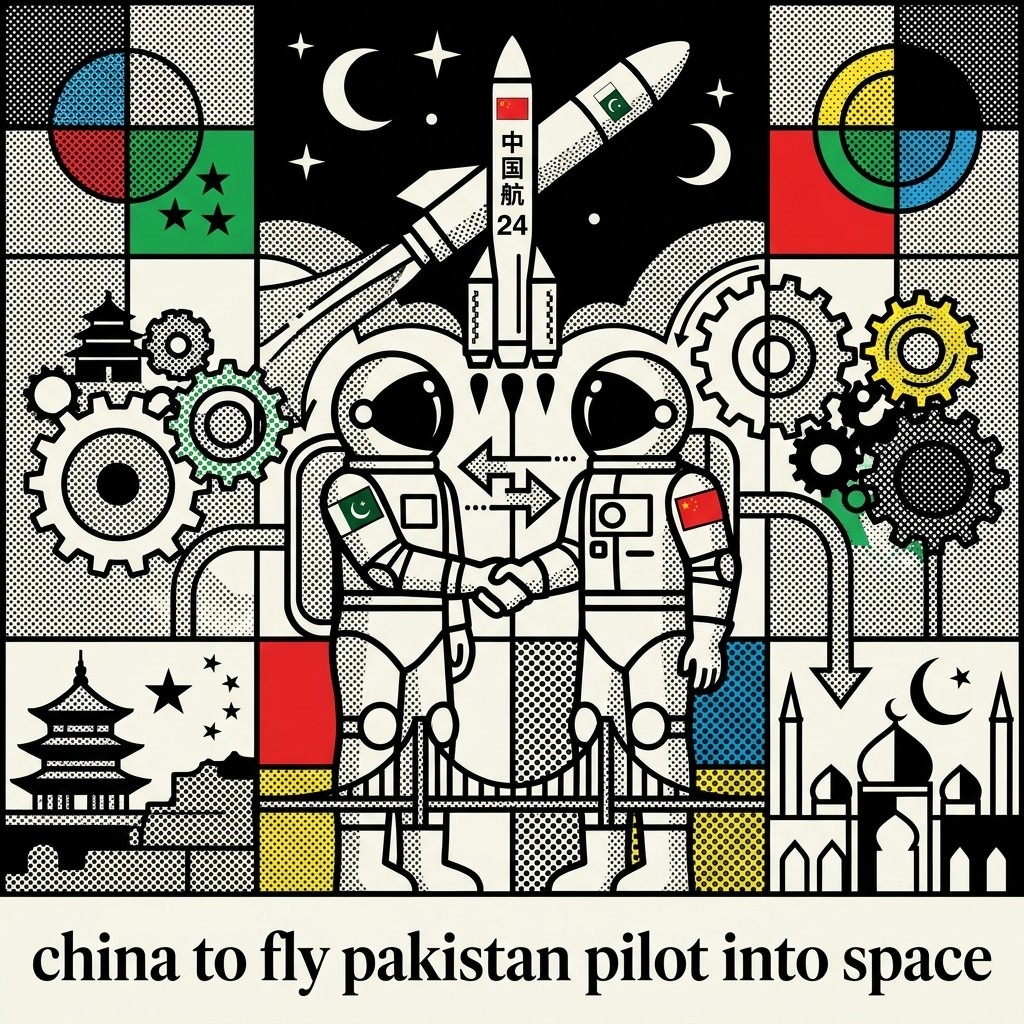
China to Fly Pakistan Pilot on Shenzhou-24: A First

Morning Intelligence • Tuesday, November 24, 2026

The Gist View

China will fly a Pakistan Air Force pilot on its Shenzhou-24 crew spacecraft on Wednesday 25 November, the first foreigner in Beijing’s crewed space programme. Because he is a serving military officer rather than a researcher, the seat looks like payment for a defence partnership: Beijing gets a visibly loyal partner for the cost of one seat, and Islamabad gets prestige and a stronger claim on Chinese support.

The offer works because US law has kept China off the International Space Station (ISS), the orbital laboratory run by the US, Russia, Europe, Japan and Canada. That leaves Beijing free to sell orbit to countries with no other route to it. ISS partners trade hardware and rules among themselves, while China’s station collects clients. Flying foreign astronauts is routine, and China may simply be showing that its programme has matured, but the question is who gets invited.

Moscow built this template. From March 1978 its Intercosmos programme flew astronauts from allied states, starting with Czechoslovakia’s Vladimir Remek, on Soviet rockets that only Moscow controlled.

The Gist AI Editor

The Global Overview

China to fly Pakistan’s first astronaut on Shenzhou-24

A Pakistan Air Force pilot, a serving military officer rather than a civilian scientist, will launch on Wednesday 25 November aboard Shenzhou-24, the Chinese spacecraft that carries crews to China’s space station (Bloomberg). He will be the first foreign astronaut in the history of China’s crewed space programme, and Bloomberg describes the flight as the latest symbol of deepening China-Pakistan ties. The ISS, the International Space Station run by the US, Russia, Europe, Japan and Canada, never admitted China, and US space cooperation still runs through agencies, contracts and allies. One example is NASA’s 23 November award of a $290.6m contract to Northrop Grumman for weather-satellite instruments running to April 2042 (NASA).

Russian warplanes near South Korea prompt jet scramble and island shelter order

South Korea scrambled fighter jets and briefly ordered residents of an island off its east coast to take shelter after Russian warplanes approached its airspace on 23 November (Bloomberg). Bloomberg calls it the latest in a string of similar incidents in the region, as Moscow steps up its use of the military to test US allies.

Mexico’s US-backed raids take down a top kingpin, but the cartel remains embedded

The Wall Street Journal reports on 24 November that US-backed raids in Mexico are delivering tactical victories, including the capture of a leading drug kingpin. The crime groups nonetheless remain deeply embedded in Mexican politics, society and the local economy, so removing a leader does not by itself dismantle the organisation.

White House pushed to reinstate Nvidia’s Jensen Huang

President Donald Trump made clear he wanted Huang, chief executive of Nvidia, the US chipmaker whose processors power most AI data centres, reinstated. On Monday he touted the board’s decision, saying the market proved it right (WSJ). Bloomberg Opinion’s Dave Lee argues that Huang’s best move after returning is to reorganise Nvidia so it can survive without him.

Stay tuned for the next Gist—your edge in a shifting world. The Gist remains independent and reader-supported. If you value news free from corporate or state interests, consider supporting our mission with a donation.
The European Perspective

Klingbeil’s 2027 budget borrows about €210bn, and the interest bill nearly doubles by 2030

Finance Minister Lars Klingbeil presents the 2027 federal budget in the Bundestag at 10:10 today. Net borrowing was first set at about €203bn and is now about €210bn (ZDF). He defends it as investment in schools, daycare centres, roads, bridges and research. Germany did under-invest in infrastructure for years and starts from a comparatively low debt base, so if the spending lifts growth the interest cost could be affordable. The less visible figure is interest: federal interest costs are put at almost €42bn in 2027 and almost €81bn in 2030, when net borrowing is almost €220bn (ZDF). Interest therefore grows far faster than borrowing, and by 2030 it equals roughly 37% of that year’s new debt, which means a growing share of fiscal room goes to servicing past debt instead of building future capacity. Higher inflation could make this worse, because it tends to raise what the government pays to borrow. Die Linke’s Dietmar Bartsch calls the plan a “gigantic debt mountain” and the AfD alleges a “debt spiral” (ZDF). The Bundestag debates departmental budgets all week, with the main debate on Wednesday.

Washington and Moscow push Europe to redesign its security set-up

Politico (24 Nov) reports that the US and Russia are pressuring Europe to recast its security arrangements during Ukraine peace talks, and it sets out five scenarios. The idea of trading Donbas territory for security guarantees for Ukraine now forces Europe to decide how to organise its own defence, not only what to tell Kyiv. Overnight, a Russian drone briefly entered Polish airspace, and Poland’s military cleared a shoot-down but held fire after the drone turned east (ZDF).

Finland summons Russia’s ambassador over a suspected helicopter incursion

Finland’s foreign ministry called Russia’s actions in Europe “dangerous and reckless” and unacceptable, and summoned the Russian ambassador over a suspected helicopter incursion (Politico, 23 Nov).

German price expectations keep rising on energy costs

The ifo institute’s price-expectations index, which tracks the share of firms planning price rises, climbed to 25.9 points in October from 23.0 in September. Crude oil and gas prices reached their highest level since 2022 in the second half of October (ifo). On 30 September, ifo’s Timo Wollmershäser said inflation would rise above 3% in the coming months, citing the Bab al-Mandab blockade. The October survey supports that call so far, though official inflation figures have yet to test it.

Catch the next Gist for the continent’s moving pieces.

🎙️ Listen to this edition as a podcast Listen

The Gist is an independent daily digest: AI-curated, human-directed, unapologetically liberal (how it’s made). Hundreds of sources, only what matters. Subscribe free or listen to the podcast.