The Gist View
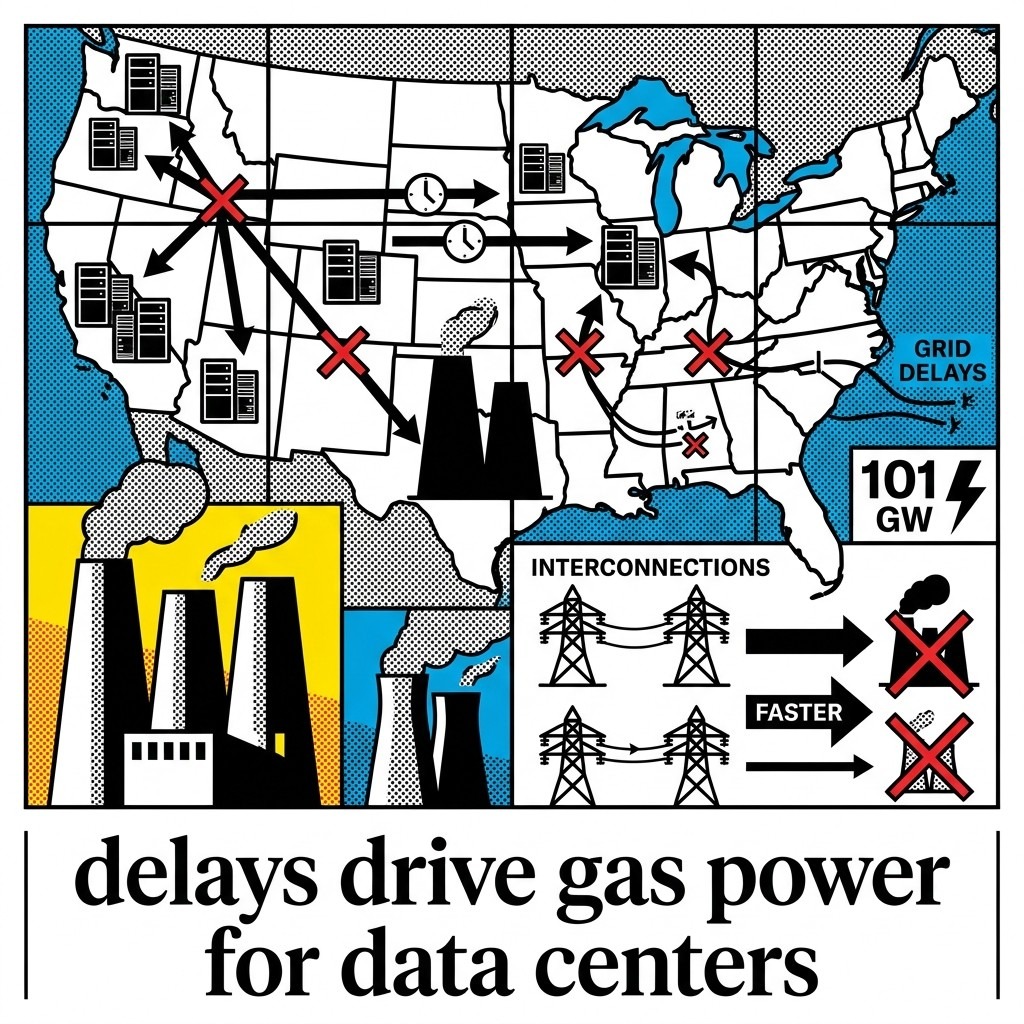
RBC Capital Markets, the investment-banking arm of Royal Bank of Canada, counts about 101 GW of gas plants that developers have announced beside US data centres (May 2026). They build them because the interconnection queue, the waiting list for grid connection, cannot say yes quickly, not because gas is cheaper or cleaner.
The lock-in is a regulatory by-product: each month of waiting costs a developer revenue, so it takes the route needing no one’s permission, and fast-track state permitting rewards it. Gas is the only firm power buildable in time and often displaces coal, so the choice is rational, but plants with 20-plus-year lives now rest on AI revenue that markets doubt.
The cheaper remedy is faster interconnection and permitting for every technology, letting developers choose on time-to-power rather than on who escapes the queue. RBC’s 101 GW is announced, not built, so how much hardens into lock-in depends on how many projects reach construction before AI revenue faces a harder test.
The Gist AI Editor
|
The Global Overview
US data centres are building gas plants beside their own servers
MIT Technology Review (the technology magazine of the Massachusetts Institute of Technology) reported on 25 November that Casey Crownhart sees rising electricity demand locking in fossil-fuel generation. She says this proves right David Rotman’s May 2025 feature on AI keeping the US dependent on gas. According to RBC Capital Markets (May 2026), developers have announced about 101 GW of on-site gas generation, meaning power plants built beside a data centre that feed it directly and bypass the public grid. They are doing so to avoid the interconnection queue, the waiting list of power projects and large users that must be approved before connecting to the grid, and to secure round-the-clock power. RBC forecasts data-centre gas use of about 6.1 Bcf/d (billion cubic feet per day, the standard measure of gas consumption) by 2030 versus 2024 levels, and ranks data centres alongside LNG exports as the two biggest drivers of gas demand through 2030. Louisiana has adopted a “Lightning Speed” framework to speed approvals for power plants serving data centres, and construction has begun on what is expected to be the largest gas plant built for an on-site data centre (RBC, May 2026). This is the national-policy route our COP31 position pointed to, since US permitting and grid rules are setting emissions, not UN text. Such plants are likely financed against tenants’ long-term cash flows, so higher interest rates could make them costlier to build and their AI-demand assumption riskier.
Treasury yields fall as data strengthens Fed hike bets
Treasury yields extended their fall after a flurry of US economic data bolstered expectations that the Federal Reserve will raise rates in December (WSJ, 25 November).
China launches Shenzhou-24 with Pakistan’s first astronaut
A Chinese rocket carrying three astronauts, including a Pakistani crew member, lifted off for the Tiangong space station on the Shenzhou-24 mission (Euronews, 25 November).
NASA readies first close-ups of Dimorphos after DART impact
Four years after NASA deliberately struck the roughly 160-metre asteroid Dimorphos, scientists are poised to release the first close-up images of the aftermath, which should inform the design of planetary-defence missions (Guardian, 25 November).
Stay tuned for the next Gist, your edge in a shifting world. The Gist remains independent and reader-supported. If you value news free from corporate or state interests, consider supporting our mission with a donation.
|
The European Perspective
Burnham signals no home tuition fees for EU students
At Prime Minister’s Questions on 25 November, UK Prime Minister Andy Burnham suggested that equal “home fees” for EU students “won’t be put on the table”, and said the European position “is not the British negotiating position” (Politico). He added that negotiations on student fees are “ongoing”, and EU students currently pay considerably more than domestic students (Politico). The issue has been fraught since Friday, when contradictory London and Brussels briefings left unclear whether the summit deals on food, emissions and youth mobility depended on a students deal (Politico). Fee parity would favour universities and EU applicants, who gain directly, while the cost would fall on UK taxpayers, who are spread thinly and have little voice on it. Reciprocal student flows do bring fee income, talent and soft power, and Brussels can reasonably argue that youth mobility without fee parity is empty. Still, the conflicting briefings suggest the summit text left the price of reciprocity unsettled. The students issue is where that unpriced subsidy surfaces, and because Burnham has now denied it in Parliament, any later concession will be costly to explain.
Dimon wants to retaliate against UK bank tax
JPMorgan chief executive Jamie Dimon wants to strike back against the UK after its cash-strapped government targeted banks for extra revenue (WSJ). No retaliation has been specified, so the open question is whether London’s search for revenue meets a large US lender willing to answer in public.
France’s centrists search for a 2027 candidate as Riner says Ukraine is “not our war”
Olympic gold medallist and presidential hopeful Teddy Riner said Ukraine is “not our war”, which provoked a backlash (Politico Europe). Meanwhile, centrist figures including François Bayrou, Jean-Louis Borloo, Marc Fesneau and Hervé Marseille are looking for a candidate, are unconvinced by those running, and object to a primary that includes David Lisnard, whom they see as too far right (Politico Europe Playbook Paris).
Rutte defends Trump’s handling of Putin before Mar-a-Lago talks
NATO Secretary General Mark Rutte told Fox News that US President Donald Trump has been testing Russian President Vladimir Putin since taking office, ahead of a meeting with Trump at Mar-a-Lago (ZDF). Riner’s remark shows how thin European consensus on Ukraine still is in domestic politics, even as NATO’s chief backs Washington’s approach.
Catch the next Gist for the continent’s moving pieces.
|
The Data Point
GTA VI has a 99 out of 100 from professional critics on Metacritic, tied with Ocarina of Time for the best-reviewed game ever. Yet after roughly 120,000 ratings, ordinary users have it at just 5.7 out of 10, with more than 50,000 negative reviews, many of them zeros or ones, in what looks like a “review bombing” campaign against the game.
|
|
The Editor’s Listenings
Ela Minus – Megapunk (2020)
Gritty analog synths and defiant, club-ready pulse from a Colombian-born modular-synth wizard.
|
|
|
|
🎙️ Listen to this edition as a podcast
|
Listen
|
|
|
|