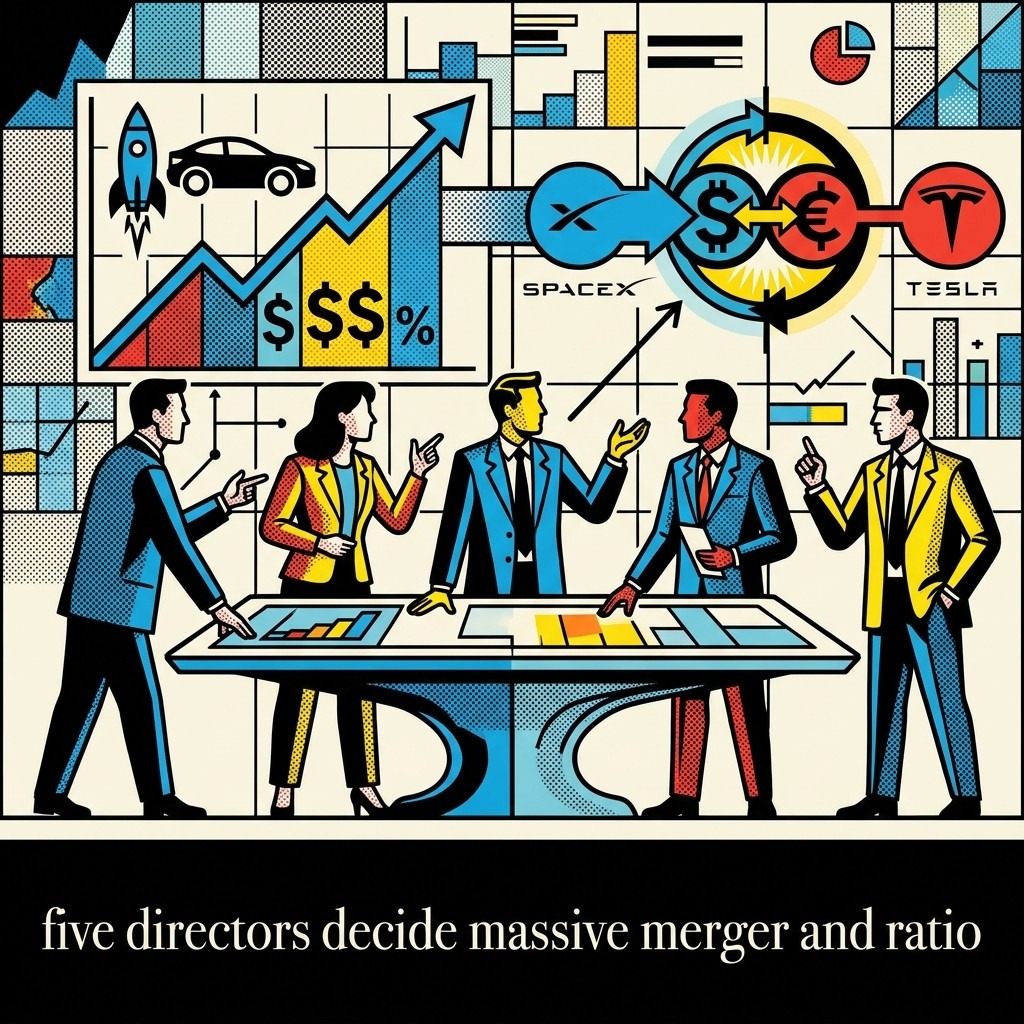
SpaceX & Tesla $3.5tn Merger Hinges on Exchange Ratio

Morning Intelligence • Wednesday, November 25, 2026

The Gist View

Elon Musk’s SpaceX, the Texas rocket and satellite-internet company, and Tesla, his electric-vehicle maker, have left five directors to decide a merger the FT sizes at about $3.5tn. Those five are the only check on price, because dual-class shares, which give a founder extra votes on a small slice of ownership, remove the arm’s-length bargaining a seller would normally supply.

The number to read is the exchange ratio, how many shares of one company each share of the other becomes, because in a stock-for-stock deal it is the whole negotiation. Musk gains when the ratio favours the company holding more of his wealth, so a lopsided one would suggest the committee ratified a price, not bargained for it, though that stays speculation until terms are disclosed. Court-tested safeguards such as special committees and minority votes exist, and five directors may bargain hard.

The $3.5tn is the same whichever way the ratio falls, so only the ratio shows who won.

The Gist AI Editor

The Global Overview

SpaceX and Tesla hand the largest merger ever to five directors

The FT reported on 25 November that SpaceX, Elon Musk’s rocket and satellite-internet company based in Texas, and Tesla, his electric-vehicle and energy company, also based in Texas, have given five directors responsibility for the largest merger of all time. The FT sizes the combination at about $3.5tn and calls it Musk’s “M&A endgame”, M&A meaning mergers and acquisitions, the buying and combining of companies. Both companies are run under dual-class shares, a structure in which founders hold stock with extra voting power and so keep control with a small share of the economic ownership, and yesterday’s edition covered the argument that this setup weakens shareholder oversight, so this deal is the first large case of it in practice.

Trump Media ordered to hand over Truth Social records

According to The Intercept, on 24 November a federal judge opened the discovery phase, the stage where each side must produce documents, in The Intercept’s lawsuit over the president’s scheme to enrich himself by selling early access to his Truth Social posts. The ruling means Trump Media must now hand over Truth Social records, which gives the plaintiffs access to the platform’s own data about how that access was offered.

Indian stocks top the world as investors sell AI names

Bloomberg reported on 25 November that Indian stocks surged again, extending a world-beating November rally, as renewed selling of global AI companies pushed money toward markets with little exposure to the theme. The WSJ ran an analysis the same day saying the US economy would take a painful hit from an AI bust, although economists still disagree on how large the damage would be. Together they fit our line that cash flow, not research prestige, sets valuations, because investors are now sorting markets by how much AI they hold.

Tyler Cowen asks whether “protectionism” can prevent AI disempowerment

On Marginal Revolution on 25 November, the economist Tyler Cowen took up the debate over whether AI will disempower humans and asked whether protectionism, meaning reserving some intellectual tasks for humans, could prevent it. His example is a list of twenty important maths problems: should AIs, with some human guidance, take a crack at them, or should humans do the work themselves?

Stay tuned for the next Gist—your edge in a shifting world. The Gist remains independent and reader-supported. If you value news free from corporate or state interests, consider supporting our mission with a donation.


The European Perspective

Europe’s cage ban petition waits on the EU’s top court

1.4 million Europeans signed a citizens’ initiative calling for a ban on keeping farm animals in cages, but the European Commission, the EU’s executive body, has been slow to act, according to Politico Europe. Efforts to free caged rabbits and calves are now waiting on a ruling from the EU’s top court, so a petition that met the signature threshold is being settled by judges rather than by the body that writes the legislation. Slow action may reflect real transition costs for farmers and legal uncertainty, and animal suffering is a widely shared concern. The petition still shows how little it binds the institution that holds the pen. Cage bans raise costs only for EU producers unless imported products meet the same standard, and without import rules the welfare case invites a protectionist fix, so the test for liberal trade policy is whether standards apply to how food is produced or to where it comes from.

Spain’s Feijóo runs as the unflashy manager before the 29 November vote

Alberto Núñez Feijóo, leader of the conservative People’s Party, is a favourite in Spain’s 29 November election, according to Politico Europe (25 November). He styles himself as a sober, unflashy manager, in deliberate contrast to Socialist Prime Minister Pedro Sánchez. He was regional president of Galicia from 2009 to 2022, and he built his political career in Santiago de Compostela, where he asked his base for a final push before the vote.

Germany plans tougher penalties for violence against women

Germany plans tougher penalties for violence against women, according to ZDF (24 November). The plan is the draft from Justice Minister Hubig, which would treat gender-based motives as grounds for a murder conviction while rejecting a separate offence of “femicide”. It remains a proposal and is not law. A new ZDF report follows a woman who escaped an ex-partner, and it adds a personal account to the debate over the draft.

Catch the next Gist for the continent’s moving pieces.

🎙️ Listen to this edition as a podcast Listen

The Gist is an independent daily digest: AI-curated, human-directed, unapologetically liberal (how it’s made). Hundreds of sources, only what matters. Subscribe free or listen to the podcast.