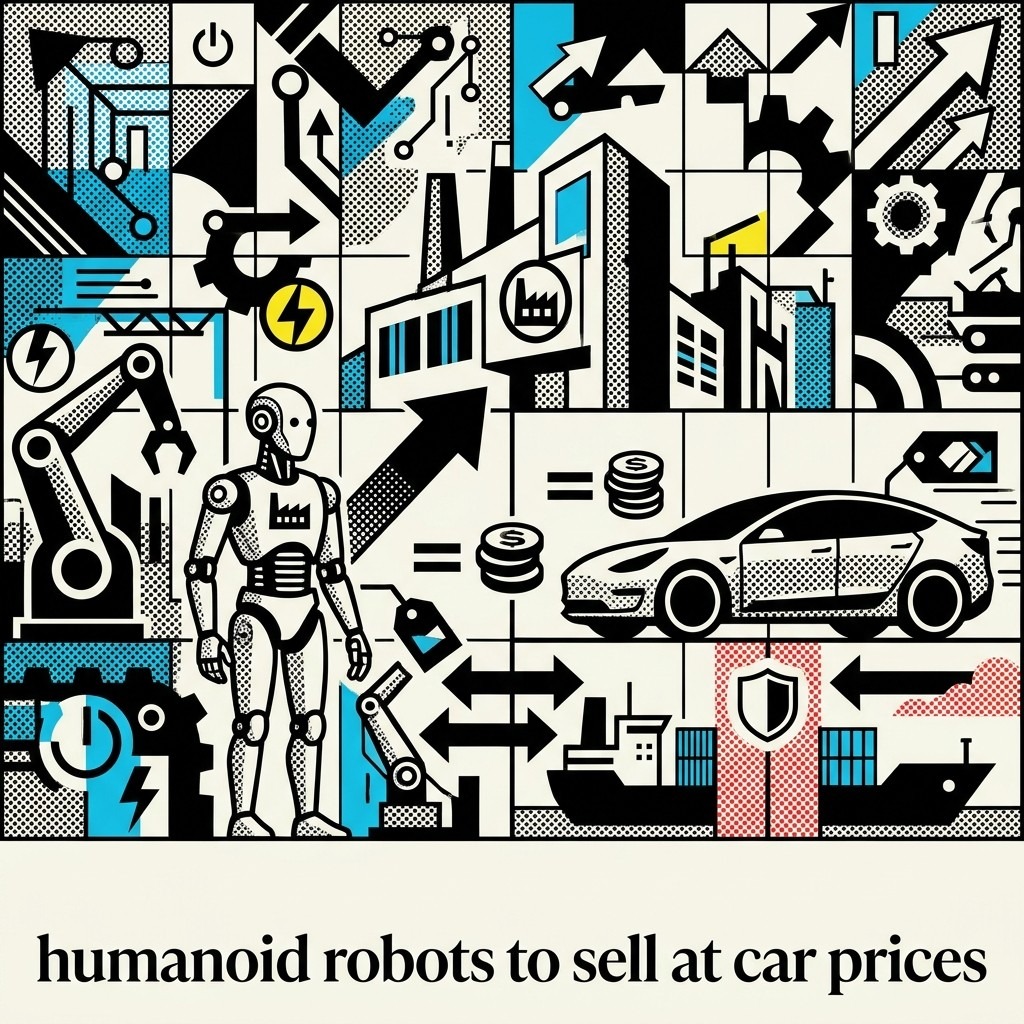
Xpeng Humanoid Robots Priced Like Electric Cars

Morning Intelligence • Thursday, November 26, 2026

The Gist View

Xpeng, a Chinese electric-vehicle maker, says its two-legged, two-armed humanoid robots will go on sale to the public in the second quarter at roughly the price of an electric car, Bloomberg reported on 26 November.

The claim is about price, not ability, and that changes who buys: a car-priced machine is capital equipment, so its first customers are firms weighing it against a wage bill, not households. Xpeng can quote that price because it already buys batteries and motors at car-factory volumes, which robotics start-ups ordering small batches cannot match, and it gains by setting the benchmark.

A launch price is a marketing anchor, and humanoid demos have outrun deployment, so early units may be few and suited to narrow tasks. Even so, whether Western firms can buy at that benchmark depends on Washington, where new tariff proposals are circulating (WSJ). The second-quarter order book will show who was allowed to place one.

The Gist AI Editor

The Global Overview

Xpeng says its humanoid robot will cost about as much as an electric car

Xpeng, a Chinese electric-vehicle maker that is moving into humanoid robots (two-legged, two-armed machines meant to do tasks built for human bodies), will sell its robots to the public in the second quarter at roughly the price of an electric vehicle, according to Bloomberg on 26 November. The robot draws on the automotive batteries, motors and manufacturing know-how the company already has. Trade policy is the live risk for any Chinese hardware export, since Asian markets rose as investors brushed aside new US tariff proposals (WSJ).

Russia is building a Starlink counterpart called Rassvet

SpaceX’s Starlink, a satellite internet network widely used by Ukraine’s military, has played a key role in countering the Russian military in Ukraine, according to DW on 26 November. Russia is now developing its own low-orbit system, Rassvet, often called “Russia’s Starlink.”

Iran’s subsidy cuts expose political divides under the US blockade

Cuts to fuel and food subsidies have put new pressure on the Iranian public as the US blockade strains the economy, and they have exposed divisions inside Iran’s political establishment, in what the Wall Street Journal calls a “silent war.”

US Army detonates unstable lead azide in Iowa; Bank of Korea resumes hikes

On Wednesday 25 November at about 9am, the US Army detonated lead azide stored at the Iowa Army Ammunition Plant in Middletown, Iowa, after finding that 68 drums had degraded and become unstable and could not be safely handled or moved (Missouri DNR). Early results show minimal signs of lead in the environment, but rigorous testing will take days (Wired). Separately, the Bank of Korea raised its benchmark rate by 25 basis points to 3.25%, resuming hikes after an October pause following increases in July and August (Bloomberg).

Stay tuned for the next Gist—your edge in a shifting world. The Gist remains independent and reader-supported. If you value news free from corporate or state interests, consider supporting our mission with a donation.
The European Perspective

EU leaders open a budget fight that favours the status quo

EU leaders meet from 26 November expecting to disagree on almost everything, and Politico lists five budget battles, among them farm subsidies and tech taxes. Costa’s post-2028 draft cuts about €204bn and adds a digital levy on big tech firms, yet Merz, Paris and the European Parliament have already rejected it. Farmers and cohesion regions (poorer regions that receive EU development money) gain concentrated payouts, while taxpayers and levy targets pay in small shares each. Because the budget needs unanimity, any one capital’s interest works as a veto, so protected spending lines survive almost by default. Farm and cohesion money does buy consent for the single market in rural areas, and cutting it without a replacement could feed the anti-EU backlash it was meant to prevent.

French real wages fall as inflation rises

As inflation rises, real wages in France are moving the opposite way, fuelling protests and a historic decline in spending power (WSJ, 26 Nov).

Germany sets a record 2027 budget

The 2027 federal budget stands at about €560bn, more than the previous year, though not all ministries benefit equally (ZDF, 25 Nov). Meanwhile the ifo institute repeats that inflation will climb above 3% in the coming months.

Germany’s digital driving licence slips

The Transport Ministry now says the digital licence, planned for the end of November in the i-Kfz app (which already shows the digital vehicle registration), will arrive by mid-December (ZDF, 26 Nov).

Catch the next Gist for the continent’s moving pieces.

🎙️ Listen to this edition as a podcast Listen

The Gist is an independent daily digest: AI-curated, human-directed, unapologetically liberal (how it’s made). Hundreds of sources, only what matters. Subscribe free or listen to the podcast.