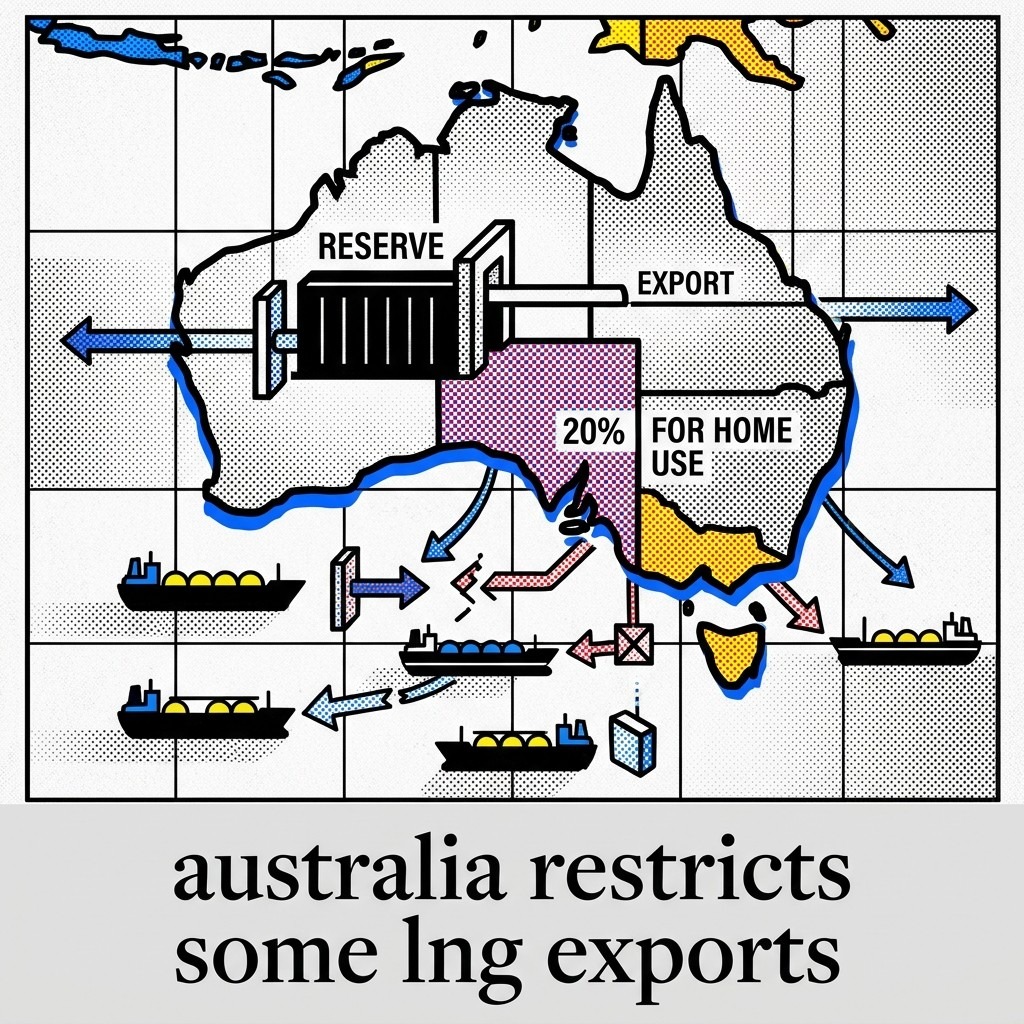
Australia Reserves 20% LNG for Domestic Use, Exports Hit

Morning Intelligence • Friday, November 27, 2026

The Gist View

Australia, a leading exporter of liquefied natural gas (LNG, gas chilled into a liquid for tankers), will require producers to reserve up to a fifth of their shipments for home buyers. A volume quota is a price control by another name: it cheapens gas for households by cutting what an export project can earn, so the next one is harder to finance.

Canberra has a case: gas is a licensed national resource, the east-coast market is thin enough to exploit, and licence-condition reservation is a long-standing, mild tool. But the shortage is partly a failure to develop supply, which a quota leaves untouched while telling investors the rules can change when world prices spike.

What matters is whether the quota binds existing long-term contracts or only new ones: new ones alone make it a modest tax on future projects, while existing ones teach buyers, Europe’s among them, that contracts last until the next price spike.

The Gist AI Editor

The Global Overview

Australia orders LNG exporters to hold back up to a fifth of their gas for home use

On 27 November, Australia said it will require exporters of liquefied natural gas (LNG, gas chilled into a liquid so tankers can carry it) to reserve up to a fifth of their shipments for the domestic market, with the stated aim of lowering power bills for local households and businesses (WSJ). Australia is one of the world’s major LNG exporters, so the government is attaching a volume condition to its largest export business. The announcement comes after the blockade of the Bab al-Mandab, the narrow strait between Yemen and the Horn of Africa that is a key route for oil and gas shipping, pushed gas and electricity prices to their highest since late 2022 in mid-September, according to the ifo economic institute. Governments that export gas could be tempted to ration shipments in a price shock, which would leave importers such as Germany bidding for a smaller pool of gas.

New Zealand’s election deadlock makes newcomer Qiulae Wong kingmaker

New Zealand’s election ended in deadlock, according to the WSJ on 27 November. Prime Minister Christopher Luxon, who leads the centre-right National Party, needs the support of the Opportunity Party, a newcomer led by Qiulae Wong, to form a majority government. That gives Wong’s party the deciding votes on whether Luxon can govern.

Ukraine says its strikes on Russian ships off Libya were never aimed at Libya

Ukraine’s Foreign Minister Andriy Sybiha said on 26 November that Kyiv did not want to extend the war to Libya, according to ZDF. He said none of Ukraine’s actions was ever directed against Libya or the Libyan people, in reference to Kyiv’s strikes on Russian ships off the Libyan coast.

Gold and silver rally as risk appetite improves

Gold and silver rose sharply on 27 November, likely helped by better market sentiment as Asian equities and US stock futures advanced (WSJ). Stock futures are contracts that trade before US markets open, so they show how investors expect the day to start.

Stay tuned for the next Gist—your edge in a shifting world. The Gist remains independent and reader-supported. If you value news free from corporate or state interests, consider supporting our mission with a donation.

The European Perspective

Baden-Württemberg’s carmakers meet state politicians in Stuttgart

On 26 November the auto industry met state politicians in Stuttgart to secure the region’s carmaking base and thousands of jobs (ZDF). Asked whether German carmakers are finished, Baden-Württemberg’s state premier Cem Özdemir answered: “if we carry on like this, yes”. He pointed to China, US President Donald Trump and high costs as the pressures.

EU budget summit ends in walkout, leaving one month to save a post-2028 deal

Leaders left Thursday’s Brussels summit visibly shocked and angry at the scale of division, with one month left to salvage a deal (Politico Europe). Governments demanding a smaller seven-year budget snubbed European Council President António Costa, whose draft cuts about €204bn and adds a digital levy on tech giants, a draft that Germany’s chancellor Friedrich Merz, Paris and the European Parliament have all rejected. Because budget decisions need every member state to agree, each capital can veto to defend its own subsidy line, so a deadline rewards the government that holds out longest rather than the one that compromises. Nobody expected a deal at this first summit, so leaders leaving visibly shocked suggests the usual ritual of bargaining signals broke down. Failed first summits are normal, and past budget deals have usually landed late, but the likelier result is a deal that slips past the deadline, protects farm and cohesion recipients and trades away the digital levy, which is speculative.

Bank of England governor says AI needs boundaries

Andrew Bailey, Governor of the Bank of England, warned on 27 November that AI must benefit humans and that the technology needs boundaries, “a bit like rearing children” (Politico Europe).

Spain’s right previews its climate policy in flood-hit Valencia

Spain votes on 29 November, and the record of the centre-right People’s Party and far-right Vox in flood-hit Valencia offers clues to how their climate-sceptic policies could play out nationally (Politico Europe). With UN consensus failing after Antalya, elections now set climate policy more than summits do, and Valencia is the preview.

Catch the next Gist for the continent’s moving pieces.

🎙️ Listen to this edition as a podcast Listen

The Gist is an independent daily digest: AI-curated, human-directed, unapologetically liberal (how it’s made). Hundreds of sources, only what matters. Subscribe free or listen to the podcast.