US Forces Strike Vessel Near Iran, Raising Shipping Risks

Morning Intelligence • Saturday, November 28, 2026

The Gist View

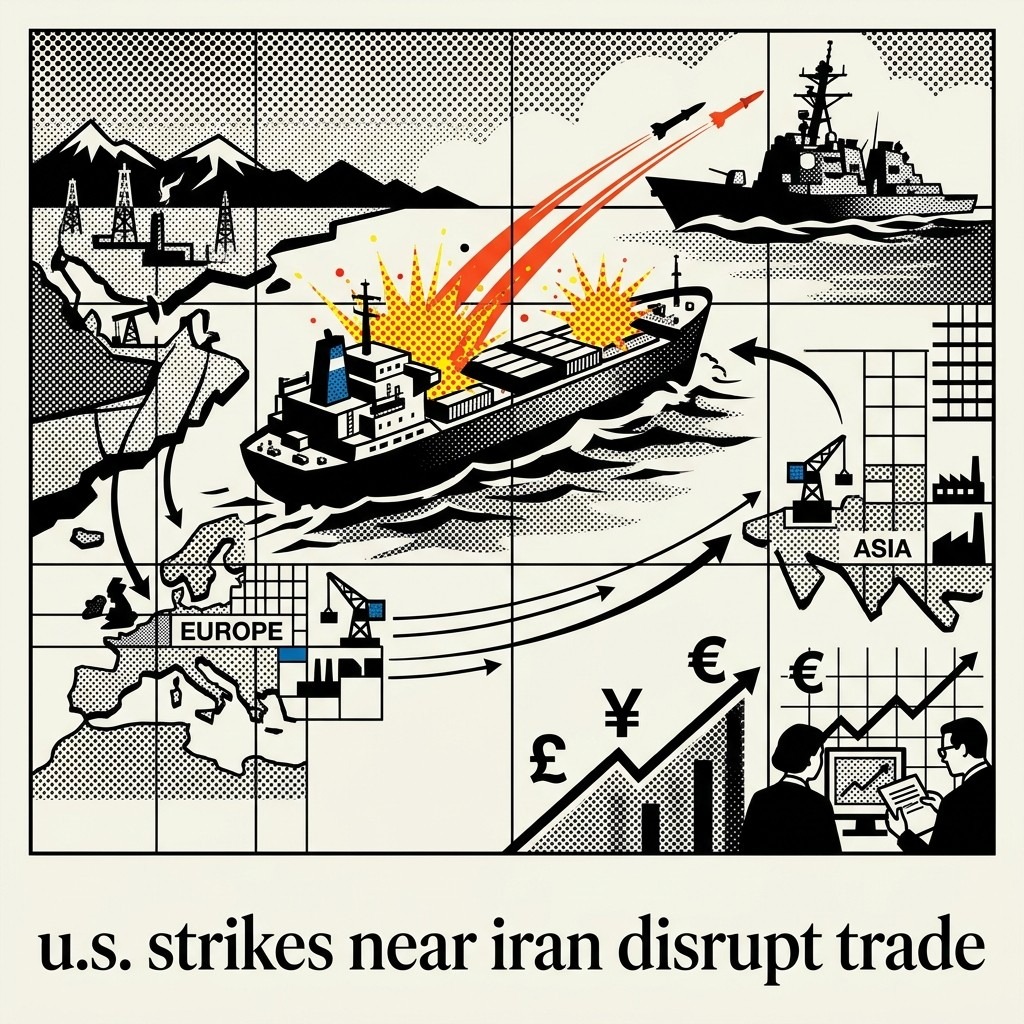
US forces struck a vessel trying to run Washington’s blockade near Iran, the WSJ reported on 27 November, and Germany is already paying: ifo, the Munich-based economic institute, says its gauge of firms planning price rises reached 25.9 points in October. The strike shows the blockade is now enforced with force, which gives shippers and insurers reason to price in the risk of being hit.

Washington collects the leverage over Tehran, while importers in Europe and Asia, who had no vote on the policy, pay through energy costs that their firms pass on to customers.

The counter is serious: a blockade backed by force is cheaper than war and may be the only lever that brings Iran back to talks, so the strike could shorten the standoff. The test is observable: if ifo’s index falls back toward September’s 23.0 once talks resume, importers bought a short episode; if not, they funded a long one.

The Gist AI Editor

The Global Overview

US strikes a vessel trying to run its blockade near Iran

The WSJ reported on 27 November that US forces struck a vessel attempting to run a blockade near Iran, while President Trump pressures Tehran’s economy and diplomatic talks hit a wall. The cost is already visible in Germany. The ifo Institute, Munich-based and Germany’s leading economic research institute, said on 28 November that its index of how many German firms plan to raise prices, the ifo Preiserwartungen, rose to 25.9 points in October from 23.0 in September, because crude and gas prices reached their highest since 2022 in the second half of October. ifo added that crude rose again after the blockade of the Bab al-Mandab strait, the narrow passage between Yemen and Djibouti at the southern end of the Red Sea and a key route for oil and container shipping. ifo’s Timo Wollmershäuser expects German inflation to climb above 3% in the coming months.

Demographers warn of a shrinking world

The research paper “Terra Incognita: The Economics of a Shrinking World” argues that humanity is not having enough children to replace itself, according to WSJ Opinion on 28 November. Co-author Jesús Fernández-Villaverde has been touring the US to present the findings and his policy suggestions for reversing the trend.

Egypt’s Mada Masr editor faces jail

Lina Attalah, founder and editor-in-chief of Egypt’s Mada Masr, risks a year in prison and the permanent closure of the outlet she co-founded, Le Monde reported on 28 November. Le Monde describes Mada Masr as one of the last spaces of free expression in Egypt.

US households hold more stocks than ever

A wave of investment in US stock funds has continued through a dizzying market downturn, leaving Americans more exposed to the stock market than ever, the WSJ reported on 28 November.

Stay tuned for the next Gist—your edge in a shifting world. The Gist remains independent and reader-supported. If you value news free from corporate or state interests, consider supporting our mission with a donation.

The European Perspective

Europe’s research is monetised by US startups, says ifo president Fuest

Clemens Fuest, president of the ifo Institute, Germany’s leading economic research institute, and more than 50 other scientists argue in the journal Science that EU-funded research often feeds US startups’ patents and market success (ifo). Fuest says funding should go where research results in Europe can become marketable innovations.

Russian strikes kill at least four in northern Ukraine

According to police, three people died in an attack on a company in Nizhyn, in Ukraine’s Chernihiv region, and seven more were injured (ZDF, 27 November). In Malyn, in the Zhytomyr region further west, regional governor Vitaliy Bunechko said one person was killed and twelve injured in a strike on what he called a “civilian enterprise” (ZDF).

Germany’s coalition splits over Schweitzer’s 288-page pension draft

On 27 November 2026, Germany’s Labour Minister Alexander Schweitzer (SPD) presented a 288-page concept that he called one of the biggest pension reforms in recent German history (ZDF). The draft keeps the “Rente mit 63” (retirement at 63) under stricter conditions, ties the retirement age to life expectancy, and protects pension agreements already concluded. Chancellery chief Nina Warken (CDU) said at once that there is no agreement on it, and Union parliamentary leader Thorsten Frei warned against maximalist demands that would burden the future financially (ZDF). The Union is the CDU/CSU, Germany’s centre-right bloc and the senior partner in the coalition with the SPD. In a ZDF interview published 28 November, Schweitzer said the plan is “not entirely without pain” and that the coalition had reached many points of convergence. The life-expectancy link is the most durable part, because Denmark and Sweden show that automatic adjustment survives changes of government better than one-off deals, and keeping a diluted “Rente mit 63” is the price of getting it through. The dispute is about who bears the adjustment rather than whether one is needed: because existing agreements are protected, today’s pensioners and near-retirees are exempt and younger cohorts carry the cost. A fair counter is that a formula may have been accepted by the SPD only in return for protected benefit levels, which could leave the reform fiscally hollow.

Italy’s Orte freight terminal targets a rail gap in the centre

The Orte interporto, a freight hub, aims to fill a gap in rail freight services in central Italy and become a reference node for intermodal transport, meaning goods moved between rail and road (Il Sole 24 Ore, 28 November). The new terminal is to connect by rail to Turin, Verona and Gioia Tauro.

Catch the next Gist for the continent’s moving pieces.
🎙️ Listen to this edition as a podcast Listen

The Gist is an independent daily digest: AI-curated, human-directed, unapologetically liberal (how it’s made). Hundreds of sources, only what matters. Subscribe free or listen to the podcast.