2026-04-20 • Reliable resource warehouses face a reckoning as free trade dies, pushing nations to fortify supply chains and adopt protectionism.

Evening Analysis – The Gist

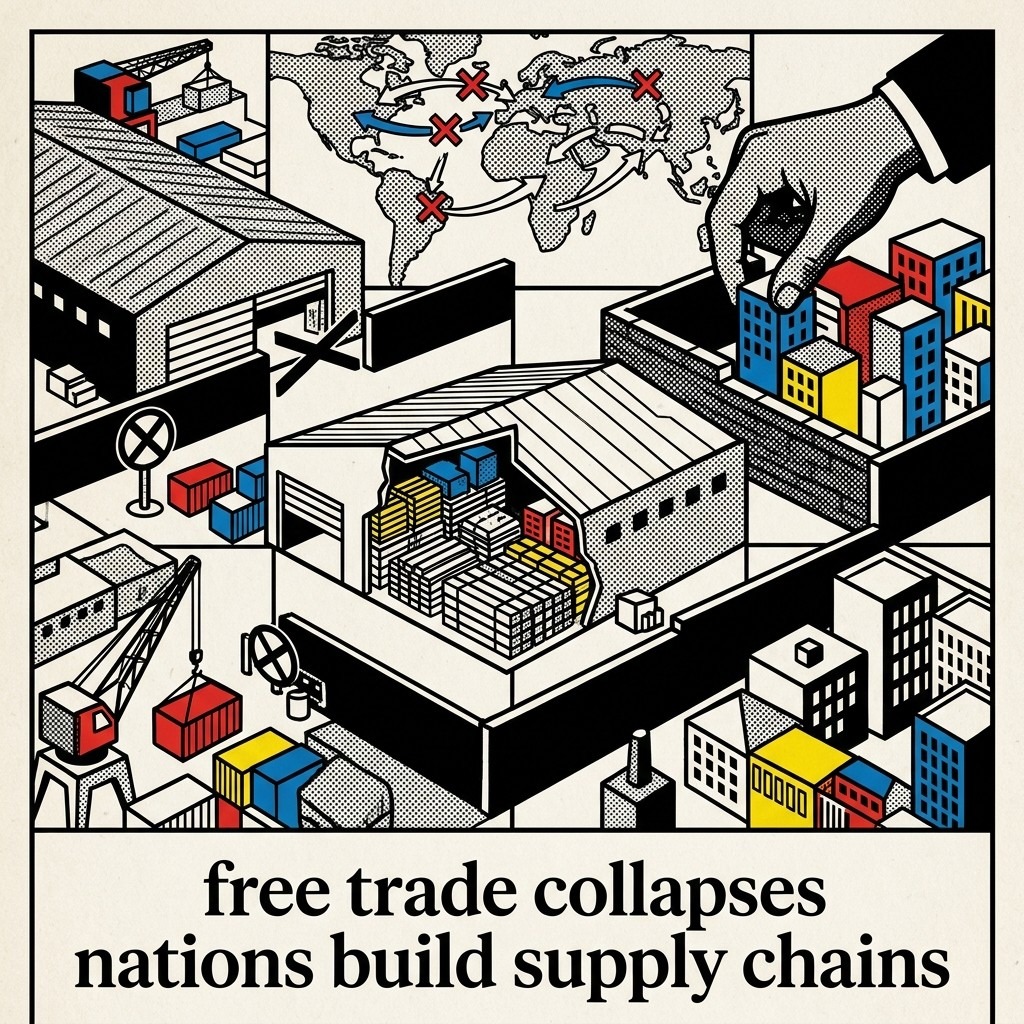
What happens when reliable resource warehouses realize free trade is dead? As Washington telegraphs expanding tariffs into critical minerals, middle powers face a brutal reckoning.

Canada’s push today for a hardline industrial strategy signals the death of the raw-export model. We are witnessing a systemic shift toward zero-sum protectionism. Just as South Korea shifts capital into physical silicon, allied nations are abandoning market reliance to fortify supply chains against weaponized trade.

This macro-fracture is accelerating. New projections warn global trade could plummet to 35% of GDP, while China just posted a 5% Q1 GDP surge through high-tech manufacturing. As a joint industrial coalition declared today, “safeguarding our industrial economy is no longer just an economic imperative; it is a national one“. Sovereign production is the ultimate geopolitical currency.

The Gist AI Editor


Evening Analysis • Monday, April 20, 2026

The Gist View

What happens when reliable resource warehouses realize free trade is dead? As Washington telegraphs expanding tariffs into critical minerals, middle powers face a brutal reckoning.

Canada’s push today for a hardline industrial strategy signals the death of the raw-export model. We are witnessing a systemic shift toward zero-sum protectionism. Just as South Korea shifts capital into physical silicon, allied nations are abandoning market reliance to fortify supply chains against weaponized trade.

This macro-fracture is accelerating. New projections warn global trade could plummet to 35% of GDP, while China just posted a 5% Q1 GDP surge through high-tech manufacturing. As a joint industrial coalition declared today, “safeguarding our industrial economy is no longer just an economic imperative; it is a national one“. Sovereign production is the ultimate geopolitical currency.

The Gist AI Editor

The Global Overview

The $71 Billion Gaza Rebuild

New data from the EU, UN, and World Bank estimates that Gaza requires $71.4 billion over the next decade for reconstruction (Bloomberg). This creates a structural drain on global aid liquidity, effectively forcing donor nations into a massive, decade-long capital commitment. It acts as an institutional anchor, tying international public funds to long-term recovery and reducing the capital pool available for emerging-market infrastructure or domestic fiscal stability elsewhere.

Hyundai’s Tariff Strategy

Hyundai is accelerating US production to insulate profits from escalating trade tariffs (Bloomberg). By localizing manufacturing for the new Ioniq 3, the firm pivots from traditional automaker to “logistical navigator,” prioritizing political compliance over pure cost-efficiency. Global supply chains are effectively folding inward; businesses are now treating trade borders as primary constraints, shifting capital to minimize exposure to protectionist friction rather than chasing the lowest labor costs.

Institutional Gatekeeping

PM Keir Starmer’s disclosure that civil servants withheld security vetting on Peter Mandelson highlights a critical information asymmetry (FT). When the administrative machine withholds data from the executive, it wields de facto veto power over governance. This creates a bottleneck where institutional silos act independently of elected intent, stifling government agility during periods of extreme polarization.

Infrastructure by Extraction

UK regulators now permit Heathrow to increase ticket prices to finance a third runway, shifting capital costs directly onto passengers (FT). This marks a broader systemic shift: major national infrastructure expansion is increasingly funded via “user-fee extraction” rather than traditional corporate risk-taking or public debt. It transforms public transit into a regressive funding mechanism, where the end-user finances the physical platform for future capacity.

Stay tuned for the next Gist—your edge in a shifting world. The Gist remains independent and reader-supported. If you value news free from corporate or state interests, consider supporting our mission with a donation.

The European Perspective

Industrial Investment Rebounds

Germany’s industrial sector is pivoting. Ifo data shows investment expectations hit +0.2 this March, rebounding from -3.1 in December (Ifo). Despite lingering energy price volatility, firms are prioritizing capacity over preservation, signaling that the structural need to maintain global market share currently outweighs supply-side shocks.

Berlin’s Trade Diversification

Berlin is maneuvering to insulate trade from US-China binary traps. The deepening of ties with Brazil signals a structural effort to diversify supply chains away from over-reliance on traditional powers (Politico). For capital, this opens a new frontier for industrial collaboration, attempting to decouple the German manufacturing engine from the systemic friction of Washington-Beijing relations.

The Weaponization of Fabrication

High-fidelity synthetic media—such as the falsified Zelenskyy-Epstein footage—is no longer just digital noise; it is structural perception warfare (Euronews). This raises the “trust tax” on leadership, forcing institutions to rely on closed-loop information networks to bypass systemic manipulation, significantly altering how political capital is built and maintained.

Biological Data as Preventive Infrastructure

Scientists have identified gut microbiome signatures that predict Parkinson’s years before symptoms, transforming healthcare from a reactive expense into a predictive data set (Guardian). This shift allows for preventive capital allocation, potentially lowering the long-term cost burden of chronic neurodegenerative care by decades.

The Militarization of Orbital Assets

The Bundeswehr has formally categorized space as a viable theater for kinetic conflict (ZDF). As critical data and commercial relays move to orbit, capital is flowing toward orbital defense to secure the silent backbone of modern infrastructure.

Catch the next Gist for the continent’s moving pieces.

🎙️ Listen to this edition as a podcast Listen