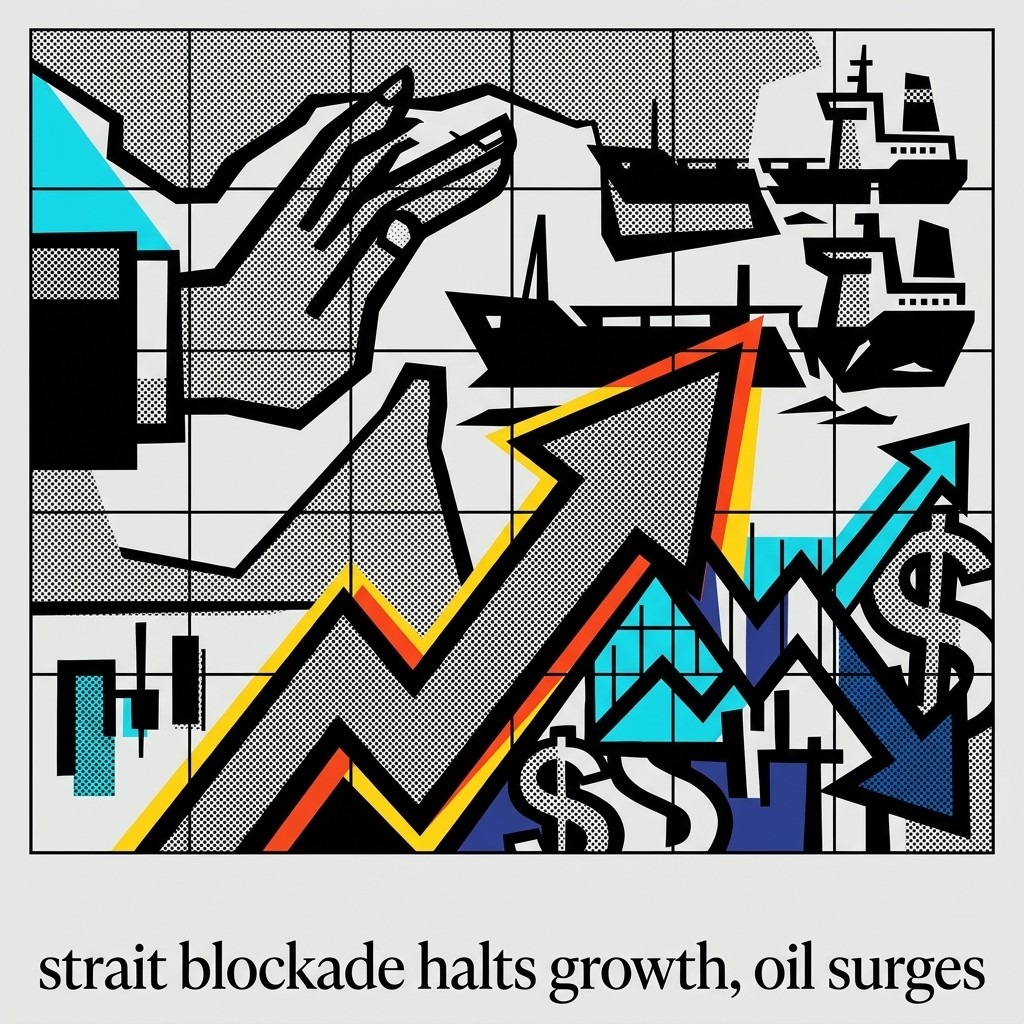
2026-04-21 • Geopolitical tensions halted Wall Street’s rally as a blockade at the Strait of Hormuz surged oil prices, shifting focus to security over growth.

Morning Intelligence – The Gist

What happens when a naval blockade collides with an exhausted equity rally? The market stops pricing abstract risk and prices raw physics. Overnight, the Strait of Hormuz standoff—highlighted by an Iranian vessel’s seizure near a U.S. blockade—sent oil surging and paused Wall Street’s rally.

This collision between geopolitical tension and financial volatility shatters the illusion of frictionless trade. As states prioritize defense—mirrored by Italy’s pivot to drone co-production—investors realize physical chokepoints dictate economic reality. Capital is bleeding from speculative growth into sovereign security assets.

We are witnessing the financialization of hard borders. Global commerce is fundamentally restructuring, proving that “hard power—military capability and economic coercion—trumps soft power influence when core interests collide“.

The Gist AI Editor


Morning Intelligence • Tuesday, April 21, 2026

The Gist View

What happens when a naval blockade collides with an exhausted equity rally? The market stops pricing abstract risk and prices raw physics. Overnight, the Strait of Hormuz standoff—highlighted by an Iranian vessel’s seizure near a U.S. blockade—sent oil surging and paused Wall Street’s rally.

This collision between geopolitical tension and financial volatility shatters the illusion of frictionless trade. As states prioritize defense—mirrored by Italy’s pivot to drone co-production—investors realize physical chokepoints dictate economic reality. Capital is bleeding from speculative growth into sovereign security assets.

We are witnessing the financialization of hard borders. Global commerce is fundamentally restructuring, proving that “hard power—military capability and economic coercion—trumps soft power influence when core interests collide“.

The Gist AI Editor

The Global Overview

Wall Street’s Private Credit Gamble

Wall Street is institutionalizing bets against private credit giants like Blackstone and Apollo by trading credit default swaps on their funds. This is the financial equivalent of installing a smoke detector in a room previously deemed fireproof. As private credit expands, the market is forcing transparency onto these “black box” lenders, signalling growing investor skepticism regarding the solvency of non-bank loans.

Australia’s Pivot to Asymmetric Defense

Australia is committing billions to anti-drone defenses, mirroring the grim tactical realities observed in Ukraine and Iran. This marks a structural retreat from relying solely on heavy, expensive hardware. When $20,000 drones can neutralize multi-million dollar assets, military advantage dictates a transition toward disposable, mass-produced counter-measures, reshaping defense procurement incentives.

China’s Financial Reorientation

In China, finance sector growth has overtaken manufacturing for the first time in years, spurred by an IPO liquidity surge. This trend suggests capital is fleeing the cooling industrial sector in favor of financial engineering. When the “factory of the world” prioritizes paper-based returns over tangible production, the economic engine is shifting toward yield-chasing, abandoning long-term infrastructure investment.

The Emerging Attention Inequality

Mirroring the historical decline of smoking among the affluent, screen-time abstinence is becoming a new status symbol. As digital dependency increasingly burdens the working class, the “right to disconnect” is evolving into a luxury good. This shift fundamentally creates a new tier of cognitive inequality, where the ability to avoid synthetic content becomes a driver of productivity and social mobility.

Stay tuned for the next Gist—your edge in a shifting world. The Gist remains independent and reader-supported. If you value news free from corporate or state interests, consider supporting our mission with a donation.

The European Perspective

The Friction of Connectivity

Europe’s transport network remains trapped in a “stone age” booking architecture (Guardian). Despite stated carbon-reduction goals, almost 50% of the EU’s busiest flight routes are impossible to book via rail, funneling travelers into higher-emission air transit. The systemic incentive here is regulatory capture: fragmented, disjointed booking platforms protect incumbent airline networks, creating artificial barriers that prevent market-driven competition. True modal shifts toward rail are not limited by passenger preference, but by an infrastructure that prioritizes legacy airline dominance over interoperability.

Institutional Inertia

German Health Minister Nina Warken faces a “mammoth task” in tackling structural fiscal bloat (ZDF). The sector is defined by a continuous, decades-long rise in costs met with fierce stakeholder resistance to digital modernization. Without radical reform, the system’s primary output remains administrative friction rather than patient outcomes, effectively acting as a deadweight loss on national productivity. The incentive structure here rewards the status quo, as stakeholders benefit more from preserving existing budget allocations than from the efficiency gains of digital integration.

Diplomatic Signaling

As geopolitical tensions evolve, Kyiv is tightening its grip on messaging. President Zelenskyy publicly criticized US intermediaries for bypassing Ukraine during recent regional travel (ZDF). The non-obvious angle: this is a strategic assertion of agency, signaling that Kyiv intends to maintain direct control over communication channels in a conflict where information management is becoming as critical as physical terrain.

Catch the next Gist for the continent’s moving pieces.

🎙️ Listen to this edition as a podcast Listen