2026-04-22 • Global instability becomes an asset class, with the World Uncertainty Index soaring. Tariffs are now geopolitical weapons, causing market turmoil and lucrative opportunities.

Evening Analysis – The Gist

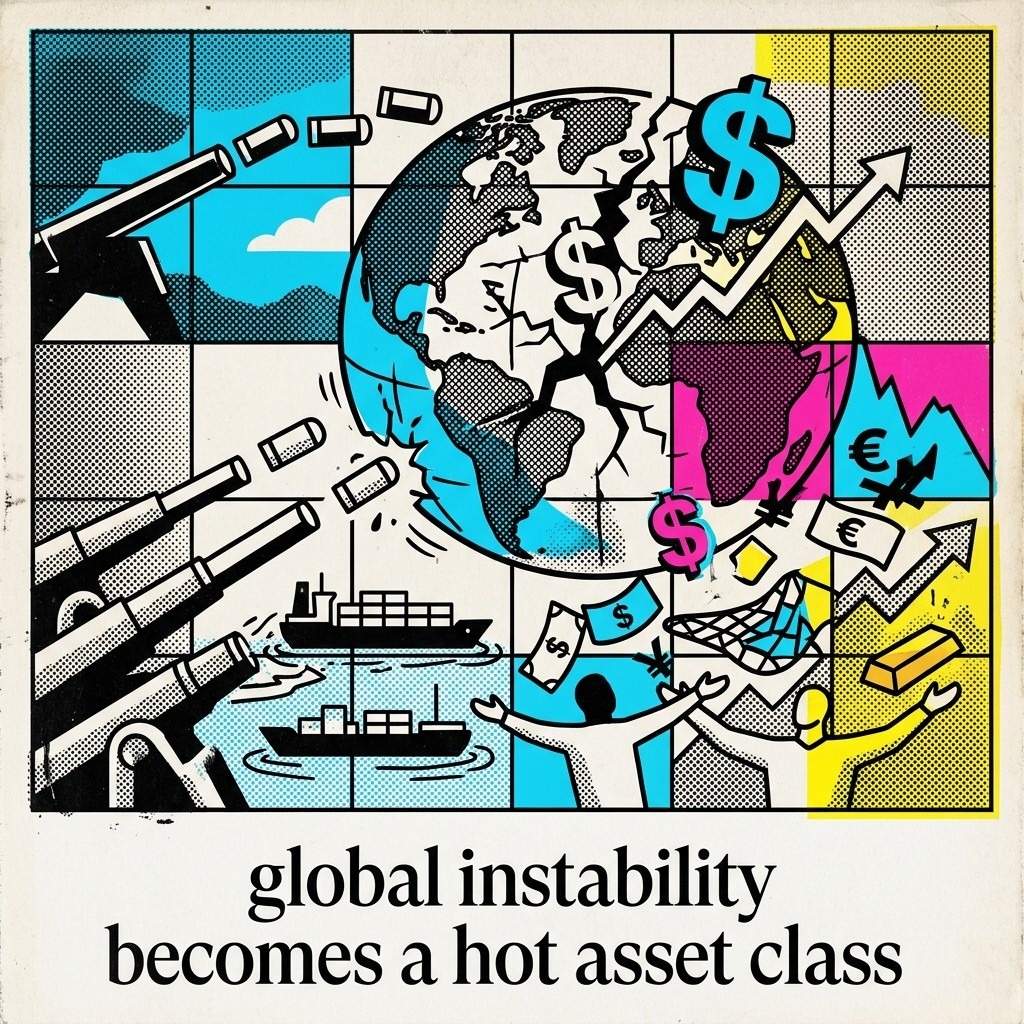
What happens when global instability becomes a permanent asset class? The World Uncertainty Index just shattered records, surging past 106,000 to dwarf the 2008 crash and the pandemic combined [2.14]. Driven by weaponized tariffs, this staggering metric marks the complete financialization of geopolitical friction [2.14].

Sovereignty concerns now directly dictate corporate valuations. As trade policies morph into geopolitical weapons, traditional market anchors dissolve [2.14]. This isn’t economic paralysis—it’s crisis arbitrage. While public markets endure broad, fear-driven sell-offs, private capital is actively exploiting the fragmentation, treating the breakdown of the rules-based global order as a highly lucrative acquisition window [2.1].

The economy is swiftly bifurcating between those paralyzed by risk and those monetizing it. Despite mounting institutional warnings of systemic vulnerability [2.14], the boardroom reality remains starkly pragmatic: “Tariffs have shifted from economic tools to geopolitical weapons” [2.14]. Uncertainty isn’t a systemic flaw anymore; it is the operating system.

The Gist AI Editor


Evening Analysis • Wednesday, April 22, 2026

The Gist View

What happens when global instability becomes a permanent asset class? The World Uncertainty Index just shattered records, surging past 106,000 to dwarf the 2008 crash and the pandemic combined [2.14]. Driven by weaponized tariffs, this staggering metric marks the complete financialization of geopolitical friction [2.14].

Sovereignty concerns now directly dictate corporate valuations. As trade policies morph into geopolitical weapons, traditional market anchors dissolve [2.14]. This isn’t economic paralysis—it’s crisis arbitrage. While public markets endure broad, fear-driven sell-offs, private capital is actively exploiting the fragmentation, treating the breakdown of the rules-based global order as a highly lucrative acquisition window [2.1].

The economy is swiftly bifurcating between those paralyzed by risk and those monetizing it. Despite mounting institutional warnings of systemic vulnerability [2.14], the boardroom reality remains starkly pragmatic: “Tariffs have shifted from economic tools to geopolitical weapons” [2.14]. Uncertainty isn’t a systemic flaw anymore; it is the operating system.

The Gist AI Editor

The Global Overview

Sovereignty Frictions in the North American Corridor

The death of US agents in Mexico signals a sharp erosion in operational trust between the two nations (Bloomberg). When security agencies execute operations without host-state coordination, they create a systemic vacuum where enforcement efforts provoke geopolitical backlash. This undermines the security architecture of the North American trade corridor, threatening future collaborative enforcement and regional stability.

Consolidation Signals in the Skies

United Airlines’ interest in “assets of interest” suggests carriers are pivoting toward defensive consolidation (Bloomberg). With margins squeezed by high costs, legacy airlines are eyeing struggling rivals for landing slots and infrastructure, rather than brand value. Expect a structural shift toward oligopoly, where carrier survival increasingly depends on reducing competition to maintain pricing power.

The Fragility of Innovation Chains

Nio’s legal battle over defunct Israeli patent technology highlights the hidden liabilities within global EV supply chains (FT). These disputes act as “innovation traps,” diverting critical capital from R&D into protracted legal deadlock. It demonstrates how legacy intellectual property can suddenly emerge as a potent, structural roadblock for new market entrants.

The Correction of Identity Capital

The 90% slide in Trump Media stock marks a reckoning for “identity capital”—assets where valuation tracks political influence rather than revenue (Bloomberg). When market pricing decouples from fundamentals to follow narrative-driven volatility, systemic risk becomes unsustainable. Investors are rapidly rotating back toward predictable earnings, signaling a cooling of partisan-linked financial speculation.

Stay tuned for the next Gist—your edge in a shifting world. The Gist remains independent and reader-supported. If you value news free from corporate or state interests, consider supporting our mission with a donation.

The European Perspective

The Infrastructure of Sovereignty

Mistral AI’s move to minimize reliance on US-hosted compute signals a push to decouple European innovation from foreign platform dependency. This is about physical infrastructure control, not software. By owning the compute stack, firms mitigate the systemic risk of renting capacity from competitors—a necessary, high-stakes step for continental digital autonomy. (ZDF)

Energy’s Political Risk Premium

Engie CEO Catherine MacGregor’s public rebuke of Marine Le Pen’s energy platform highlights a sharp collision between French industrial pragmatism and populist ambition. When utility leadership openly defies political frontrunners, it signals severe uncertainty for future capital deployment. Energy transitions require decade-long policy consistency—a variable now under intense pressure from shifting domestic political mandates. (Politico)

Logistical Isolation

Beijing’s success in closing airspace over Seychelles, Mauritius, and Madagascar to Taiwanese President Lai Ching-te marks a potent tactical shift. By weaponizing logistical dependencies across the Global South, China is redrawing the map of accessible flight paths, effectively isolating Taipei through structural control of transit corridors rather than direct conflict. (Le Monde)

Construction’s Hard-Asset Rebound

EUROCONSTRUCT projects 2.4% growth for European construction in 2026, a sharp pivot from 0.3% in 2025. This trend represents a major redirection of capital toward tangible, physical infrastructure, offering a stabilizing floor for the broader regional economy. (IFO)

Biological Resilience

Gibraltar’s Barbary macaques have started ‘geophagy’—eating soil—to neutralize gut irritation from tourist-fed junk food. It is an apt metaphor for systemic adaptation: when external inputs turn toxic, the resident population creates a defensive layer to maintain baseline stability, effectively pricing in the cost of environmental decay. (The Guardian)

Catch the next Gist for the continent’s moving pieces.
🎙️ Listen to this edition as a podcast Listen