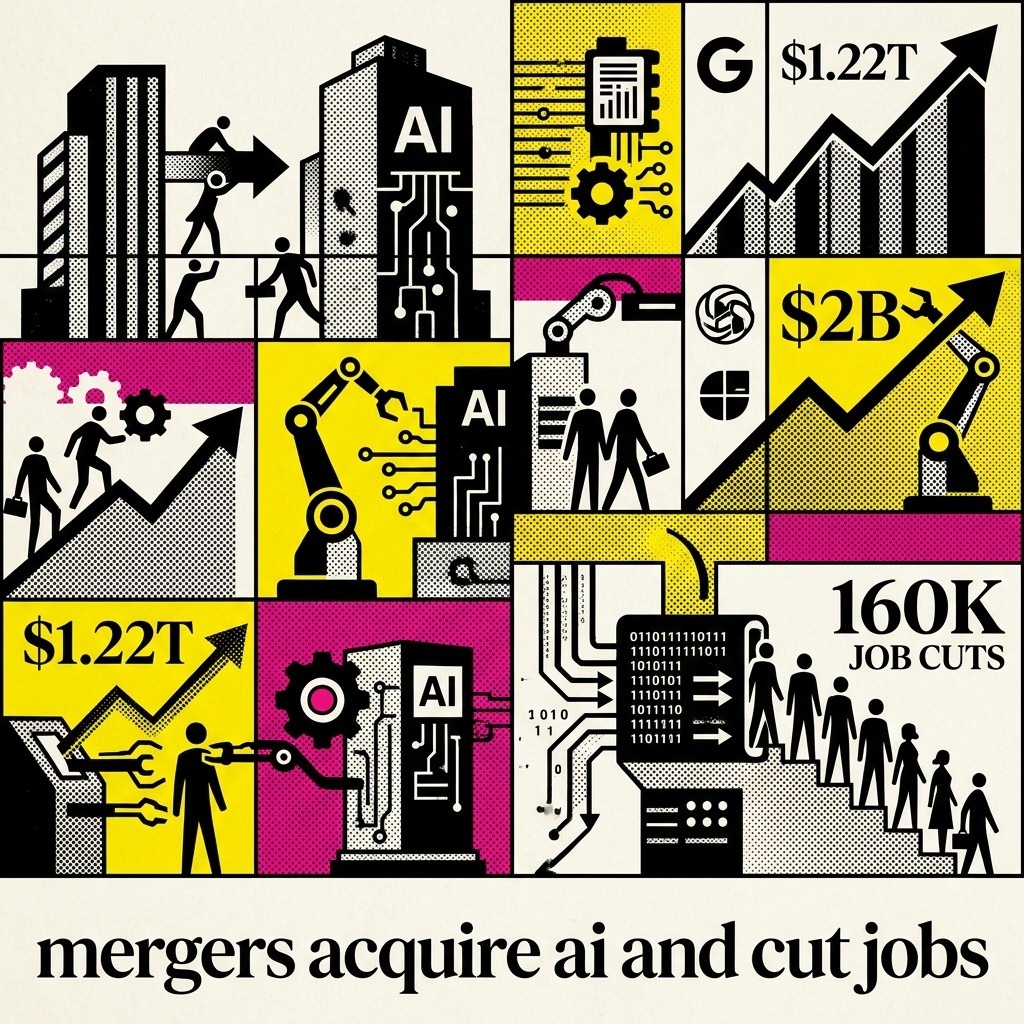
2026-04-22 • Corporate mergers focus on acquiring AI to replace human roles, with $1.22T in M&A and 160K job cuts, pivoting from payrolls to machine efficiency.

Morning Intelligence – The Gist

Why pretend corporate mergers are simply about market share, when they are now about acquiring the computing power to replace human capital? Global M&A volume just hit a record $1.22 trillion for Q1 2026. Companies aren’t just absorbing competitors; they are aggressively buying AI infrastructure to flatten their organizational charts.

Building on South Korea’s strategic pivot toward physical silicon, this consolidation coincides with 160,000 corporate job cuts since January. Executives aren’t blaming macroeconomic headwinds—they are explicitly citing AI-led automation. This is a deliberate redirection of capital from payrolls to server farms, systematically substituting human cognition for machine efficiency.

As economists warn that new cognitive production models push toward a corner solution of “all machine, no human”, the structural reality is clear. The labor market isn’t just evolving—it’s being acquired.

The Gist AI Editor


Morning Intelligence • Wednesday, April 22, 2026

The Gist View

Why pretend corporate mergers are simply about market share, when they are now about acquiring the computing power to replace human capital? Global M&A volume just hit a record $1.22 trillion for Q1 2026. Companies aren’t just absorbing competitors; they are aggressively buying AI infrastructure to flatten their organizational charts.

Building on South Korea’s strategic pivot toward physical silicon, this consolidation coincides with 160,000 corporate job cuts since January. Executives aren’t blaming macroeconomic headwinds—they are explicitly citing AI-led automation. This is a deliberate redirection of capital from payrolls to server farms, systematically substituting human cognition for machine efficiency.

As economists warn that new cognitive production models push toward a corner solution of “all machine, no human”, the structural reality is clear. The labor market isn’t just evolving—it’s being acquired.

The Gist AI Editor

The Global Overview

Historical Precedent for the AI Age

Fresh analysis of 170 million census records (1851–1911) from the British Industrial Revolution suggests technological displacement rarely functions as a sudden “job killer,” but rather as a silent shift in entry pathways. As mechanization hit the bootmaking industry, 152,000 artisanal roles vanished, yet 144,000 new jobs emerged (Marginal Revolution). Crucially, incumbent workers weren’t displaced; the decline was driven by young workers no longer entering the obsolete trade. If current AI diffusion follows this Victorian template, the systemic friction isn’t mass unemployment, but a generational “hollowing out” where career ladders vanish before new ones are built.

Capital Unlocking Through Divestiture

Retailers and medical suppliers are currently favoring structural fission over conglomerate synergy. Primark’s decision to demerge into two pure-play entities creates two FTSE 100 constituents, allowing the market to price its business units separately (FT). Simultaneously, private equity firms CVC and GTCR are targeting medical equipment provider Teleflex in a take-private bid (Bloomberg). This trend signals a shift away from bloated holding companies toward agile, sector-specific vehicles. Institutional investors now prefer clarity; they want to bet on a specific manufacturing capability rather than a complex corporate “black box.”

Hormuz Logistics Update

As the Strait of Hormuz blockade persists, Iran’s latest maneuver—ferrying 9 million barrels of crude past naval lines (Bloomberg)—proves supply chains remain resilient to static pressure. Tankers masking their signals effectively bypass the enforcement mechanisms meant to constrain state revenue, turning basic maritime logistics into a high-stakes game of information asymmetry.

Stay tuned for the next Gist—your edge in a shifting world. The Gist remains independent and reader-supported. If you value news free from corporate or state interests, consider supporting our mission with a donation.

The European Perspective

Regulatory Compliance Friction

The EU’s Packaging and Packaging Waste Regulation (PPWR) hits the implementation phase this August 2026. While the goal is circularity, the lack of operational definition in Articles 32 and 33 creates a “compliance trap” for businesses. Firms are forced into capital expenditure for reusable infrastructure without enforcement certainty, effectively squeezing operational margins while regulators scramble to define metrics. This creates an uneven playing field where nimble incumbents gain while smaller players struggle with the regulatory burden (Politico).

Urban Spatial Optimization

Cities like Paris and Barcelona are re-engineering public space, pivoting from car-centric planning to pedestrian-dense models. By reclaiming square footage, these municipalities aren’t just pursuing aesthetics; they are optimizing for high-velocity retail and social capital. Real estate value is increasingly decoupled from transit volume and tethered directly to human density, transforming municipal layouts into engines for local economic activity (The Guardian).

Demographic Capital Flow

Retiree migration acts as a structural regional stimulant. Data (1968–2008) reveals seniors as liquid capital in motion, shifting tax bases and construction demand away from hyper-concentrated urban cores into underserved areas. They effectively flatten the geographic inequality of economic production, serving as a stabilizing economic force often overlooked in macro-policy (CEPR).

Luxury’s Youth Pivot

Frederique Constant is aggressively targeting younger buyers with reimagined designs, signaling a shift in luxury sector strategy. Brands are re-tooling identities to lock in lifetime customer value early, hedging against the volatility of aging demographics. As tech-driven labor displacement fuels anxiety regarding long-term purchasing power, legacy firms are fighting to capture the remaining discretionary income of Gen Z before structural shifts fully harden (Euronews).

Catch the next Gist for the continent’s moving pieces.

🎙️ Listen to this edition as a podcast Listen