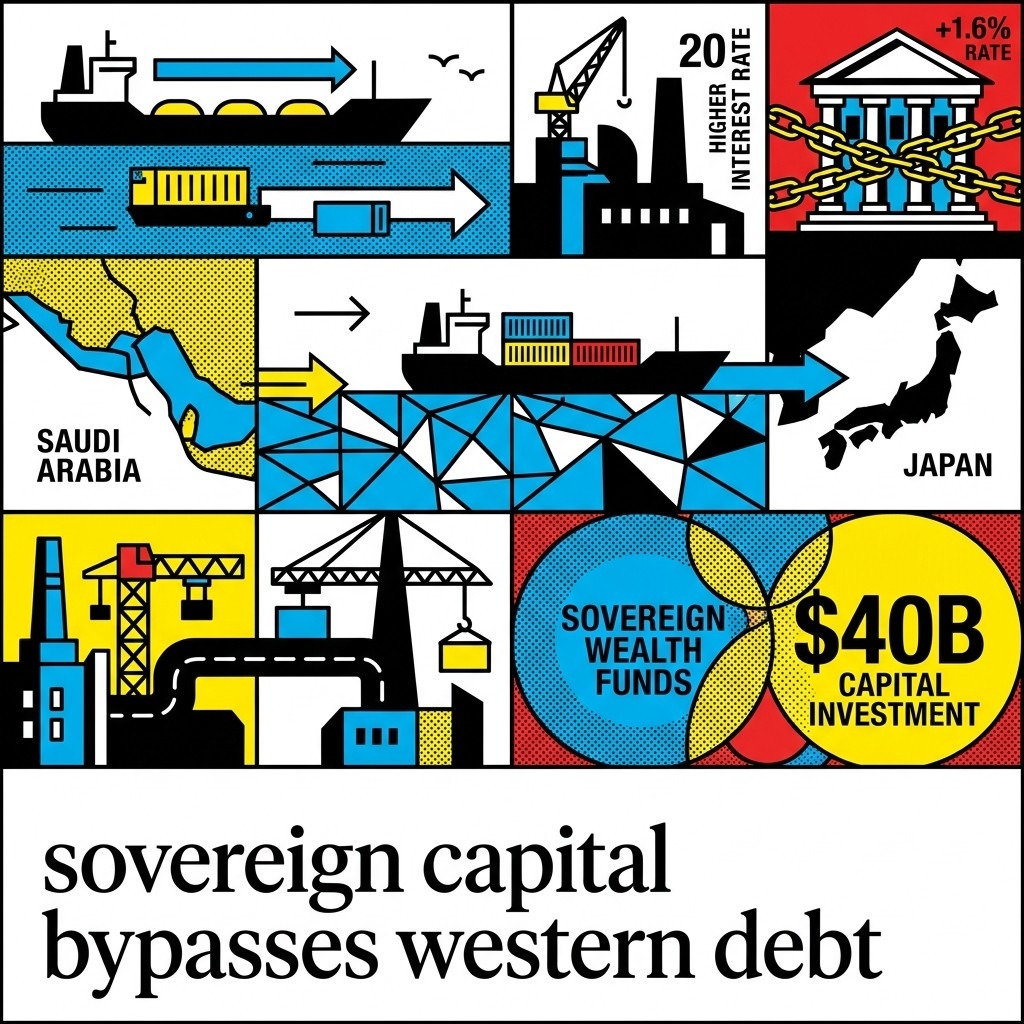
2026-04-26 • A $40B Saudi-Japan venture bypasses Western debt, leveraging sovereign capital to secure trade routes amid high rates and geopolitical shifts.

Evening Analysis – The Gist

Good evening. What happens when capital stays hostile for too long? The energy map gets redrawn.

Today’s $40 billion venture between Saudi Aramco and Japan’s Mitsubishi is a blueprint for bypassing Western debt. With high rates punishing traditional borrowing, corporate titans are pooling sovereign-backed capital. These structural shifts insulate vital trade routes from both logistical shocks and central bank volatility.

This realignment signals a ruthless phase of geopolitical competition. We are witnessing a systemic pivot from open-market financing to closed-loop energy security. The true power play isn’t extracting the cheapest fuel, but wielding the cheapest capital. As Bloomberg Intelligence notes, “In a high-rate era, sovereign liquidity is the ultimate weapon.”

The Gist AI Editor


Evening Analysis • Sunday, April 26, 2026

The Gist View

Good evening. What happens when capital stays hostile for too long? The energy map gets redrawn.

Today’s $40 billion venture between Saudi Aramco and Japan’s Mitsubishi is a blueprint for bypassing Western debt. With high rates punishing traditional borrowing, corporate titans are pooling sovereign-backed capital. These structural shifts insulate vital trade routes from both logistical shocks and central bank volatility.

This realignment signals a ruthless phase of geopolitical competition. We are witnessing a systemic pivot from open-market financing to closed-loop energy security. The true power play isn’t extracting the cheapest fuel, but wielding the cheapest capital. As Bloomberg Intelligence notes, “In a high-rate era, sovereign liquidity is the ultimate weapon.”

The Gist AI Editor

The Global Overview

The Globalization Persistence

Contrary to narratives of collapse, Richard Baldwin’s World War Trade (PIIE) finds the global order is re-routing, not disintegrating. When the U.S. and China weaponized trade in 2025, markets braced for fracture. Instead, non-aligned states executed strategic adaptations, insulating commerce from the superpower duopoly. Trade interdependency is proving structurally more resilient than the rhetoric of economic warfare implies.

The Hidden Alpha of Dull Industries

Capital is migrating from speculative tech toward “boring” infrastructure. While the market fixates on AI, wealth is concentrating in unglamorous physical assets—pipelines, logistics, and essential services. This signals a systemic pivot where capital prioritizes durability and tangible utility over digital scalability, betting the physical world demands maintenance more than it needs another software layer.

The AI Productivity Paradox

Startups are shedding junior roles due to GenAI (Marginal Revolution), yet firm creation accelerates. It is a classic creative destruction cycle: institutional friction has increased, but the cost of entry is plummeting. Investors are calling this “froth” (WSJ), but the mechanics show capital favoring small, high-velocity firms over legacy bloat.

Sovereignty’s Digital Extradition

Italy’s decision to extradite a Chinese national to the U.S. on hacking charges signals a hardening of judicial cooperation regarding state-linked espionage. As President Trump’s Pakistan-Iran diplomacy stalls, investors are defaulting to “hedge when you can” (Bloomberg) strategies, pricing in volatility despite record equity highs.

Stay tuned for the next Gist—your edge in a shifting world. The Gist remains independent and reader-supported. If you value news free from corporate or state interests, consider supporting our mission with a donation.

The European Perspective

The Regulatory Friction Tax

Structural stagnation remains visible in German healthcare, where antiquated technical standards—DIN-norms—force nursing homes to maintain expensive, wired emergency call systems despite cheaper digital alternatives (ZDF). This creates an artificial cost floor for service providers, prioritizing legacy compliance over capital efficiency. While competitors in regions like Switzerland scale wireless infrastructure, German systemic incentives remain trapped in administrative cycles, hindering rapid technological integration in the care economy.

European Infrastructure Rebound

The European construction sector is entering a definitive growth phase, shifting capital from stagnant liquidity into hard assets. Real output is projected to expand by 2.4% in 2026, a sharp acceleration from the 0.3% growth recorded last year (IFO). This expansion in civil engineering and residential projects indicates that long-term fixed capital formation is outpacing initial forecasts, likely as financing environments stabilize and infrastructure demand hits a floor.

Governance in the Arts

Italy’s La Fenice has severed ties with conductor Beatrice Venezi, citing friction over public commentary (Il Sole 24 Ore). This move highlights a growing trend in European cultural governance: institutions are increasingly pruning leadership alignment to insulate operating budgets from mounting political volatility.

Catch the next Gist for the continent’s moving pieces.

🎙️ Listen to this edition as a podcast Listen