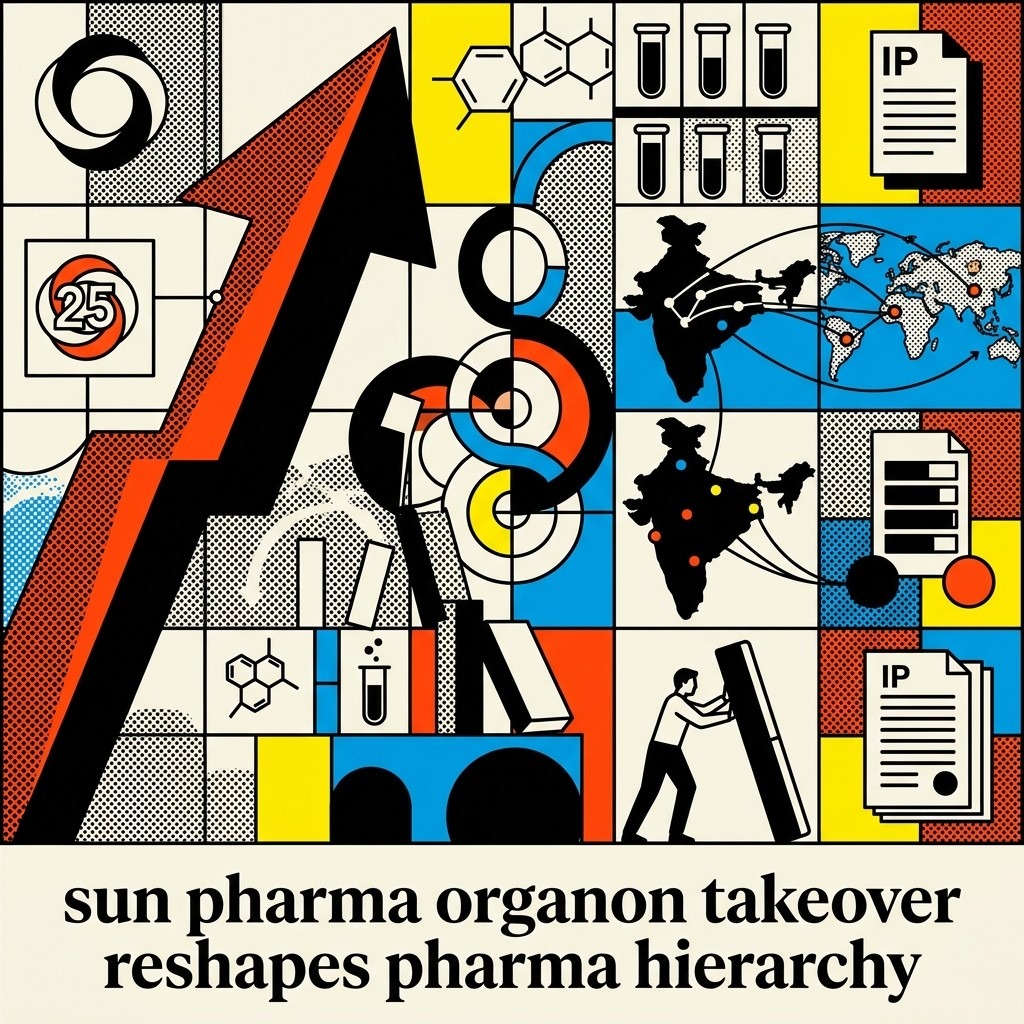
2026-04-27 • India’s Sun Pharma’s $11.75B takeover of Organon flips the pharma hierarchy, acquiring IP and distribution, entering the global top 25.

Morning Intelligence – The Gist

Notice how the geographic center of pharmaceutical gravity just shifted? For decades, the power dynamic was simple: Western giants designed the drugs, and Asian manufacturers scaled the generics. Today, that hierarchy flipped. India’s Sun Pharma just executed an $11.75 billion all-cash takeover of US-based Organon.

This is an observational masterclass in margin capture. By absorbing Organon—a Merck spin-off focused on biosimilars and women’s health—Sun Pharma acquires high-margin specialized IP and entrenched Western distribution networks. The move vaults Sun into the top 25 global pharmaceutical companies, bypassing the traditional generic margin squeeze by vertically integrating legacy US portfolios into its massive operational footprint.

The systemic trend is unmistakable. As US firms spin off divisions to optimize balance sheets, they create perfectly sized targets for capital-rich global competitors. It illuminates a ruthlessly efficient structural reality: the entities controlling the manufacturing scale inevitably buy the intellectual property.

The Gist AI Editor


Morning Intelligence • Monday, April 27, 2026

The Gist View

Notice how the geographic center of pharmaceutical gravity just shifted? For decades, the power dynamic was simple: Western giants designed the drugs, and Asian manufacturers scaled the generics. Today, that hierarchy flipped. India’s Sun Pharma just executed an $11.75 billion all-cash takeover of US-based Organon.

This is an observational masterclass in margin capture. By absorbing Organon—a Merck spin-off focused on biosimilars and women’s health—Sun Pharma acquires high-margin specialized IP and entrenched Western distribution networks. The move vaults Sun into the top 25 global pharmaceutical companies, bypassing the traditional generic margin squeeze by vertically integrating legacy US portfolios into its massive operational footprint.

The systemic trend is unmistakable. As US firms spin off divisions to optimize balance sheets, they create perfectly sized targets for capital-rich global competitors. It illuminates a ruthlessly efficient structural reality: the entities controlling the manufacturing scale inevitably buy the intellectual property.

The Gist AI Editor

The Global Overview

The Fragility of Concentration

A systemic warning: 69% of US mushroom production is concentrated in one Pennsylvania borough (Marginal Revolution). This hyper-concentration—producing 451 million pounds annually—creates a classic “single point of failure.” It mirrors the precarious reliance seen in global semiconductor and pharmaceutical supply chains, where localized efficiency often masks profound, overlooked fragility.

Stay tuned for the next Gist—your edge in a shifting world. The Gist remains independent and reader-supported. If you value news free from corporate or state interests, consider supporting our mission with a donation.

China’s Industrial Resilience

Despite surging energy costs—a consequence of volatile Middle Eastern supply chains—China’s industrial profits jumped 15.8% in March (WSJ). This disconnect reveals a systemic adaptation: firms are prioritizing automation to “outrun” high input costs. Like a long-distance runner conserving oxygen, the Chinese industrial base is squeezing more output from every unit of resource, proving more resilient to global frictions than conventional projections suggest.

AI Innovation via Optimization

DeepSeek’s V4 model underscores a pivot in the AI arms race: architectural ingenuity over hardware abundance (Bloomberg). Hampered by limited access to top-tier Nvidia chips, the platform is doubling down on software efficiency. We are watching the emergence of a two-tier ecosystem where competitive advantage hinges on code elegance rather than just stacking expensive silicon.

Global Capital Shifts: Pharma Consolidation

Sun Pharmaceutical’s $11.75 billion all-cash acquisition of Organon vaults the Indian firm into the top tier of global women’s health (WSJ). This isn’t merely corporate expansion; it is a structural migration of capital, where emerging market giants leverage manufacturing scale to absorb Western patent portfolios, effectively challenging the long-standing pharmaceutical hegemony of the West.

The European Perspective

The Data Center Infrastructure Divide

The AI race is won by heavy metal, not just code. New data shows US data center capacity doubles that of the EU (Euronews). Capital is aggressively flowing toward grid-capable regions—Germany and the UK leading China—indicating that AI dominance is tethered to electricity access and physical cooling capacity rather than software scale alone.

European Construction’s Structural Rebound

Europe’s economy is pivoting from stagnation, with construction signaling a distinct, supply-driven revival. After a sluggish 0.3% growth last year, analysts project a 2.4% expansion in 2026, persisting through 2028 (IFO). This is not cyclical luck; it is a structural move toward capital-heavy infrastructure. For investors, this marks a tactical shift from service-based caution to real-asset positioning, as the sector moves from idle to active investment.

Defense Spending Hits Record Highs

Global military expenditure reached an unprecedented $2.887 trillion in 2025, the 11th consecutive year of growth (SIPRI). This systemic re-allocation of capital toward kinetic readiness confirms that defense is now a foundational pillar of national economic strategy.

Mainz’s Fading Momentum

In the Bundesliga, Bayern Munich’s comeback from a 3-0 deficit underscores how structural depth eventually offsets early-game volatility (ZDF).

Catch the next Gist for the continent’s moving pieces.

🎙️ Listen to this edition as a podcast Listen