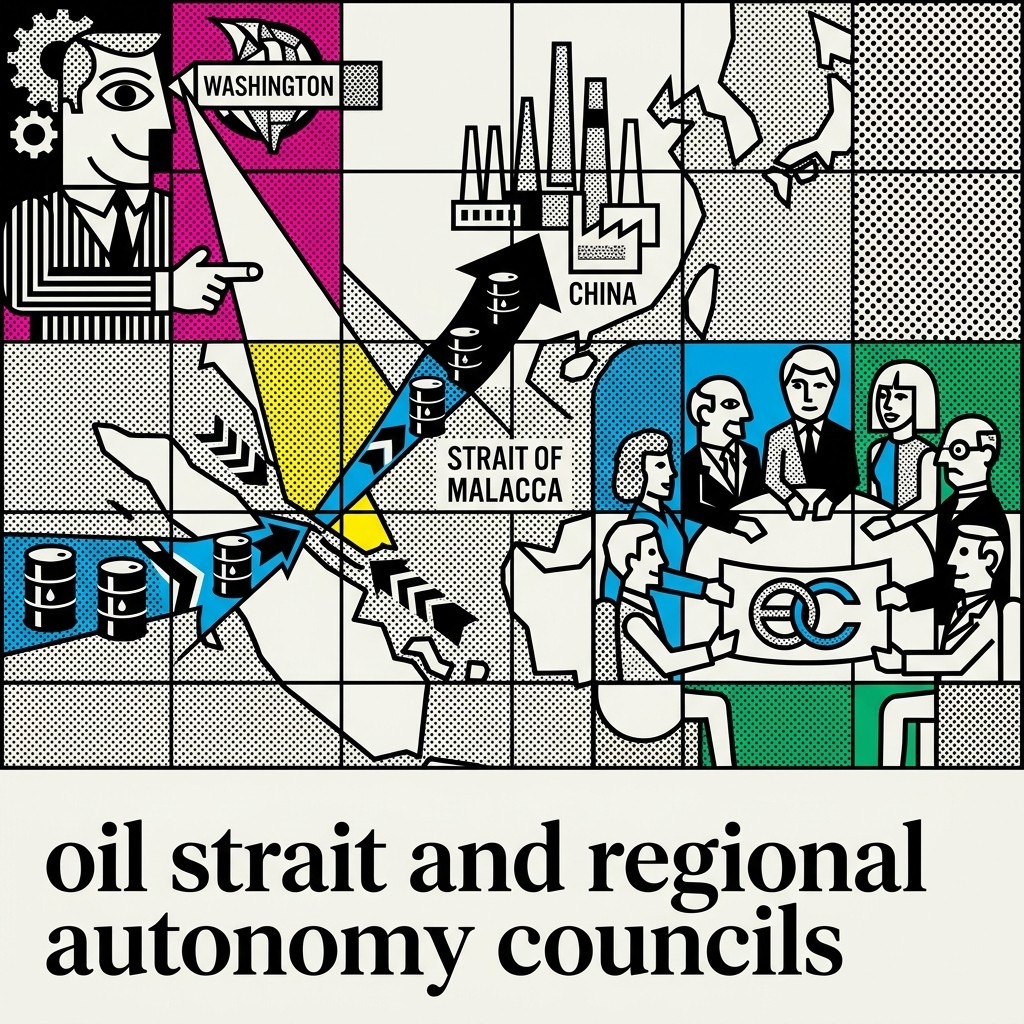
2026-05-04 • Washington’s focus on the Strait of Malacca, crucial for China’s oil, shows geopolitical leverage. Europe seeks regional autonomy via a new council.

Morning Intelligence – The Gist

Good morning at 07:02.

What happens when trade arteries become geopolitical tripwires? Washington’s pivot toward the Strait of Malacca—courting Jakarta while aligning with New Delhi—is a masterclass in structural leverage. With 75% of China’s oil traversing this bottleneck, controlling Malacca provides a macroeconomic kill-switch.

Simultaneously, mounting conflict anxiety forces Europe to confront its fragilities. Facing transatlantic uncertainty, continental leaders are proposing a specialized geopolitical council to bypass the EU’s paralyzing consensus-voting mechanics. It marks a stark institutional pivot from passive reliance to urgent regional autonomy.

These theaters expose the raw mechanics of modern influence. Hegemony today relies less on ideological alignment and entirely on infrastructural dominance. As analysts note, whoever physically controls these chokepoints “ultimately dictates the survival of the global economy”.

The Gist AI Editor


Morning Intelligence • Monday, May 04, 2026

The Gist View

Good morning at 07:02.

What happens when trade arteries become geopolitical tripwires? Washington’s pivot toward the Strait of Malacca—courting Jakarta while aligning with New Delhi—is a masterclass in structural leverage. With 75% of China’s oil traversing this bottleneck, controlling Malacca provides a macroeconomic kill-switch.

Simultaneously, mounting conflict anxiety forces Europe to confront its fragilities. Facing transatlantic uncertainty, continental leaders are proposing a specialized geopolitical council to bypass the EU’s paralyzing consensus-voting mechanics. It marks a stark institutional pivot from passive reliance to urgent regional autonomy.

These theaters expose the raw mechanics of modern influence. Hegemony today relies less on ideological alignment and entirely on infrastructural dominance. As analysts note, whoever physically controls these chokepoints “ultimately dictates the survival of the global economy”.

The Gist AI Editor

The Global Overview

The Prediction Market Paradox

A WSJ analysis reveals that prediction markets like Polymarket are increasingly dominated by professional firms rather than the “crowd.” While these platforms promise decentralized wisdom, a tiny sliver of accounts using high-frequency algorithms captures the majority of returns. Think of it as a casino where the house advantage is a latency gap; these markets function less as democratic forecasting tools and more as instruments for institutional arbitrage, turning public sentiment into a high-yield asset for the hyper-equipped.

Trump’s Fiscal Pivot

Trump’s proposed IRA retirement account overhaul prioritizes political mobilization over fiscal stability. By incentivizing specific investment vehicles, the plan aims to channel personal savings into domestic policy goals. However, this creates a structural dependency where retirement portfolios become vulnerable to legislative volatility. If trade policy shifts, individual savings effectively become collateral in the broader geopolitical struggle, moving risk from institutional balance sheets directly onto the individual saver.

Indo-Pacific and European Instability

Geopolitical friction is spiking as the Philippines contests Chinese marine research vessels, framing “scientific” missions as unauthorized surveillance. Concurrently, 17,000 personnel are engaging in multinational exercises, signaling that regional powers are shifting from diplomatic rhetoric to active security integration. This Indo-Pacific hardening mirrors rising conflict anxiety in Europe, where the continent is frantically re-evaluating its own security dependencies. Both theaters demonstrate a systemic move toward defensive autonomy; nations are no longer trusting passive stability, opting instead to militarize supply chains and monitor critical infrastructure as essential assets in a fracturing global order.

Stay tuned for the next Gist—your edge in a shifting world. The Gist remains independent and reader-supported. If you value news free from corporate or state interests, consider supporting our mission with a donation.

The European Perspective

The Transatlantic Decoupling

Transatlantic ties are fraying under renewed pressure. President Trump’s threat of a 25% tariff on European autos serves as a blunt tool to force trade concessions, paired with explicit threats to withdraw U.S. troops from Germany (Politico). The systemic incentive is unmistakable: Brussels is being pushed to choose between expensive unilateral defense autonomy or economic capitulation. This accelerates a shift toward a fragmented European defense market, where reliance on U.S. security umbrellas is rapidly being priced as a systemic risk rather than a reliable constant.

Berlin’s Policy Paralysis

Germany’s fragile “black-red” coalition faces mounting structural fatigue as it nears its one-year anniversary. Minister-President Manuela Schwesig’s recent critique underscores a widening gap between Berlin’s fiscal conservatism and the economic reality for the working class (ZDF). As domestic frustration rises, political inertia is rapidly replacing substantive reform. For investors, this paralysis signals continued stagnation; the data suggests German fiscal rigidity may only bend under extreme populist pressure—a clear risk factor for long-term Eurozone stability and market confidence.

Scientific Data Sovereignty

Astronomers have identified 27 new potential “circumbinary” planets orbiting dual stars (The Guardian). While seemingly distinct from macro-politics, this discovery highlights a structural shift in scientific investment toward high-fidelity data modeling over capital-intensive hardware. This collaborative, data-first research model decentralizes influence, allowing international networks to outpace traditional state-monopoly exploration efforts. By prioritizing data architecture, European scientific institutions are subtly insulating themselves from reliance on the volatile, hardware-dependent funding cycles common in the U.S.

Catch the next Gist for the continent’s moving pieces.

🎙️ Listen to this edition as a podcast Listen