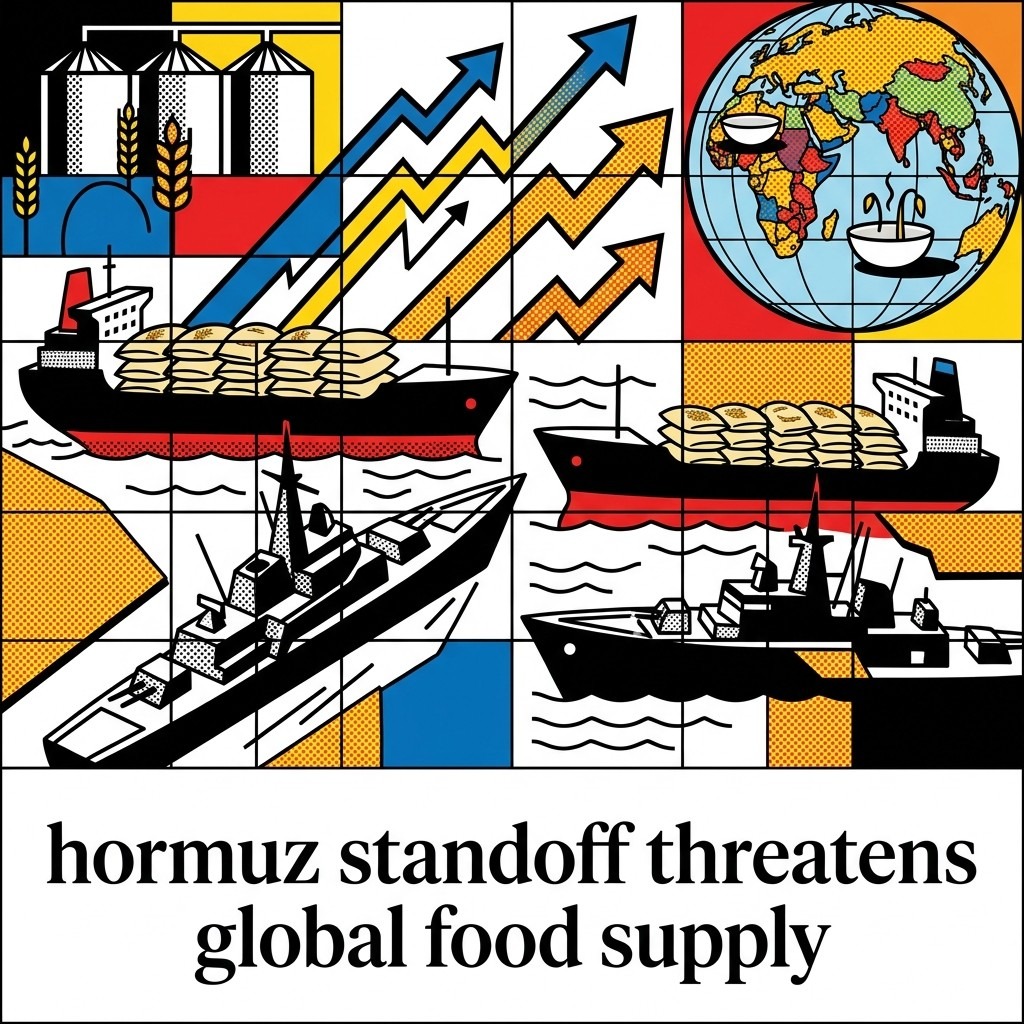
2026-05-04 • Naval standoff in the Strait of Hormuz disrupts fertilizer flow, spiking prices and threatening global food supply, especially in developing nations.

Evening Analysis – The Gist

Good evening at 18:32.

Ever wonder how a naval standoff rewrites survival math for farmers worldwide? As Middle Eastern maritime tensions shutter the Strait of Hormuz, panic predictably centers on crude. Yet the hidden crisis is more elemental: agricultural survival. With the waterway blockaded, over 1.9 million tonnes of fertilizer are trapped, mutating a military bottleneck into a systemic threat to global food supplies.

This is the profound weaponization of commodity chains. Urea prices have surged 70%, sparking a global auction where wealthy nations secure inputs and developing states are priced out. This financial volatility bleeds from energy into food futures, engineering an inflation crisis central banks cannot simply regulate away.

True leverage now lies in weaponizing raw material geography, bypassing traditional deterrence. As market analysis starkly notes, “the Gulf is arguably even more central to the global fertiliser industry than it is to energy”.

The Gist AI Editor


Evening Analysis • Monday, May 04, 2026

The Gist View

Good evening at 18:32.

Ever wonder how a naval standoff rewrites survival math for farmers worldwide? As Middle Eastern maritime tensions shutter the Strait of Hormuz, panic predictably centers on crude. Yet the hidden crisis is more elemental: agricultural survival. With the waterway blockaded, over 1.9 million tonnes of fertilizer are trapped, mutating a military bottleneck into a systemic threat to global food supplies.

This is the profound weaponization of commodity chains. Urea prices have surged 70%, sparking a global auction where wealthy nations secure inputs and developing states are priced out. This financial volatility bleeds from energy into food futures, engineering an inflation crisis central banks cannot simply regulate away.

True leverage now lies in weaponizing raw material geography, bypassing traditional deterrence. As market analysis starkly notes, “the Gulf is arguably even more central to the global fertiliser industry than it is to energy”.

The Gist AI Editor

The Global Overview

Capital’s Pivot to Private Credit

As AI-driven speculation creates valuation fog, institutional capital is quietly rotating. Apollo’s John Zito recently signaled that private credit—loans made directly by non-bank firms—is becoming the primary sanctuary for investors bracing for a “higher-volatility regime.” When public markets trade on narrative rather than underlying cash flow, smart money moves to where contracts offer secured yield. This represents a structural realignment: by bypassing traditional banks, capital concentrates in private hands, trading public transparency for increased resilience. The systemic incentive is logical: when the macro environment turns erratic, owning the debt is significantly safer than betting on the growth hype.

The Strait of Hormuz Supply Squeeze

Maritime activity in the Persian Gulf is hardening. With Iran expanding its “control zone” in the Strait of Hormuz, commercial shipping is treating the waterway like a minefield, forcing at least 13 vessels to divert (Bloomberg). This isn’t merely a security friction; it is a systemic supply chain tax. As the blockade tightens, the “crisis-like adjustment” warned by the (FT) suggests that energy-dependent economies face an immediate cost-push inflationary shock. Think of it as a toll-booth operator abruptly closing the gate; the structural risk is the interruption of energy flows that keep industrial centers from idling. Geopolitical leverage is translating directly into immediate global fiscal instability.

Stay tuned for the next Gist—your edge in a shifting world. The Gist remains independent and reader-supported. If you value news free from corporate or state interests, consider supporting our mission with a donation.

The European Perspective

Europe’s Agricultural Reboot

Europe is rethinking Haber-Bosch production. Fertilizer manufacturing, currently tied to volatile fossil fuel inputs, has become a systemic liability for food security. Policy shifts are now prioritizing decentralized, green ammonia production to insulate agricultural supply chains (Euronews). This pivot creates a structural opportunity for agile, decarbonized startups to disrupt legacy chemical giants, pushing venture capital toward modular, localized manufacturing rather than energy-intensive centralized hubs.

Privatizing Southern Transit

Sicily’s SAC is formally seeking private partners to manage Catania and Comiso airports (Il Sole 24 Ore). This mirrors a broader Eurozone trend: regional governments transferring operational risk to private equity to bypass tightening fiscal constraints. By trading ownership stakes for efficiency expertise, these hubs are positioning themselves to capture tourism flows without requiring direct state capital injections.

Shadow Fleet Friction

Sweden’s May 4 arrest of a captain commanding a suspected Russian “shadow fleet” vessel signals an accelerating risk premium on maritime commodity trade (ZDF). As enforcement tightens, the incentive for obscure shipping structures is colliding with European jurisdiction. This volatility forces shippers and insurers to aggressively price in legal risk alongside broader, Hormuz-adjacent maritime tensions.

VR as Institutional Buffer

London’s pilot across 15 secondary schools is deploying VR to mitigate exam anxiety (Guardian). Beyond education, this signals a quiet systemic shift: utilizing repeatable, immersive digital therapy to relieve NHS capacity constraints, effectively turning private tech into essential public-infrastructure staples.

Catch the next Gist for the continent’s moving pieces.

🎙️ Listen to this edition as a podcast Listen