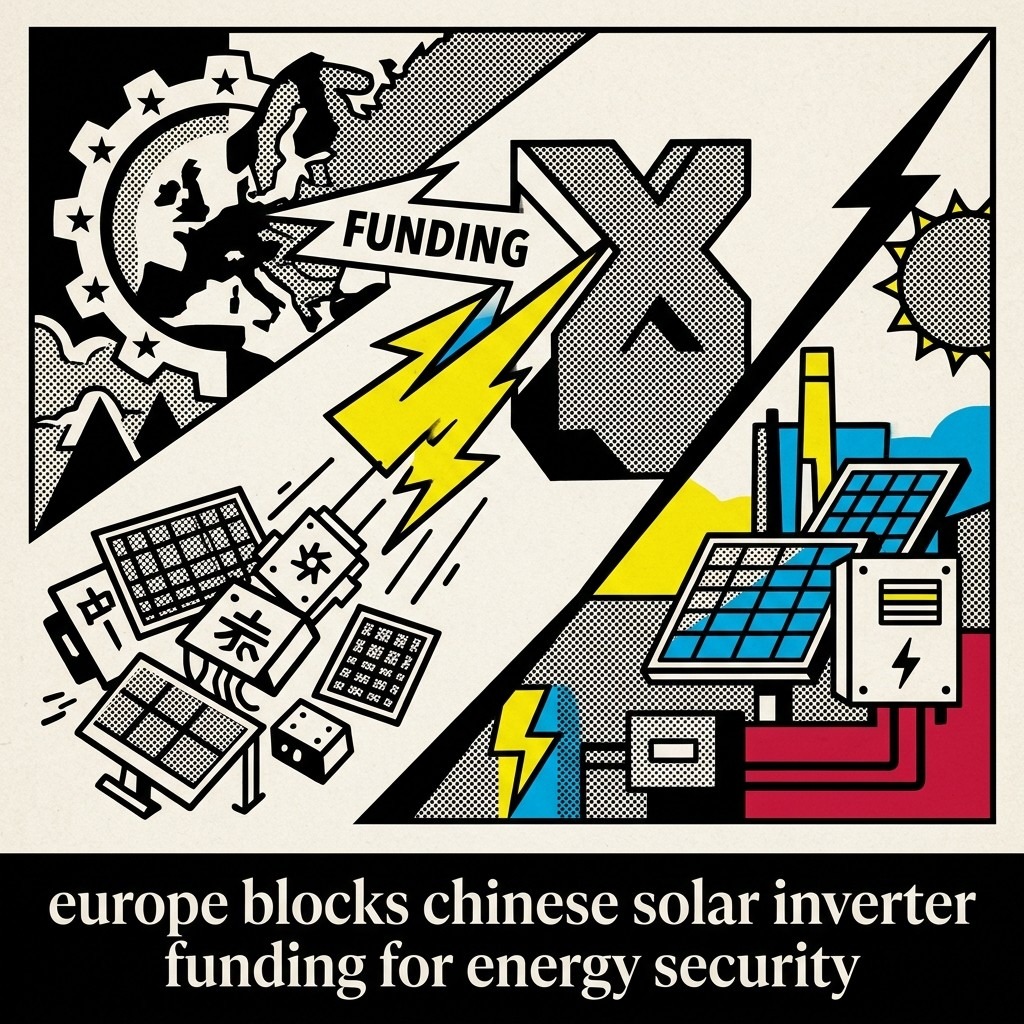
2026-05-05 • Europe blocks funding for projects using Chinese solar inverters, fearing manipulation. Despite higher costs, it’s a move for energy security.

Evening Analysis – The Gist

Think of the clean energy transition, and you picture solar panels. But the real geopolitical battleground is the digital ‘brain’ attached to them. Building on Europe’s recent push to localize green supply chains, the European Commission blocked funding today for energy projects utilizing Chinese-made solar inverters.

Inverters are gatekeepers, converting solar electricity into grid-ready current. Brussels fears that relying on firms like Huawei could allow foreign actors to manipulate production or trigger remote blackouts. This exposes a vital tension: rapid green transitions risk swapping legacy fossil-fuel dependence for severe hardware vulnerabilities.

Chinese manufacturers command roughly 80% of the global inverter market. Yet, banning them from EU-funded infrastructure increases installation costs by less than 2%. It’s a calculated sovereignty trade-off proving modern energy security requires controlling the code, not just the fuel.

The Gist AI Editor


Evening Analysis • Tuesday, May 05, 2026

The Gist View

Think of the clean energy transition, and you picture solar panels. But the real geopolitical battleground is the digital ‘brain’ attached to them. Building on Europe’s recent push to localize green supply chains, the European Commission blocked funding today for energy projects utilizing Chinese-made solar inverters.

Inverters are gatekeepers, converting solar electricity into grid-ready current. Brussels fears that relying on firms like Huawei could allow foreign actors to manipulate production or trigger remote blackouts. This exposes a vital tension: rapid green transitions risk swapping legacy fossil-fuel dependence for severe hardware vulnerabilities.

Chinese manufacturers command roughly 80% of the global inverter market. Yet, banning them from EU-funded infrastructure increases installation costs by less than 2%. It’s a calculated sovereignty trade-off proving modern energy security requires controlling the code, not just the fuel.

The Gist AI Editor

The Global Overview

Transatlantic Trade Friction

The EU is pushing an ultimatum, demanding the adoption of core US trade pact components by July (Bloomberg). This is “deadline diplomacy,” designed to force Washington to lock in commitments before domestic political cycles harden. It’s an attempt to convert vague promises into binding institutional constraints, ensuring market access remains predictable as global supply chains continue to fragment.

The Biotech Pivot

BioNTech is shedding 20% of its workforce as it exits Covid-19 vaccine production to focus exclusively on oncology R&D (FT). This is corporate pruning: as pandemic-era cash flow evaporates, capital is being ruthlessly reallocated to high-stakes cancer therapies. It confirms that institutional survival requires shedding legacy assets to fund the next frontier of growth, regardless of the immediate human capital friction.

Data Sovereignty Battles

Meta faces lawsuits from five major publishing groups over Llama AI training data, alleging “massive” copyright infringement (FT). This is a systemic collision over who owns the “raw material” of the AI age. Like early railroad barons fighting for land rights, AI giants are discovering that their greatest bottleneck isn’t compute power—it’s the proprietary information currently locked behind traditional intellectual property gates.

Regulatory Alpha

Archer-Daniels-Midland raised its full-year earnings outlook, a direct beneficiary of new Trump administration mandates for higher biofuel content in fuels (WSJ). This illustrates how regulation functions as an artificial profit engine; when the state alters the “rules of the road” for energy consumption, capital flows predictably to firms positioned to supply the mandated inputs, proving that policy is often more lucrative than operational efficiency.

Stay tuned for the next Gist—your edge in a shifting world. The Gist remains independent and reader-supported. If you value news free from corporate or state interests, consider supporting our mission with a donation.

The European Perspective

Trade Uncertainty and the US Tariff Threat

EU finance ministers are dismissing President Trump’s tariff threats as noise, yet the structural reaction is hardening. With some MEPs calling to abandon the EU–US trade deal, capital is shifting to price in “de-risking” rather than free trade. The systemic incentive is moving toward localized self-sufficiency; companies are treating the US market as a high-volatility asset, forcing a pivot toward strengthening intra-European value chains (Politico, Euronews).

The Automotive Friction

The collapse of the Canada-US trade deal reveals that negotiations fractured primarily over automotive supply chain control. For European firms, this validates a reality: when the US prioritizes localized manufacturing, export strategies based on global interoperability fail. The structural outcome is a shift toward regional “island” manufacturing, moving capital away from efficient, streamlined logistics to survive increasingly fragmented regulatory environments (Politico).

AI’s Cyber-Security Disappointment

Research from the University of Edinburgh shows cybercriminals are currently failing to effectively weaponize AI. The technology adds complexity rather than efficacy, creating a “quiet zone” for defensive cybersecurity architecture to mature. Capital flows should track defensive AI infrastructure, which currently maintains a functional R&D moat (Euronews).

German Fuel Policy Pivot

Transport Minister Patrick Schnieder is defending the “Tankrabatt,” which reduced fuel prices by ~17 cents per liter as of May 1. Despite Ifo Institute criticism regarding distorted incentives, the move serves as a tactical intervention to stabilize household purchasing power amid the energy transition (ZDF).

Catch the next Gist for the continent’s moving pieces.

🎙️ Listen to this edition as a podcast Listen