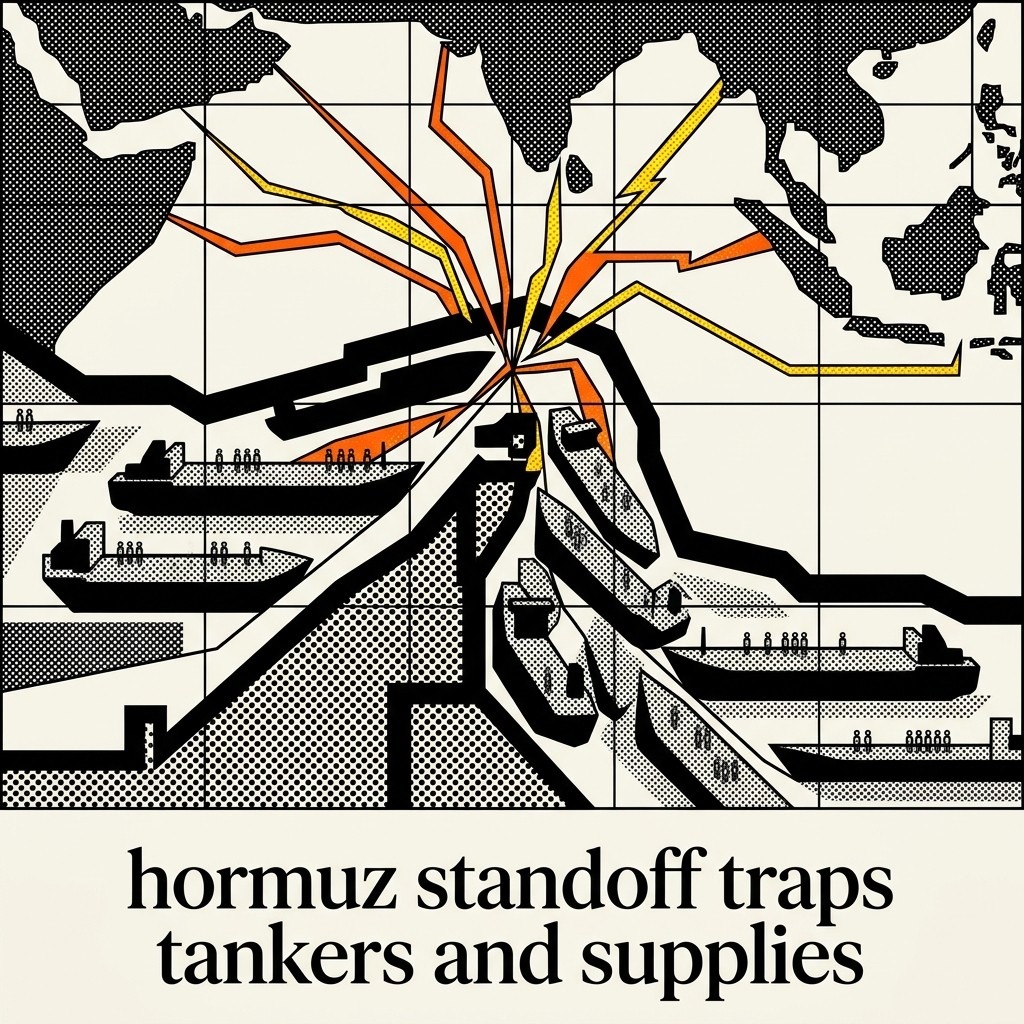
2026-05-07 • Markets misprice choke points until crises reveal fragility. The Hormuz standoff traps 20,000 seafarers, disrupting Asian energy supplies.

Morning Intelligence – The Gist

Why do markets misprice maritime choke points until they snap? As the Hormuz standoff drags on, the UN has declared an unprecedented crisis: 20,000 seafarers are trapped in the Persian Gulf. These crews are now leverage in a geopolitical stalemate, triggering a reactive U.S. escort operation.

This paralysis is a systemic rupture for Asian energy supply chains. With 84% of oil and 90% of LNG passing through the strait destined for Eastern markets, the blockade weaponizes basic energy dependency. It exposes the profound fragility of nations outsourcing their economic lifeblood to a volatile, two-mile-wide corridor.

Military intervention merely treats the symptom. As the UN’s International Maritime Organization warns, “naval escorts are not a sustainable solution… true de-escalation is the only way forward”. Supreme structural power resides with whoever controls the geographic pinch points.

The Gist AI Editor


Morning Intelligence • Thursday, May 07, 2026

The Gist View

Why do markets misprice maritime choke points until they snap? As the Hormuz standoff drags on, the UN has declared an unprecedented crisis: 20,000 seafarers are trapped in the Persian Gulf. These crews are now leverage in a geopolitical stalemate, triggering a reactive U.S. escort operation.

This paralysis is a systemic rupture for Asian energy supply chains. With 84% of oil and 90% of LNG passing through the strait destined for Eastern markets, the blockade weaponizes basic energy dependency. It exposes the profound fragility of nations outsourcing their economic lifeblood to a volatile, two-mile-wide corridor.

Military intervention merely treats the symptom. As the UN’s International Maritime Organization warns, “naval escorts are not a sustainable solution… true de-escalation is the only way forward”. Supreme structural power resides with whoever controls the geographic pinch points.

The Gist AI Editor

The Global Overview

The Plastic Bottleneck

The Iranian oil crisis has triggered a “plastic shock” in Asian markets. Shortages of petrochemical inputs—the building blocks for food and medical packaging—are forcing a desperate supply scramble. Think of this like a traffic jam; downstream price hikes are inevitable. Capital is fleeing firms tethered to disrupted pipelines, seeking instead those with diversified, resilient inputs.

Transatlantic Standoff Escalates

Brussels and the Trump administration remain at an impasse on trade. The structural friction is simple: Europe is asserting regulatory independence, while US leverage is applied via fresh tariff threats. The EU must now choose between yielding to these demands or accelerating regional self-sufficiency to insulate against external volatility.

Corporate Neutrality Is Dead

A firm in China firing the relative of a Taiwanese minister signals that corporate employment is now a strategic lever. Institutional power is reaching into individual careers, turning the corporate sector into a proxy battleground. Global firms must now decouple personnel from volatile jurisdictions to avoid becoming collateral damage.

The Logic of Automation

Finally, consider Jevons’ 1860s “Logical Abacus.” It sought the same goal as modern AI: automating logic faster than human cognition. Technological progress is merely an iterative process of offloading cognitive labor to machinery, proving the drive for systemic efficiency hasn’t changed in a century.

Stay tuned for the next Gist—your edge in a shifting world. The Gist remains independent and reader-supported. If you value news free from corporate or state interests, consider supporting our mission with a donation.

The European Perspective

Stalled Transatlantic Commerce

EU negotiators failed to finalize a U.S. trade agreement, defying President Donald Trump’s threats to hike auto tariffs (Politico). This stalemate leaves the bloc’s automotive sector—a critical pillar of European manufacturing—exposed. The systemic risk is distinct: markets anticipated a defensive trade shield, but internal fragmentation has stalled progress, granting the U.S. asymmetric leverage over Europe’s industrial backbone.

The AI Debt Premium

Bond markets are diverging on technology integration. While U.S. municipal yields often drop with AI adoption, five non-U.S. OECD nations see higher bond yields as AI job intensity rises (CEPR). Investors are not pricing long-term efficiency; they are pricing the volatility of structural transition. The systemic incentive is binary: unless firms prioritize AI for augmentation rather than mere replacement, markets view the transition as a fiscal liability rather than a growth engine.

Institutional Realignment

German Foreign Minister Johann Wadephul is pushing to replace EU unanimity with qualified majority voting to accelerate decision-making (ZDF). Parallel to this, the leadership transition regarding Cem Özdemir within the German Greens signals a shift toward institutional pragmatism, aiming to re-tool the party for systemic competition (Politico).

Rewilding Capital

Portugal is launching Europe’s first large-scale elephant sanctuary, rehoming some of the 600 animals currently held in captivity (The Guardian).

Catch the next Gist for the continent’s moving pieces.

🎙️ Listen to this edition as a podcast Listen