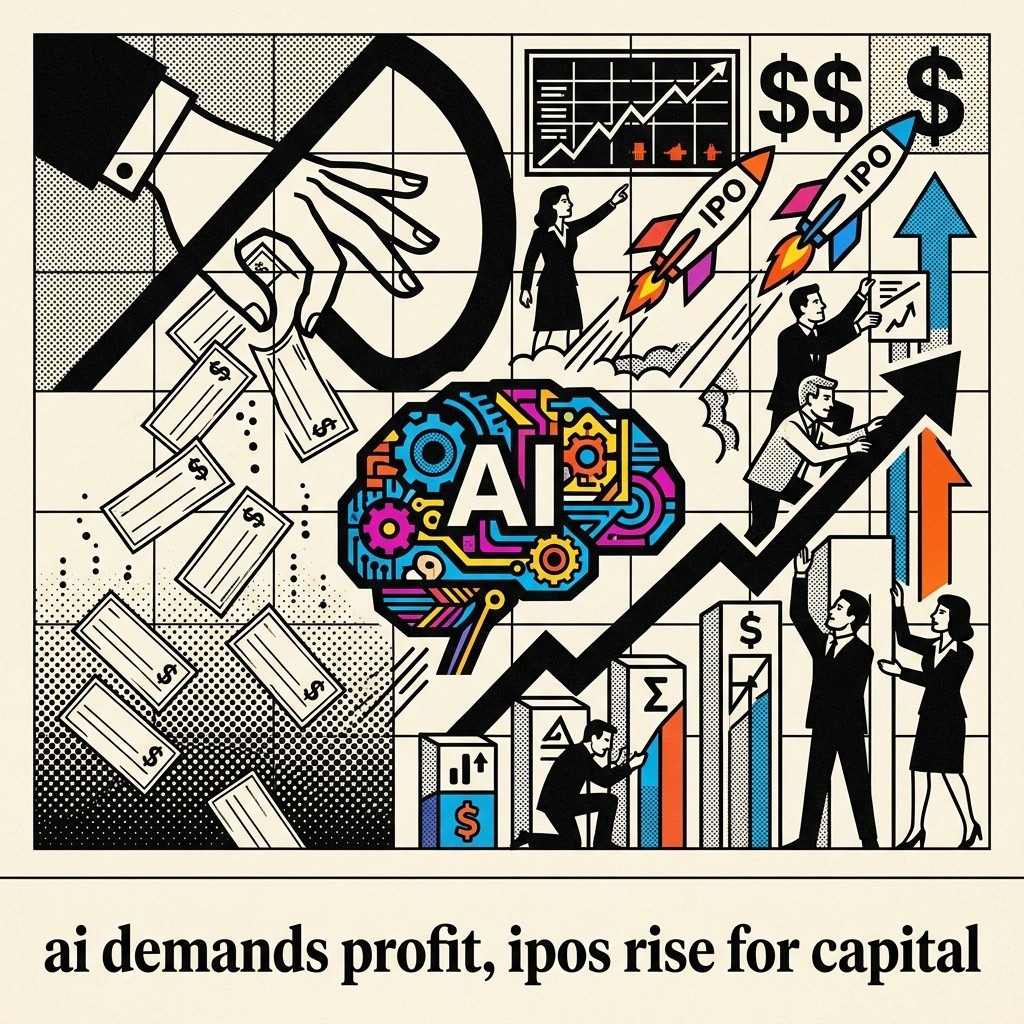
2026-05-08 • Tech’s era of blank checks is ending as AI demands profitability. IPOs rise, and founders must embrace public markets for needed capital.

Morning Intelligence – The Gist

Are we witnessing the end of tech’s blank-check era? As artificial intelligence collides with Wall Street’s gravitational pull, the structural narrative is abruptly shifting from boundless possibility to hard profitability.

Driven by an insatiable need for computing power—and as bond markets continue digesting AI transition risks—infrastructure firms are abandoning private-market opacity for public liquidity. With global IPO proceeds jumping 36% to $40.6 billion last quarter despite lower deal volumes, capital is concentrating at the top. The underlying mechanic is unavoidable: the projected $3 trillion required for data center buildouts by 2030 cannot be sustained by venture capital alone.

To survive this compute arms race, founders must surrender control to public shareholders. As T. Rowe Price’s 2026 market outlook sharply observes, “The age of speculation is giving way to real-world results”.

The Gist AI Editor


Morning Intelligence • Friday, May 08, 2026

The Gist View

Are we witnessing the end of tech’s blank-check era? As artificial intelligence collides with Wall Street’s gravitational pull, the structural narrative is abruptly shifting from boundless possibility to hard profitability.

Driven by an insatiable need for computing power—and as bond markets continue digesting AI transition risks—infrastructure firms are abandoning private-market opacity for public liquidity. With global IPO proceeds jumping 36% to $40.6 billion last quarter despite lower deal volumes, capital is concentrating at the top. The underlying mechanic is unavoidable: the projected $3 trillion required for data center buildouts by 2030 cannot be sustained by venture capital alone.

To survive this compute arms race, founders must surrender control to public shareholders. As T. Rowe Price’s 2026 market outlook sharply observes, “The age of speculation is giving way to real-world results”.

The Gist AI Editor

The Global Overview

Capital flows to AI hardware and mobility

Baidu’s move to dual-list its Kunlunxin AI chip unit in Shanghai and Hong Kong, alongside Go Inc.’s target of a ¥200 billion ($1.3 billion) Tokyo IPO, signals a concerted rush for liquidity. Firms are aggressively capitalizing on semiconductor and automation hype cycles before regulatory friction or valuation cooling sets in. This is a classic “lock-in” maneuver; companies are front-running potential market shifts by converting private tech bets into public cash while investor appetite remains at peak froth.

Institutional hardening in Beijing

The sentencing of former defense ministers—part of the most extensive military purges since the Mao era—reveals a structural realignment of power. By systematically gutting the upper ranks, the state is prioritizing absolute internal loyalty over personnel continuity. This is akin to clearing a machine of debris before increasing the power setting; removing dissent is a prerequisite for executing more decisive, unhindered strategic maneuvers in the near future.

The mechanics of poverty reduction

New data confirms global extreme poverty dropped from 36% in 1990 to 9% in 2015. The non-obvious takeaway: this wasn’t a rising tide lifting all boats, but a sequential “within-cohort” transition. Households didn’t just get lucky; they moved up the ladder as specific demographic windows aligned with structural economic shifts. Systemic poverty reduction is less about broad-spectrum aid and more about timing the developmental phases that allow distinct population segments to climb simultaneously.

Stay tuned for the next Gist—your edge in a shifting world. The Gist remains independent and reader-supported. If you value news free from corporate or state interests, consider supporting our mission with a donation.

The European Perspective

Ceasefire Optics vs. Reality

Moscow’s unilateral ceasefire has effectively collapsed. The interception of 20+ Ukrainian drones over the capital suggests that deterrence, not diplomacy, remains the operative logic. For observers, these tactical pauses are serving as re-calibration windows for both sides rather than meaningful steps toward de-escalation, as both powers optimize their intelligence and defensive posture (ZDF).

The High-Stakes Balancing Act

Trump’s upcoming summit with Beijing regarding business delegation composition underscores a shift in corporate diplomacy. The administration is navigating a narrow “commercial de-risking” path, insulating US firms from political blowback while securing essential access to Chinese capital. It is a precise calculation: separating institutional profit motives from geopolitical friction to maintain market stability (Politico).

The AI Productivity Gambit

German policymakers are promoting AI as the engine to restart economic growth, betting that algorithmic efficiency can bridge systemic labor gaps. The incentive structure is explicit: redirecting capital from legacy friction to digital automation. The critical variable remains the EU’s ability to defend its internal IP framework without curtailing the scalability essential for high-tech competitiveness (ZDF).

Fencing’s Sci-Fi Pivot

In a unique cultural shift, “lightsaber fencing”—a tactical evolution of classical fencing—is formalizing into a serious competitive circuit in Paris. It illustrates how niche, sci-fi-adjacent interests can rapidly morph into structured institutions, capturing the regional imagination where traditional athletics have stagnated (The Guardian).

Catch the next Gist for the continent’s moving pieces.

🎙️ Listen to this edition as a podcast Listen