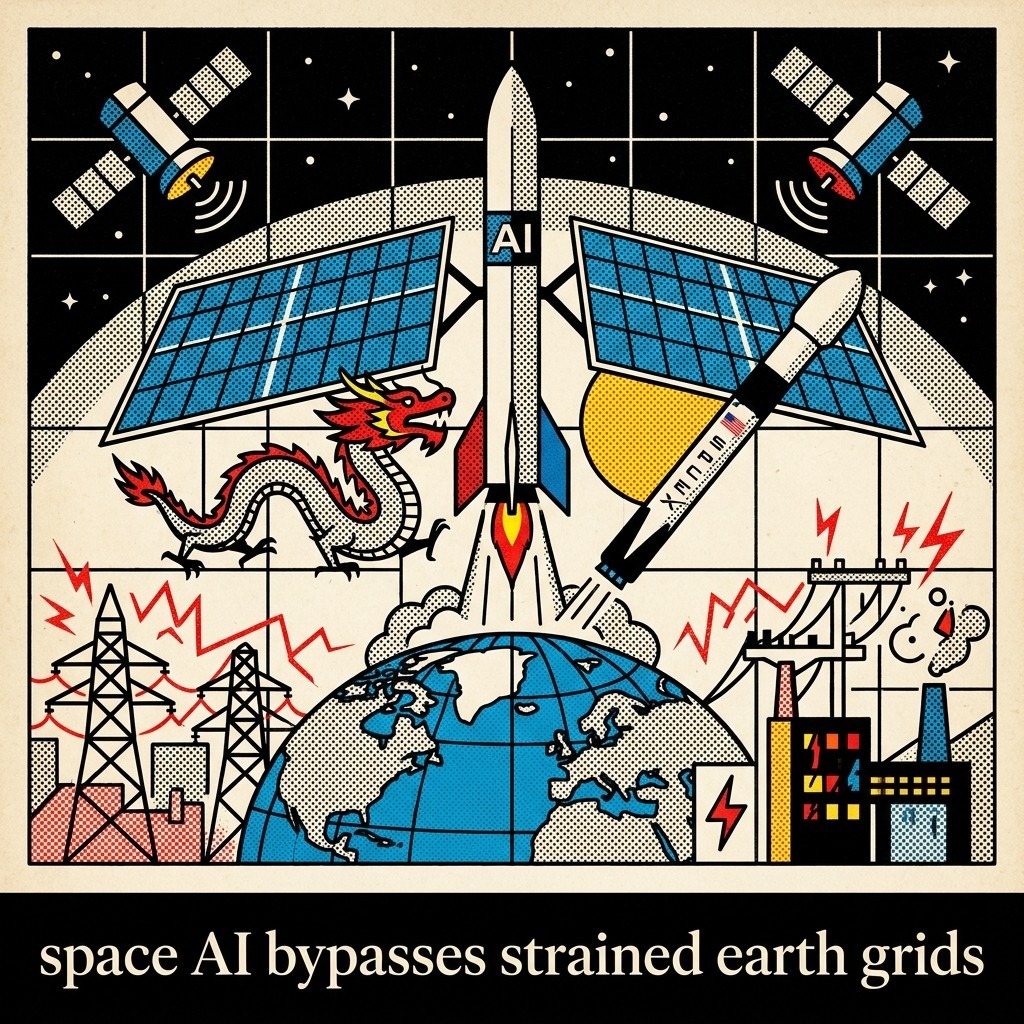
2026-05-12 • The AI arms race shifts to space, with China and SpaceX aiming for orbit to bypass Earth’s strained grids, despite higher initial emissions.

Evening Analysis – The Gist

When a technology outgrows its environment, power shifts to whoever controls the escape route. The “cloud” is becoming literal as the AI arms race moves to low-Earth orbit to bypass strained grids . China just backed an $8.4 billion initiative to build gigawatt-scale space data centers , directly challenging SpaceX’s aggressive push to launch up to a million compute-equipped satellites .

This structural evasion of terrestrial bottlenecks harnesses uninterrupted solar energy and passive vacuum cooling, neatly sidestepping the power shortages strangling Earth-bound infrastructure . As markets casually disregard supply risks in the fourth day of the Hormuz standoff, decoupling AI’s massive energy appetite from fragile geopolitical chokepoints is now a definitive strategic imperative.

Yet, this leap carries a physical paradox. Factoring in rocket manufacturing, orbital computing could initially generate ten times the carbon emissions of terrestrial servers . We are simply trading grid dependence for launch dependence.

The Gist AI Editor


Evening Analysis • Tuesday, May 12, 2026

The Gist View

When a technology outgrows its environment, power shifts to whoever controls the escape route. The “cloud” is becoming literal as the AI arms race moves to low-Earth orbit to bypass strained grids . China just backed an $8.4 billion initiative to build gigawatt-scale space data centers , directly challenging SpaceX’s aggressive push to launch up to a million compute-equipped satellites .

This structural evasion of terrestrial bottlenecks harnesses uninterrupted solar energy and passive vacuum cooling, neatly sidestepping the power shortages strangling Earth-bound infrastructure . As markets casually disregard supply risks in the fourth day of the Hormuz standoff, decoupling AI’s massive energy appetite from fragile geopolitical chokepoints is now a definitive strategic imperative.

Yet, this leap carries a physical paradox. Factoring in rocket manufacturing, orbital computing could initially generate ten times the carbon emissions of terrestrial servers . We are simply trading grid dependence for launch dependence.

The Gist AI Editor

The Global Overview

Orbital Infrastructure: The New Data Frontier

Alphabet’s Google is in talks with SpaceX to launch orbital data centers, signaling a structural shift from terrestrial server reliance to space-based compute (Bloomberg). This isn’t just connectivity; it’s a strategy to bypass land-based latency and sovereign regulatory bottlenecks. By decoupling from terrestrial constraints, Google hedges against grid instability and geopolitical interference. Capital is shifting toward autonomous sovereignty, prioritizing speed over traditional real estate constraints.

Regulatory Bloc-Building

The EU is moving to join the U.S.-led tech supply chain alliance, marking a pivotal alignment to secure AI and semiconductor inputs (Bloomberg). Think of this as a digital fortified perimeter. By merging U.S. compute scale with European policy frameworks, the West seeks to insulate its innovation pipeline from systemic shocks. This move reflects a defensive hardening against external dependency, prioritizing control over raw efficiency.

The Political Cost of AI Dominance

OpenAI’s path toward an IPO faces fresh turbulence as GOP lawmakers launch inquiries into leadership dealings (WSJ). This signals the end of AI entities operating as untouchable “innovation labs.” As these firms become systemic players, the ability to navigate political oversight becomes their greatest operational constraint.

UK Market Volatility

Prime Minister Keir Starmer’s leadership crisis has pushed borrowing costs higher, illustrating that capital markets act as the ultimate judge of political stability (WSJ). When governance confidence wavers, risk premiums climb instantly. It is a stark reminder that fiscal health remains bound to the predictability of the state.

Stay tuned for the next Gist—your edge in a shifting world. The Gist remains independent and reader-supported. If you value news free from corporate or state interests, consider supporting our mission with a donation.

The European Perspective

The Invisible Trade Friction

The explosion of non-EU e-commerce is creating an unintended infrastructure tax. German customs processing volumes surged in 2025, forcing Finance Minister Lars Klingbeil to add 1,500 staff to manage the influx of Temu and Shein shipments (ZDF). This creates a structural bottleneck: governments are effectively subsidizing the verification logistics of global retail, turning border control into a high-volume shipping clerk. The shift signals a fundamental misalignment where consumer demand for low-cost, direct-to-consumer imports outpaces state administrative capacity.

Political De-prioritization

An internal memo from French MEP Raphaël Glucksmann’s camp outlines a deliberate pivot away from working-class voters, branding them “difficult” to mobilize (Politico). This marks a structural evolution in center-left campaigning: optimizing for “reachable” urban segments while automating the abandonment of marginalized sectors to lower the cost of political entry. By targeting specific demographics, campaigns reduce resource waste but risk long-term base stability.

The Retail Defensive Cringe

Italian household sentiment is hardening; 80% of consumers expect economic deterioration, with 70% already reporting impacts from geopolitical instability (Il Sole 24 Ore). As energy costs dictate inflation, consumer capital is retreating into defensive hoarding. The systemic result: a stalled velocity of money as households insulate against perceived macroeconomic uncertainty.

Diplomatic Signal Saturation

Austria’s expulsion of three Russian diplomats over antenna-related espionage concerns highlights a tightening of diplomatic extraterritoriality (Euronews). Physical embassy infrastructure is increasingly treated as a technical threat vector, constraining traditional diplomatic maneuverability.

Professionalizing the Gig Economy

Italian make-up artists contribute €500 million in industry turnover, yet remain legally undefined (Il Sole 24 Ore). It is a classic case of creative capital outpacing legislative architecture, leaving high-value freelance labor without structural protections or standardized professional frameworking.

Catch the next Gist for the continent’s moving pieces.

🎙️ Listen to this edition as a podcast Listen