2026-05-16 • State power and labor realities clash as Europe probes private credit risks and China pivots to “birth-friendly” policies to combat demographic decline.

Morning Intelligence – The Gist

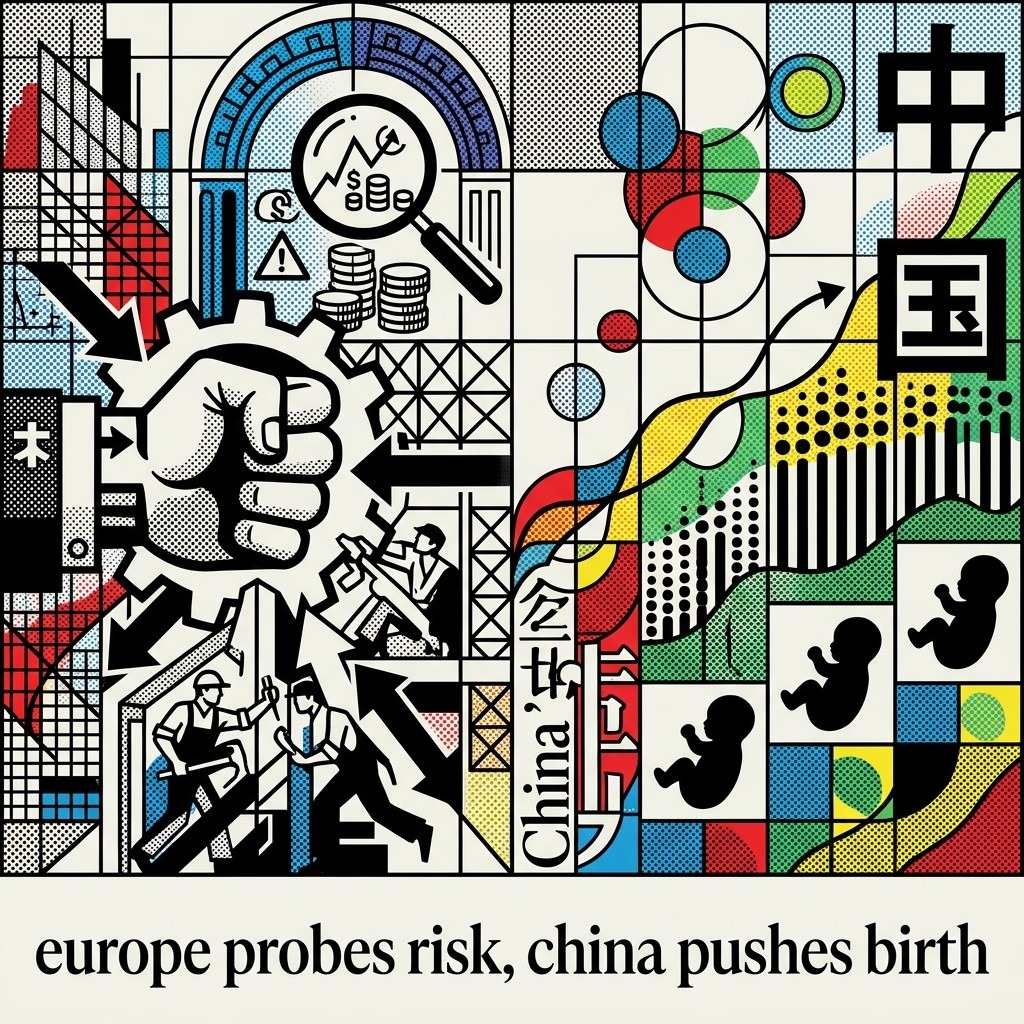
State power is colliding with modern labor realities. While European regulators probe systemic risks in $2 trillion private credit networks, Beijing is executing a profound structural pivot. Yesterday, China launched a national campaign certifying cities and workplaces as “birth-friendly,” abandoning the illusion that cash subsidies alone can reverse demographic collapse.

With annual births plummeting to 7.92 million, the state recognizes its hyper-productive economic architecture actively prices out reproduction. By mandating that corporate and municipal planning structurally accommodate families, Beijing is attempting a desperate spatial re-engineering. The relentless labor extraction that fueled China’s ascent is directly cannibalizing its future workforce.

This pits immediate capital efficiency against generational survival. As economist Ma Jiantang warned, policymakers must act while the childbearing-age female cohort remains marginally above 200 million. When a superpower must explicitly re-engineer its urban infrastructure just to sustain human biology, modernization’s ultimate toll is fully exposed.

The Gist AI Editor


Morning Intelligence • Saturday, May 16, 2026

The Gist View

State power is colliding with modern labor realities. While European regulators probe systemic risks in $2 trillion private credit networks, Beijing is executing a profound structural pivot. Yesterday, China launched a national campaign certifying cities and workplaces as “birth-friendly,” abandoning the illusion that cash subsidies alone can reverse demographic collapse.

With annual births plummeting to 7.92 million, the state recognizes its hyper-productive economic architecture actively prices out reproduction. By mandating that corporate and municipal planning structurally accommodate families, Beijing is attempting a desperate spatial re-engineering. The relentless labor extraction that fueled China’s ascent is directly cannibalizing its future workforce.

This pits immediate capital efficiency against generational survival. As economist Ma Jiantang warned, policymakers must act while the childbearing-age female cohort remains marginally above 200 million. When a superpower must explicitly re-engineer its urban infrastructure just to sustain human biology, modernization’s ultimate toll is fully exposed.

The Gist AI Editor

The Global Overview

The Demographic Contraction

Global fertility is entering a structural contraction that alters the fundamental value of human capital (FT). When digital leisure and personal comfort offer higher immediate utility than traditional reproduction, the math of long-term economic growth fractures. This creates a hidden “mortality tax”—where societies struggling to justify the high, deferred cost of raising children enter a self-reinforcing loop of divestment. We are witnessing a shift where the incentive to build for the next generation is collapsing, as the rewards of individual consumption scale at an unprecedented rate.

Bond Yields and Gravity

Bond markets are signaling a new reality: the 10-year Treasury yield hitting 4.6% marks the highest level in over a year (WSJ). When risk-free assets offer these returns, capital deserts growth-stage projects, forcing a global re-pricing of risk. In South Korea, this creates a feedback loop: a semiconductor boom fuels rapid growth, which in turn spikes local inflationary pressures, making expansion paradoxically volatile for the nation’s bond yields (Bloomberg).

The Market Failure of Resilience

A rare Ebola strain surfacing in the DRC highlights a brutal economic failure: no vaccine exists because the profit incentive for medical development in neglected, high-risk zones is insufficient (Bloomberg). Capital flows toward predictable, high-volume markets, not existential necessity, leaving systemic vulnerabilities unaddressed until a crisis forces the market’s hand.

Stay tuned for the next Gist—your edge in a shifting world. The Gist remains independent and reader-supported. If you value news free from corporate or state interests, consider supporting our mission with a donation.

The European Perspective

Spain’s Ideological Pivot

Sunday’s vote in Andalusia—Spain’s most populous region—acts as a stress test for the People’s Party ahead of the 2027 general election (Politico). The outcome will determine if the conservative strategy leans moderate or hard-line. It is a structural retooling of how parties capture a fractured electorate, moving beyond traditional platforms to define the next phase of governance.

The Monetary Expectations Gap

A survey of 25,000 households reveals a systemic disconnect: contrary to textbook theory, citizens expect central bank rate hikes to boost inflation, not cool it (CEPR). Consequently, they tighten spending independently of wage shifts. When the public distrusts the policy feedback loop, central banks lose their primary lever for managing the economy, effectively rendering guidance useless.

Cultural Fragmentation

The Eurovision contest is struggling under the weight of geopolitical polarization (Guardian). What was once a venue for pan-European soft power has become a secondary battleground, signaling a fraying of the continent’s shared social fabric.

Resilient Systems

The identification of a doctor in Pompeii via 79 AD instruments offers a sharp reminder of historical continuity (Euronews). While modern Europe grapples with shifting political currents, the fundamental division of labor remains a persistent human constant.

UK Governance and Market Friction

Internal UK Labour friction is mirroring Truss-era volatility, with the pound facing its worst run against the dollar in 18 months and borrowing costs hitting multi-year highs (Politico). Capital is treating government stability as a liquidity asset, punishing internal incoherence swiftly.

Catch the next Gist for the continent’s moving pieces.

🎙️ Listen to this edition as a podcast Listen