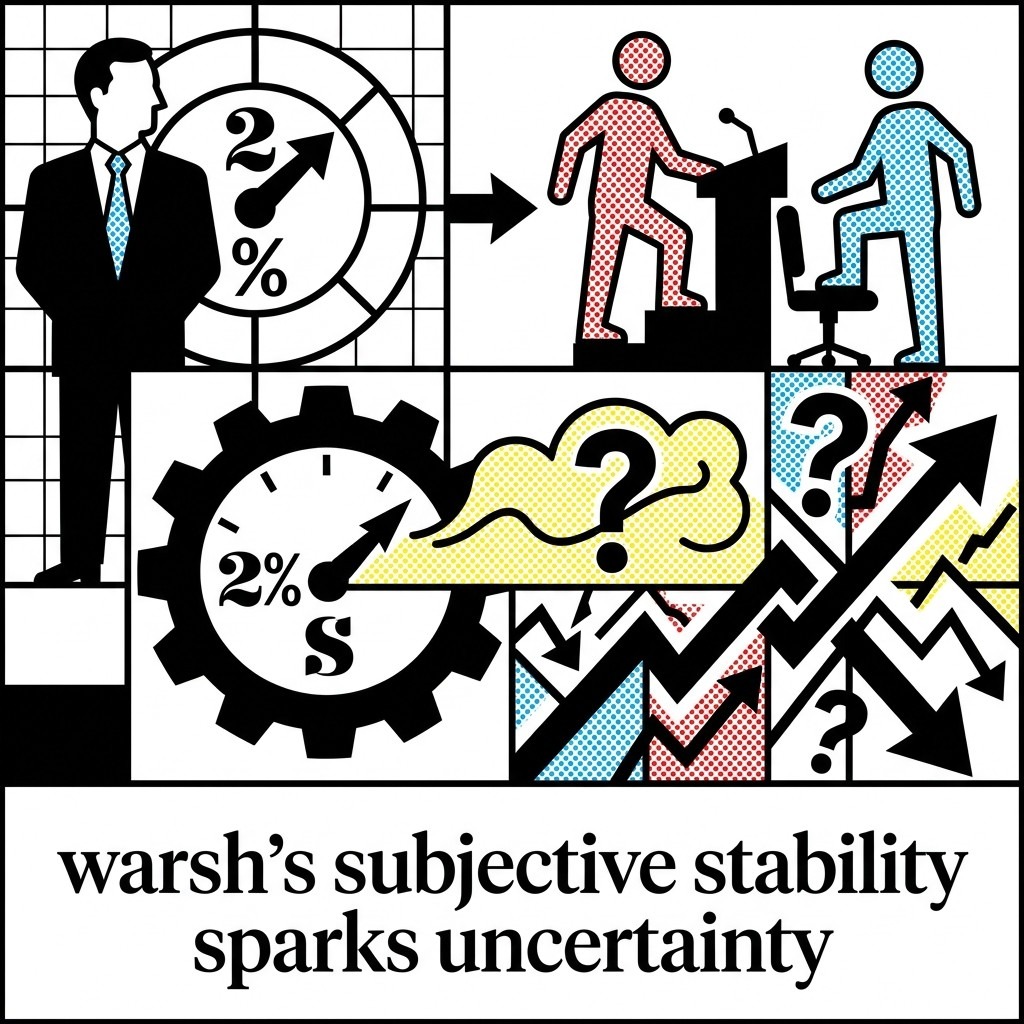
2026-05-15 • Warsh replaces Powell as Fed Chair, aiming to shift from a 2% inflation target to subjective stability, sparking market uncertainty.

Evening Analysis – The Gist

What happens when the global economy’s referee discards the scoreboard? Today marks Jerome Powell’s final day as Federal Reserve Chair, passing the baton to Kevin Warsh amid a sharp Wall Street sell-off. The real structural shock isn’t the personnel change, but Warsh’s intent to dismantle the rigid 2% inflation target for a subjective approach.

Warsh argues true price stability is achieved simply when “no one’s talking about it”. Replacing mathematical benchmarks with behavioral standards fundamentally alters global liquidity. With U.S. annual debt service costs crossing $1 trillion and ongoing Hormuz tensions continuing to squeeze energy markets, capital can no longer rely on the transparent metric-targeting of the Powell era.

The central bank is shifting from managing economic data to managing market perception. As analysts warn, this new subjectivity injects profound uncertainty into capital markets. The global economy must now price in the hidden structural tax of unpredictable monetary policy.

The Gist AI Editor


Evening Analysis • Friday, May 15, 2026

The Gist View

What happens when the global economy’s referee discards the scoreboard? Today marks Jerome Powell’s final day as Federal Reserve Chair, passing the baton to Kevin Warsh amid a sharp Wall Street sell-off. The real structural shock isn’t the personnel change, but Warsh’s intent to dismantle the rigid 2% inflation target for a subjective approach.

Warsh argues true price stability is achieved simply when “no one’s talking about it”. Replacing mathematical benchmarks with behavioral standards fundamentally alters global liquidity. With U.S. annual debt service costs crossing $1 trillion and ongoing Hormuz tensions continuing to squeeze energy markets, capital can no longer rely on the transparent metric-targeting of the Powell era.

The central bank is shifting from managing economic data to managing market perception. As analysts warn, this new subjectivity injects profound uncertainty into capital markets. The global economy must now price in the hidden structural tax of unpredictable monetary policy.

The Gist AI Editor

The Global Overview

Treasury Liquidity Strains

Global yields are surging, testing the Treasury futures market—the primary plumbing for hedging U.S. debt. When yields spike, the cost of maintaining these hedges becomes prohibitive, forcing sudden, massive shifts in trader positions (Bloomberg). Think of this like a crowded fire exit: the system works fine until everyone tries to exit at once, creating a bottleneck that amplifies market instability and volatility.

The Apple-OpenAI Fracture

Apple’s partnership with OpenAI is fraying, with potential legal action looming (Bloomberg). This reveals a core structural shift: in AI, platform control now trumps data access. For Apple, the deal was merely an integration experiment; for OpenAI, it was a failed distribution bet. Capital is increasingly migrating toward firms that control the user interface rather than those simply providing underlying models.

Dexcom’s Metabolic Pivot

Dexcom is expanding its continuous glucose monitors beyond diabetes into the mainstream wellness market (Bloomberg). By hitching its hardware wagon to the GLP-1 drug boom, Dexcom is transforming a medical device into a consumer commodity, securing recurring revenue by riding the incentives of current high-growth pharmaceutical trends.

Boeing’s Diplomatic Bargaining

Boeing shares slid as outcomes from President Trump’s China summit prioritized agriculture and energy purchases over aerospace deals (FT). It’s a sharp reminder that in high-stakes trade diplomacy, massive industrial manufacturers are often treated as bargaining chips, not the primary beneficiaries of political alignment.

Stay tuned for the next Gist—your edge in a shifting world. The Gist remains independent and reader-supported. If you value news free from corporate or state interests, consider supporting our mission with a donation.

The European Perspective

Hybrid Borders and the New Normal

In Helsinki, a drone incursion is serving as a high-stakes stress test for defensive posturing. President Stubb’s insistence that Finland faces “no direct military threat” is a calculated attempt to maintain economic normalcy and prevent capital flight from Nordic markets. The structural reality is a shift toward a perpetual state of “grey-zone” vigilance, where hardware scarcity and surveillance integration are becoming mandatory operational costs for border states rather than tactical anomalies (Politico).

The High-Stakes Trade-Off

President Trump’s summit with President Xi in Beijing is attempting to anchor global market stability by leveraging the Iran-Hormuz crisis to realign trade priorities. The system is currently pricing in extreme volatility, and the pressure is filtering down to the regional level: the Philippines, which imports 98% of its oil from the Gulf, is facing acute fuel shortages. With 20% of global oil transiting Hormuz and 60% of global trade navigating the South China Sea, the incentive for Beijing to mediate the Iran conflict—in exchange for trade concessions—is immense. Capital is watching for a clear off-ramp, as current market pricing assumes a prolonged supply constraint that threatens to trigger regional recessions if the “Trump-Xi” axis fails to reset the supply chain risk premium (Chatham House).

Pricing the Green Transition

ITA Airways is shifting its pricing models to integrate “green fares,” adopting Lufthansa’s policy to offset carbon emissions. This is an elegant transfer of regulatory compliance risk: by embedding emissions-reduction costs directly into ticket pricing, the firm immunizes its margins against inevitable future environmental taxation, effectively forcing the consumer to subsidize the corporate sustainability transition (Il Sole 24 Ore).

Institutionalizing Sovereignty Costs

Germany and 36 other nations have formalized the path toward a special tribunal for Ukraine. This marks a structural evolution in global geopolitical accountability, moving from temporary, reactive sanctions to fixed, long-term legal architecture. For international markets, this creates a permanent compliance layer and a clear, enduring cost structure for any future interaction with state actors violating established sovereignty norms (ZDF).

The Trento Networking Pulse

As the Festival of Economics opens in Trento, the gathering of 20 ministers and global elites serves as the definitive seasonal ritual for political-economic consolidation. It functions as the physical marketplace where policy alignment is finalized, providing a clear window into the continent’s legislative priorities for the coming quarter (Il Sole 24 Ore).

Catch the next Gist for the continent’s moving pieces.

🎙️ Listen to this edition as a podcast Listen