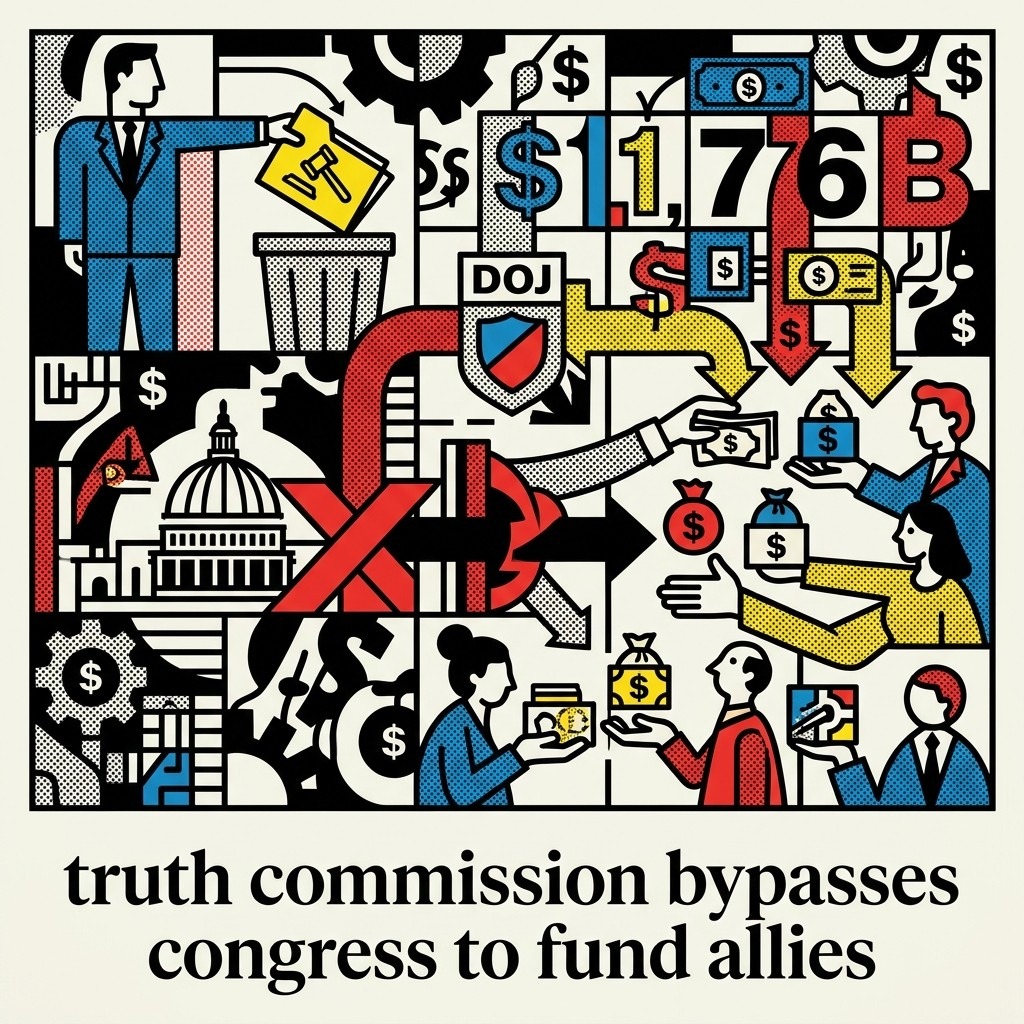
2026-05-17 • Trump drops IRS lawsuit for a $1.776B DOJ “Truth and Justice Commission,” bypassing Congress to fund allies, highlighting governance monetization.

Morning Intelligence – The Gist

What is the market price for institutional retribution? Exactly $1.776 billion. President Trump is dropping an IRS lawsuit in exchange for a DOJ-created “Truth and Justice Commission”—a taxpayer pool compensating political allies who claim the previous administration targeted them.

This executes a profound mutation in governance. By leveraging an intra-branch legal settlement, the administration bypasses congressional appropriations entirely. It converts the justice apparatus into a formalized patronage network, cloaking a massive transfer of public capital in the performative, nationalist branding of 1776.

These mechanics pioneer a novel executive loophole. By invoking the “rule of necessity” to sue his own agencies, Trump exposes a stark structural reality: the state’s architecture is no longer merely politically influenced—it is explicitly monetized to underwrite ideological loyalty.

The Gist AI Editor


Morning Intelligence • Sunday, May 17, 2026

The Gist View

What is the market price for institutional retribution? Exactly $1.776 billion. President Trump is dropping an IRS lawsuit in exchange for a DOJ-created “Truth and Justice Commission”—a taxpayer pool compensating political allies who claim the previous administration targeted them.

This executes a profound mutation in governance. By leveraging an intra-branch legal settlement, the administration bypasses congressional appropriations entirely. It converts the justice apparatus into a formalized patronage network, cloaking a massive transfer of public capital in the performative, nationalist branding of 1776.

These mechanics pioneer a novel executive loophole. By invoking the “rule of necessity” to sue his own agencies, Trump exposes a stark structural reality: the state’s architecture is no longer merely politically influenced—it is explicitly monetized to underwrite ideological loyalty.

The Gist AI Editor

The Global Overview

The Trump Consolidation

President Donald Trump and Health Secretary Robert F. Kennedy Jr.’s success in unseating Senator Bill Cassidy signals the total consolidation of the GOP apparatus. By effectively purging internal dissent, the administration isn’t just securing electoral wins; it is hardening the party against institutional fragmentation. This structural shift ensures that executive loyalty supersedes traditional conservative policy orthodoxies, allowing the White House to execute its agenda without the friction of internal legislative resistance.

The Gamification of Geopolitics

Regulators are now targeting prediction markets like Kalshi and Polymarket, probing wagers on military and political events (WSJ). When private capital begins pricing real-time conflict outcomes, it creates a “shadow” intelligence network that often outpaces state analysis. The non-obvious angle: authorities fear losing the monopoly on truth. When citizens can bet on geopolitical outcomes, they stop waiting for official state assessments, eroding the government’s ability to shape public sentiment during volatile transitions.

Institutional Capital’s Pivot

Bain Capital just closed a $10.5 billion Asia fund, securing $2.1 billion more than targeted (FT). This highlights a massive reallocation of institutional capital toward Asian markets, betting that regional growth remains a safer hedge than the tightening regulatory capture found in Western economies. Smart money is effectively voting against domestic stagnation, moving where industrial policy aligns with fiscal incentive.

The Hidden Toll

The current oil shock is forcing a $45 billion rupture in the global economy (WSJ). This functions as an involuntary transfer of wealth from consumer discretionary spending to energy producers. It acts as a systemic brake, where growth in the broader market is essentially taxed to sustain commodity margins.

Stay tuned for the next Gist—your edge in a shifting world. The Gist remains independent and reader-supported. If you value news free from corporate or state interests, consider supporting our mission with a donation.

The European Perspective

UK Leadership Volatility

The UK’s political center is rapidly hollowing out. Following the electoral breakthrough of Reform UK, former Health Minister Wes Streeting’s direct challenge to PM Keir Starmer signals a deeper revolt within the Labour ranks (ZDF). This dual-front pressure—populist gains on the periphery and internecine strife at the center—suggests the traditional binary political model is fracturing. Markets must now account for higher policy unpredictability in London as institutional cohesion decays.

Eurovision’s Geopolitical Friction

Vienna’s staging of the 70th Eurovision Song Contest confirmed that cultural platforms are increasingly battlegrounds for geopolitical signaling. Bulgaria’s victory with 516 points (Politico) avoided the anticipated diplomatic gridlock surrounding Israel, yet the event was defined by widespread boycotts rather than artistic merit. This serves as a bellwether for European fragmentation; soft-power institutions are now primary sites for airing systemic grievances, signaling a structural shift where neutral cultural ground effectively no longer exists.

Consolidation of Media Gatekeepers

The acquisition of an 80% stake in Editoriale Nazionale by Lmdv (Il Sole 24 Ore) marks a significant tightening of the Italian media landscape. Such consolidation concentrates influence over narrative curation, raising structural concerns regarding institutional integrity. As media ecosystems shrink, incentives for editorial alignment with state or commercial interests strengthen, reducing the space for non-obvious, independent critique.

Catch the next Gist for the continent’s moving pieces.

🎙️ Listen to this edition as a podcast Listen