2026-05-18 • The Trump-Xi summit shifts from decoupling to managed pragmatism, highlighting systemic tensions and strategic tech containment amid supply chain realities.

Morning Intelligence – The Gist

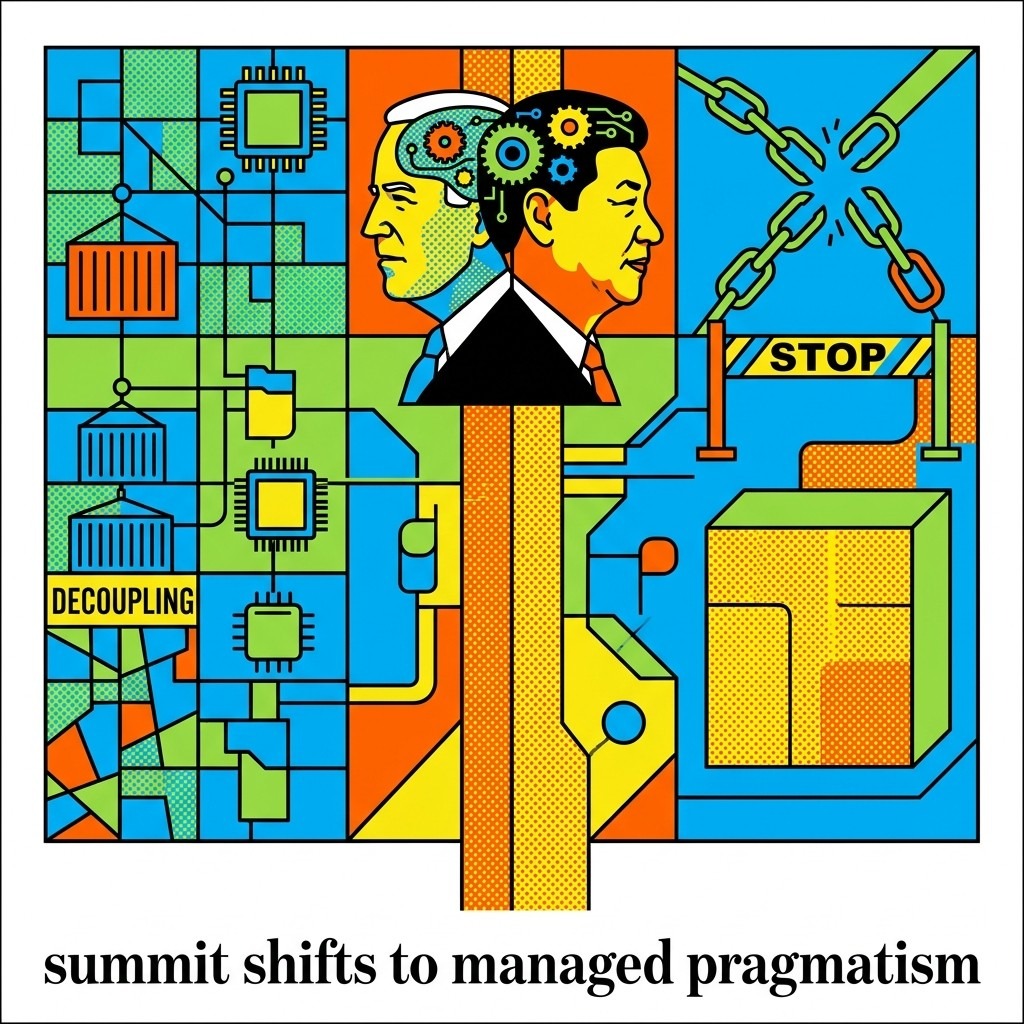
What happens when the dream of total decoupling hits the bedrock of supply chain reality? Building on recent tech diplomacy that has shifted European geopolitical alignments, the weekend Trump-Xi summit in Beijing yielded new bilateral trade councils , signaling a pivot from scorched-earth separation to a highly managed, protectionist pragmatism .

Despite the commercial theater of $17 billion in agricultural purchases and 200 Boeing jets , systemic tensions remain intact. Washington is actively structuring tiered countermeasures against Chinese clean energy overcapacity , while global supply chain diversification merely routes Chinese manufacturing through proxy hubs in Southeast Asia, masking structural dependency rather than eliminating it .

This isn’t a peace treaty; it’s a containment grid. With corporate titans acting as diplomatic shields, the new geopolitical order prioritizes “securing high-profile, transactional victories” over ideological warfare—ensuring strategic tech bottlenecks remain fiercely guarded while essential global commerce continues to flow.

The Gist AI Editor


Morning Intelligence • Monday, May 18, 2026

The Gist View

What happens when the dream of total decoupling hits the bedrock of supply chain reality? Building on recent tech diplomacy that has shifted European geopolitical alignments, the weekend Trump-Xi summit in Beijing yielded new bilateral trade councils , signaling a pivot from scorched-earth separation to a highly managed, protectionist pragmatism .

Despite the commercial theater of $17 billion in agricultural purchases and 200 Boeing jets , systemic tensions remain intact. Washington is actively structuring tiered countermeasures against Chinese clean energy overcapacity , while global supply chain diversification merely routes Chinese manufacturing through proxy hubs in Southeast Asia, masking structural dependency rather than eliminating it .

This isn’t a peace treaty; it’s a containment grid. With corporate titans acting as diplomatic shields, the new geopolitical order prioritizes “securing high-profile, transactional victories” over ideological warfare—ensuring strategic tech bottlenecks remain fiercely guarded while essential global commerce continues to flow.

The Gist AI Editor

The Global Overview

China’s Economic Stall

China’s activity data reveals a slowdown across consumption, real estate, and investment (WSJ). Export strength can no longer carry the structural load. As internal demand cools, the system faces a bottleneck: over-reliance on external sales. This decoupling forces capital to seek yield elsewhere, accelerating global supply chain diversification.

Strategic Tech Hubs

Zelostech’s pivot to Singapore and the Middle East for autonomous driving expansion highlights a shift in tech capital flows (Bloomberg). Positioning as a neutral node between geopolitical blocs, the company leverages regional openness to bypass regulatory frictions. This treats sovereignty as an asset, funneling investment into markets that prioritize rapid infrastructure scaling over ideological alignment.

Arctic Resource Logistics

Commercial flows from the Pikka discovery in Alaska signal a shift in North American resource logistics (Bloomberg). By activating dormant Arctic reserves, firms are betting on sustained demand that outweighs the high upfront costs of polar extraction. This reduces dependence on volatile transit routes, shifting the risk premium to predictable jurisdictions.

Japan’s Currency Policy

The Yen remains under pressure as Prime Minister Sanae Takaichi signals reluctance to hike rates, preferring the stimulus of a weak currency for exports (WSJ). This prioritizes short-term benefits for manufacturers over the risk of capital flight, signaling a bet that global demand will absorb the pricing gap.

Stay tuned for the next Gist—your edge in a shifting world. The Gist remains independent and reader-supported. If you value news free from corporate or state interests, consider supporting our mission with a donation.

The European Perspective

The Structural Pivot from Beijing

The European Commission is formalizing a harder stance against Chinese dependency (Politico). Brussels is increasingly targeting raw material exposure, recognizing that industrial decline is tethered to subsidized import saturation. This is a systemic attempt to “de-risk” supply chains, treating economic sovereignty as a fundamental prerequisite for industrial survival rather than a negotiable policy preference.

Transatlantic Tariff Calibration

President Trump’s re-imposition of tariffs on EU automobiles, hiking rates from 15% to 25%, mandates a swift reassessment of European trade elasticity (Politico). The incentive is clear: leverage dictates terms. As economic modeling confirms, transitory tariffs generate persistent inflation and output losses, forcing European capitals to pivot toward localized production resilience rather than relying on historical trade access (CEPR).

The Hormuz Risk Premium

As tensions in the Strait of Hormuz mount, the G7 is recalculating its dependency on critical sea-lane logistics (ZDF). The focus is shifting from immediate conflict management to structural supply chain hardening; capital is actively seeking diversified energy sourcing to bypass vulnerable maritime chokepoints.

Recalibrating the Urban Asset

Barcelona is pushing back against mass tourism, appointing a commissioner to reclaim city infrastructure (Guardian). With 26 million visitors last year—a 2.4% increase—the city is reclassifying tourism from a growth engine to an infrastructural burden.

Catch the next Gist for the continent’s moving pieces.

🎙️ Listen to this edition as a podcast Listen