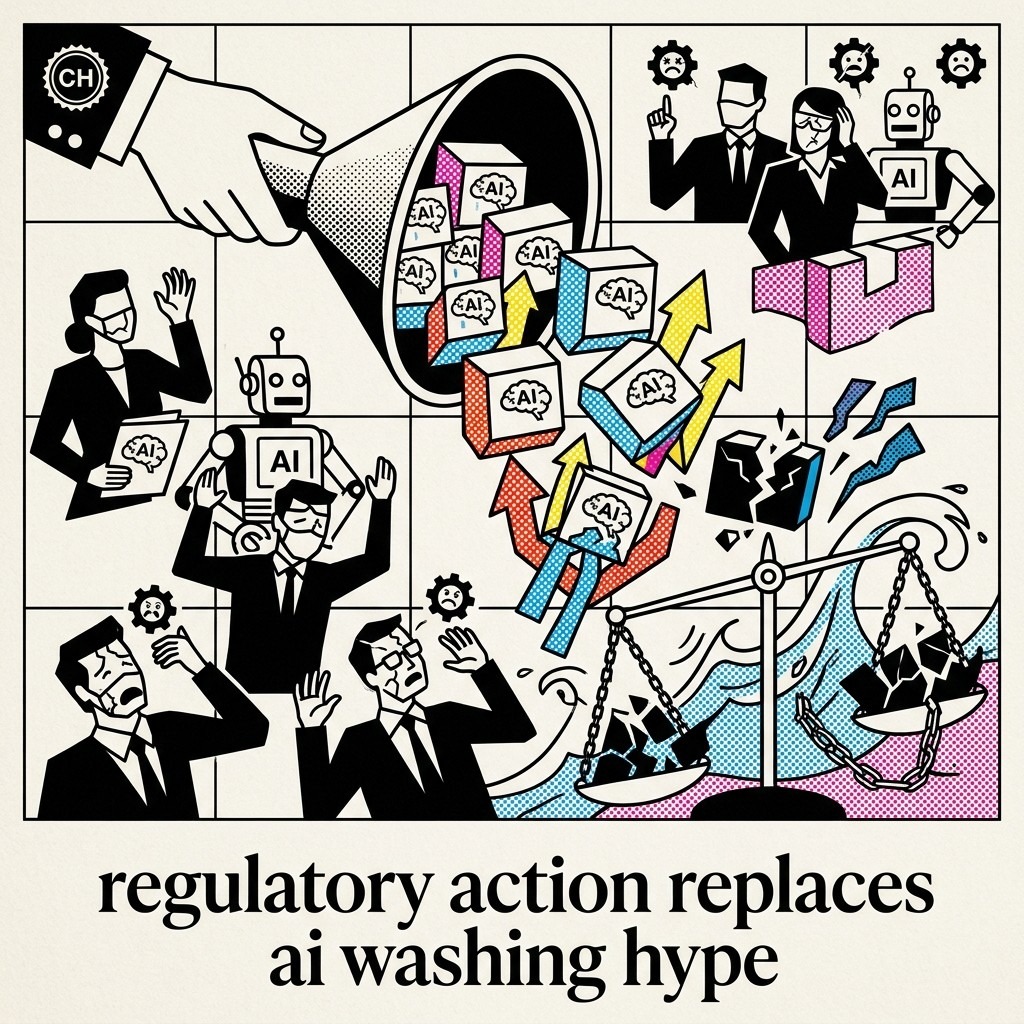
2026-05-19 • The tech sector’s biggest risk is “AI washing,” with regulatory and legal repercussions replacing hype, leading to market volatility and liability shifts.

Morning Intelligence – The Gist

Why is the tech sector’s greatest systemic risk not rogue superintelligence, but the mundane legal trap of “AI washing”?

We are witnessing a structural pivot from hype to liability. Labeling a product “AI” once guaranteed a valuation premium; today, it invites a subpoena. The SEC is actively penalizing algorithmic mismarketing, while the EU’s AI Act weaponizes fines of up to 7% of global revenue for misrepresenting capabilities. This forces a brutal repricing of tech assets, compounding market volatility as ongoing US-China tech diplomacy continues to shift global alliances. Crucially, as companies deploy autonomous agents that inevitably err, courts are shifting the liability burden away from software developers and directly onto deploying organizations.

The era of consequence-free tech marketing is dead. The widening gap between algorithmic claims and operational reality has transitioned into “a tangible risk, with regulatory, legal, financial and reputational consequences”.

The Gist AI Editor


Morning Intelligence • Tuesday, May 19, 2026

The Gist View

Why is the tech sector’s greatest systemic risk not rogue superintelligence, but the mundane legal trap of “AI washing”?

We are witnessing a structural pivot from hype to liability. Labeling a product “AI” once guaranteed a valuation premium; today, it invites a subpoena. The SEC is actively penalizing algorithmic mismarketing, while the EU’s AI Act weaponizes fines of up to 7% of global revenue for misrepresenting capabilities. This forces a brutal repricing of tech assets, compounding market volatility as ongoing US-China tech diplomacy continues to shift global alliances. Crucially, as companies deploy autonomous agents that inevitably err, courts are shifting the liability burden away from software developers and directly onto deploying organizations.

The era of consequence-free tech marketing is dead. The widening gap between algorithmic claims and operational reality has transitioned into “a tangible risk, with regulatory, legal, financial and reputational consequences”.

The Gist AI Editor

The Global Overview

The Geopolitical Pause

President Trump’s decision to halt military strikes against Iran, following appeals from Persian Gulf allies, exposes the widening gap between US military projection and regional diplomatic priorities (Bloomberg). While global markets often price in immediate escalation, the reliance on regional intermediaries—who are effectively hedging against conflict to preserve trade continuity—remains a critical structural bottleneck. This deferral offers a temporary reprieve for supply chains but underscores an emerging reality: US military leverage is increasingly tethered to the diplomatic appetite of local partners, who are now prioritizing market stability over punitive geopolitical signaling.

Capital Reallocation in China

Foreign capital flows into China resumed in April, reversing the volatility triggered by March’s conflict-related outflows (Bloomberg). This shift suggests that institutional investors are recalibrating their risk appetite, viewing the Chinese market through the lens of economic relative value rather than ideological friction. As the Yuan appreciates, China is leveraging this liquidity to stabilize its industrial base, proving that even amidst regional tension, capital follows the path of least resistance.

The AI Healthcare Industrial Shift

Boston Children’s Hospital’s leadership has framed AI adoption as an “industrial revolution,” marking a transition from experimental pilot programs to deep infrastructure integration (Bloomberg). The systemic incentive is clear: institutions are weaponizing AI to solve the productivity stagnation plaguing clinical diagnostics. By automating complex, data-heavy workflows, health systems are effectively decoupling provider capacity from labor scarcity, creating a scalable model that will redefine high-value operational efficiency for the next decade.

The Oil Risk Premium Adjustment

Brent crude prices slipped in early trading as markets reassessed supply-disruption threats (WSJ). This pullback is a mechanical unwinding of the “fear premium” injected by recent regional instability. As traders lower the probability of kinetic conflict in the Middle East, the rapid repricing confirms that global energy markets remain the most sensitive bellwether for institutional trust in current deterrence strategies.

Stay tuned for the next Gist—your edge in a shifting world. The Gist remains independent and reader-supported. If you value news free from corporate or state interests, consider supporting our mission with a donation.

The European Perspective

The Contagion-Capital Friction

Global connectivity is colliding with bio-security reality. The U.S. has instituted 30-day travel restrictions on non-passport holders from Ebola outbreak zones (Politico). For international industry, this is not just a health protocol—it is a structural tax on labor mobility and supply chain agility. It signals a return to hardening border regimes, forcing multinational firms to choose between decentralized local production or exposure to sudden, policy-driven shutdowns.

The Sino-Russian Economic Gravitation

Moscow and Beijing are finalizing a fundamental redirection of Russian logistics. Border hubs like Suifenhe are pivoting from agriculture to sanction-proof automotive transit, turning stagnant regions into vital capillaries for the Russian war economy (Guardian). The structural reality is clear: Russia has transitioned into a junior partner, tethering its output to China’s supply chains. This shift effectively bypasses traditional Western credit and capital markets, creating a closed-loop trade ecosystem that mitigates the impact of isolation.

The Tail-Risk Paralysis

A critical shift in German capital: firms are slashing investment not due to standard uncertainty, but because of “macroeconomic tail risk” (CEPR). Companies are paralyzed by low-probability, high-impact disasters. Until fiscal policy offers rule-based stability, capital will remain trapped in risk-off positions, regardless of baseline growth indicators.

Belfast’s Industrial Bet

Northern Ireland is bucking the regional trend. The Belfast Harbour operator plans a £1.3 billion investment over 25 years to scale quays and offshore wind facilities (Guardian). It is a calculated move to harvest value from local growth, utilizing physical infrastructure as a hedge against broader continental stagnation.

Catch the next Gist for the continent’s moving pieces.

🎙️ Listen to this edition as a podcast Listen