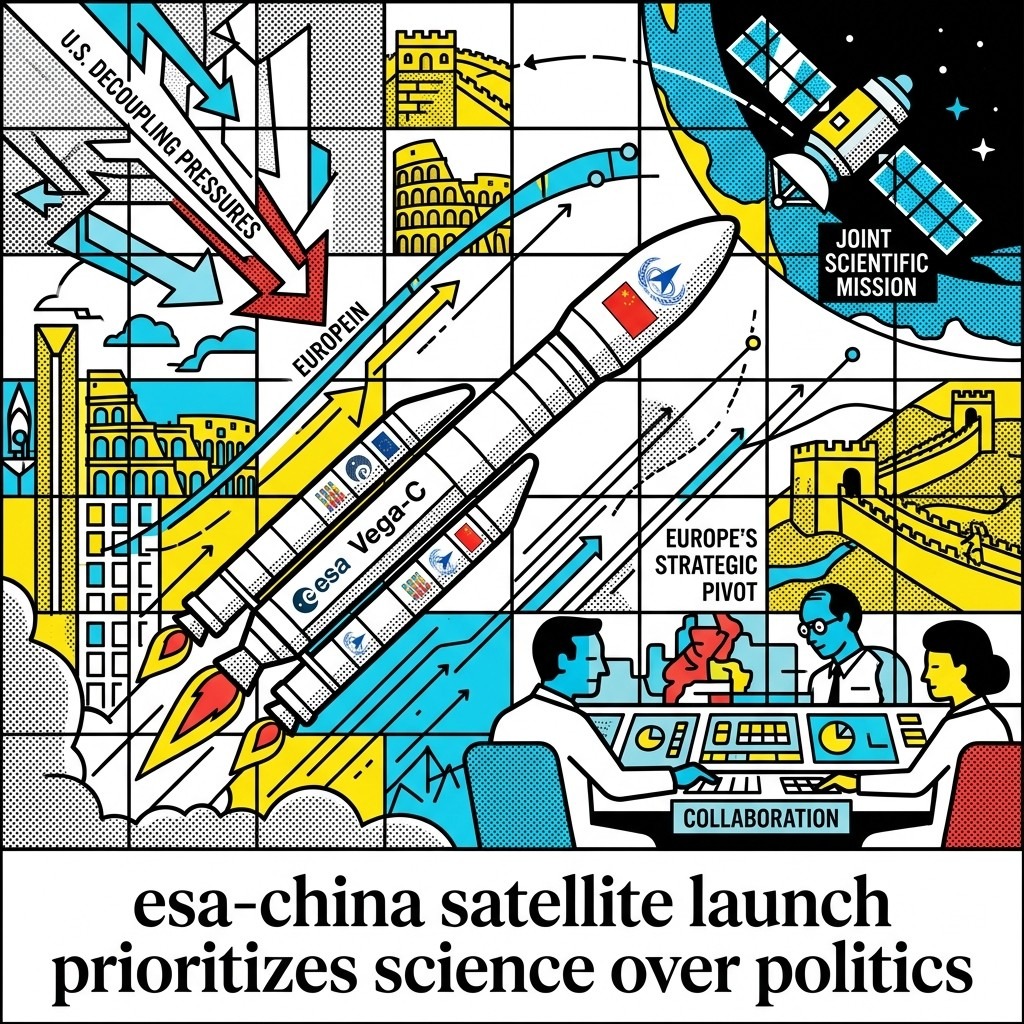
2026-05-19 • Joint ESA-China satellite launch on Vega-C signals Europe’s strategic pivot, prioritizing scientific collaboration over U.S. decoupling pressures.

Evening Analysis – The Gist

Building on the orbital resource race, today’s sharpest geopolitical maneuver happened atop a European Vega-C rocket. The SMILE satellite’s launch—an unprecedented joint mission between ESA and the Chinese Academy of Sciences—signals a profound fracture in Western technological strategy.

While Washington isolates its aerospace sector behind the Artemis Accords, Europe systematically hedges its bets. Co-developing solar wind mapping infrastructure proves scientific alignment can bypass terrestrial decoupling. This guarantees Europe retains access to ascending Chinese aerospace capital despite U.S. pressure.

Orbital pragmatism now overrides ideological divides. As Wang Chi, the mission’s Chinese lead, noted regarding their leap to global observation: “Previously, we could only see the trees, not the forest”—a technical reality mirroring Europe’s macro-strategic recalibration.

The Gist AI Editor


Evening Analysis • Tuesday, May 19, 2026

The Gist View

Building on the orbital resource race, today’s sharpest geopolitical maneuver happened atop a European Vega-C rocket. The SMILE satellite’s launch—an unprecedented joint mission between ESA and the Chinese Academy of Sciences—signals a profound fracture in Western technological strategy.

While Washington isolates its aerospace sector behind the Artemis Accords, Europe systematically hedges its bets. Co-developing solar wind mapping infrastructure proves scientific alignment can bypass terrestrial decoupling. This guarantees Europe retains access to ascending Chinese aerospace capital despite U.S. pressure.

Orbital pragmatism now overrides ideological divides. As Wang Chi, the mission’s Chinese lead, noted regarding their leap to global observation: “Previously, we could only see the trees, not the forest”—a technical reality mirroring Europe’s macro-strategic recalibration.

The Gist AI Editor

The Global Overview

The Orbital Wealth Effect

SpaceX’s trajectory toward an IPO is transforming the Texas border economy, signaling that space infrastructure is now a primary engine for regional capital accumulation (Bloomberg). Beyond the company’s valuation, this shift suggests that “space-adjacent” real estate and labor markets are decoupling from traditional industrial cycles. Investors are betting that satellite-dependent infrastructure—not legacy manufacturing—is the new, defensible bedrock of global trade.

The Yield-Curve Gravity

Gold prices are retreating as the US Dollar firms, revealing market anxiety over interest rates remaining elevated due to stubborn, energy-driven inflation (WSJ, Bloomberg). Think of this as a liquidity trap: when energy costs stay high, central banks hold borrowing costs tight to dampen demand. Investors are currently fleeing physical hedges like gold to park capital in the Dollar, which offers both relative safety and yield. This underscores a brutal incentive: energy shocks force capital out of tangible assets and back into the US financial plumbing.

The Algorithmic Pulitzer

An AI-generated story winning a literary prize marks a quiet, structural decoupling of cultural authority from human cognition (Marginal Revolution). When “craft” becomes a commodity, the incentive for labor shifts from creation to curation. We are no longer rewarding the effort of production, but the ability to prompt the machine for the optimal output.

Stay tuned for the next Gist—your edge in a shifting world. The Gist remains independent and reader-supported. If you value news free from corporate or state interests, consider supporting our mission with a donation.

The European Perspective

Orbital Pragmatism

While terrestrial diplomacy remains frozen, the European Space Agency and China are bypassing geopolitical gridlock via orbital data sharing. Their new joint SMILE mission to map the Earth’s magnetosphere represents a calculated, high-stakes alignment (Euronews). By pooling deep-space tracking infrastructure, both powers are prioritizing scientific utility over policy friction. This signals a structural shift: in the emerging space economy, strategic necessity is creating a rare, neutral zone for high-tech cooperation that defies current diplomatic cooling.

The Moscow-Beijing Asymmetry

President Putin’s latest delegation to Beijing—featuring eight ministers and the heads of massive state-owned energy conglomerates—cements a stark structural change in the Kremlin’s resource alignment (ZDF). This maneuver confirms that Russia’s economy is now effectively tethered to China’s orbit. For global observers, the leverage has fully inverted: Moscow is no longer a peer actor but a junior partner in a bilateral supply chain. The tangible benefit accrues to Beijing, which secures reliable, long-term energy pricing, while Russia accepts permanent systemic dependency to maintain its state liquidity.

Health Infrastructure Stress

As regional authorities bolster monitoring protocols, confirmed Ebola-related fatalities in Central Africa have surged by 30% in just 24 hours (Politico). The rapid escalation underscores the ongoing fragility of cross-border surveillance, forcing European transit hubs to re-evaluate contagion response measures to prevent potential disruptions to labor mobility.

Catch the next Gist for the continent’s moving pieces.

🎙️ Listen to this edition as a podcast Listen