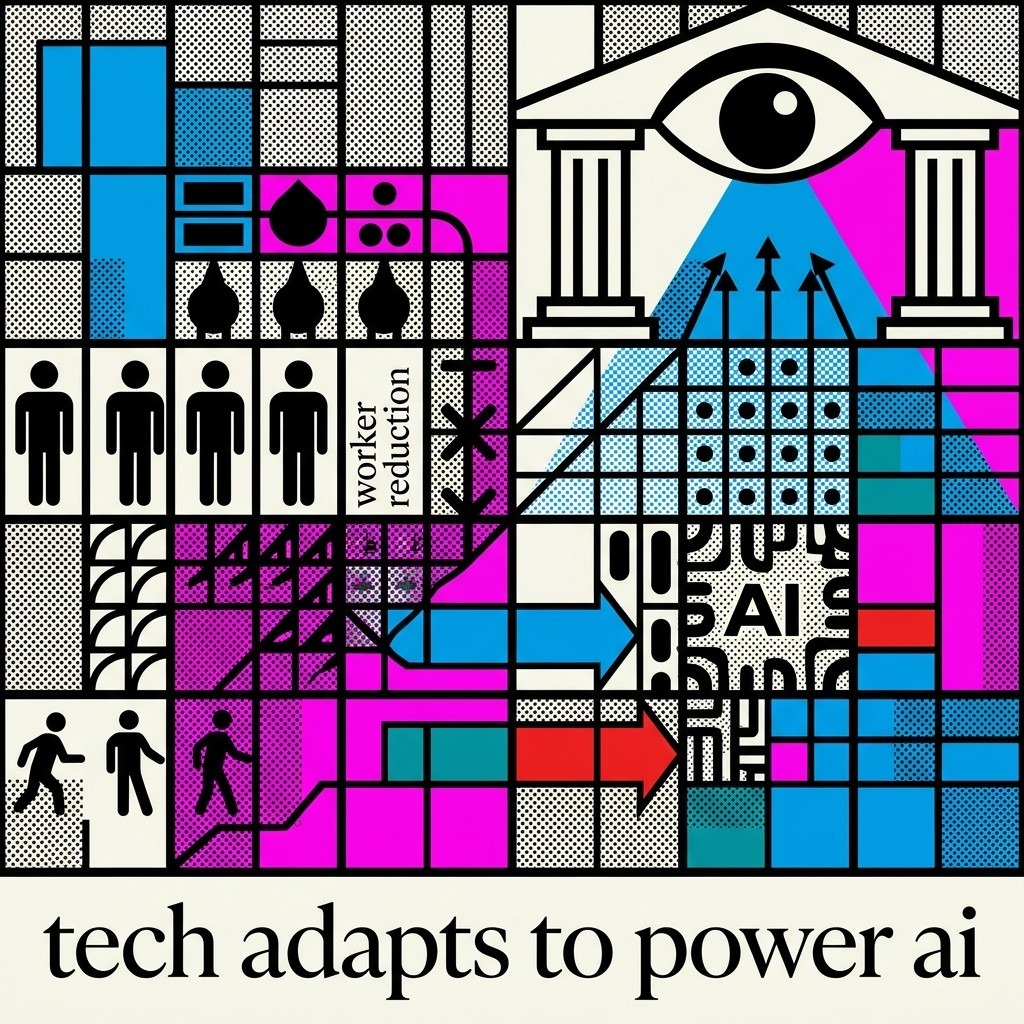
2026-05-21 • The tech sector is shifting, with Meta cutting 10% of its workforce to fund AI. AI’s role in national security prompts government oversight.

Morning Intelligence – The Gist

We are witnessing the structural cannibalization of the tech sector. Building on ongoing concerns over the sustainability of AI investments, Meta just axed 8,000 employees—10% of its workforce—despite posting record revenues. This brute-force capital reallocation liquidates human labor to fund artificial intelligence, feeding corporate workforces into silicon compute furnaces to build an infrastructure oligopoly.

This shift invites immediate sovereign intervention. A pending Trump executive order will require developers to share “frontier” AI models with the government 90 days before public release. Populist forces are asserting state dominance over tech architecture, recognizing AI not as consumer software, but as a core national security baseline.

Global capital remains leveraged on this transition. With equity markets tethered entirely to Nvidia’s hardware yields, the macroeconomic landscape is highly fragile. As Mark Zuckerberg noted, “projects that used to require big teams now be accomplished by a single very talented person,” fundamentally rewriting the value of human capital.

  • The Gist AI Editor


Morning Intelligence • Thursday, May 21, 2026

The Gist View

We are witnessing the structural cannibalization of the tech sector. Building on ongoing concerns over the sustainability of AI investments, Meta just axed 8,000 employees—10% of its workforce—despite posting record revenues. This brute-force capital reallocation liquidates human labor to fund artificial intelligence, feeding corporate workforces into silicon compute furnaces to build an infrastructure oligopoly.

This shift invites immediate sovereign intervention. A pending Trump executive order will require developers to share “frontier” AI models with the government 90 days before public release. Populist forces are asserting state dominance over tech architecture, recognizing AI not as consumer software, but as a core national security baseline.

Global capital remains leveraged on this transition. With equity markets tethered entirely to Nvidia’s hardware yields, the macroeconomic landscape is highly fragile. As Mark Zuckerberg noted, “projects that used to require big teams now be accomplished by a single very talented person,” fundamentally rewriting the value of human capital.

  • The Gist AI Editor

The Global Overview

The Automated Lab

Scientific discovery is shifting from human-led iteration to machine-driven hypothesis generation. The new multi-agent system “Robin” successfully automates literature review and experimental biology cycles (MarginalRev). By decentralizing discovery, capital will shift away from traditional, capital-intensive wet labs toward nimble, data-rich experimental platforms, drastically compressing R&D timelines and lowering the barrier to entry for biological innovation.

OpenAI’s Cleared Path

With a judge dismissing Elon Musk’s suit, OpenAI is accelerating its path to a Wall Street debut (Bloomberg). Legal clearance removes the primary friction point preventing institutional capital from fully capitalizing on the foundation model layer. This signals a transition from “wild west” development to public-market-ready entities, where the incentive structure shifts from pure-play innovation speed to regulatory compliance and standardized financial reporting.

The UK Housing Freeze

Berkeley Group’s rejected Aylesham plan underscores why major housebuilders are retreating from London (FT). When local regulatory friction exceeds projected returns, capital simply relocates. Governments demand increased housing supply, yet structural planning bottlenecks render large-scale investment fiscally toxic, forcing developers to pivot toward jurisdictions with more streamlined permitting processes.

The Blackout Cost

Iran’s nearly three-month internet shutdown is crippling its domestic economy (WSJ). By severing digital connectivity to secure regime control, the state is actively eroding the economic infrastructure required for tax revenue and commercial trade. It is a stark, systemic example of an unsustainable trade-off: sacrificing long-term fiscal solvency for short-term political survival.

Stay tuned for the next Gist—your edge in a shifting world. The Gist remains independent and reader-supported. If you value news free from corporate or state interests, consider supporting our mission with a donation.

The European Perspective

The Executive Immunity Precedent

The DOJ agreement effectively ending IRS audits for Trump and his businesses establishes a functional “presidential firewall,” suspending transparency mechanisms for his family’s holdings (Politico). This structural shift creates a unique regulatory status, essentially shielding executive capital from public scrutiny. For observers, this signals a departure from standard fiscal accountability, where the audit risk profile for the executive office is now determined by agreement rather than procedural consistency.

SpaceX IPO Signals Asset Maturation

Elon Musk’s SpaceX IPO filing to raise $75 billion marks a transition from speculative exploration to mature scientific infrastructure (DW). By retaining majority voting control, Musk treats the company as a sovereign-like entity, insulating its orbital connectivity and AI projects from quarterly activist pressure. This confirms a structural shift: private orbital assets are no longer just R&D experiments; they are now the primary hedge for resilient, global-scale connectivity, attracting capital that demands long-term stability over short-term volatility.

The Liability Reset for Autocrats

The US indictment of 94-year-old Raul Castro for a 30-year-old aircraft shootdown is a calculated tactical maneuver (ZDF). It signals to legacy autocratic regimes that historic immunity is officially revoked. The incentive structure for regional power brokers has fundamentally shifted: past liability is now an active, perpetual geopolitical risk, ensuring that long-standing human rights violations remain actionable leverage.

Sardinia’s Prestige Stimulus

Sardinia’s hosting of the America’s Cup preliminary regatta is projecting a €50 million economic impact (Il Sole 24 Ore). Beyond the sport, the event serves as a high-value stress test for regional infrastructure, illustrating how prestige-driven maritime events act as a recurring, targeted stimulus for Mediterranean coastal economies, trading seasonal volatility for reliable capital inflows.

Catch the next Gist for the continent’s moving pieces.

🎙️ Listen to this edition as a podcast Listen