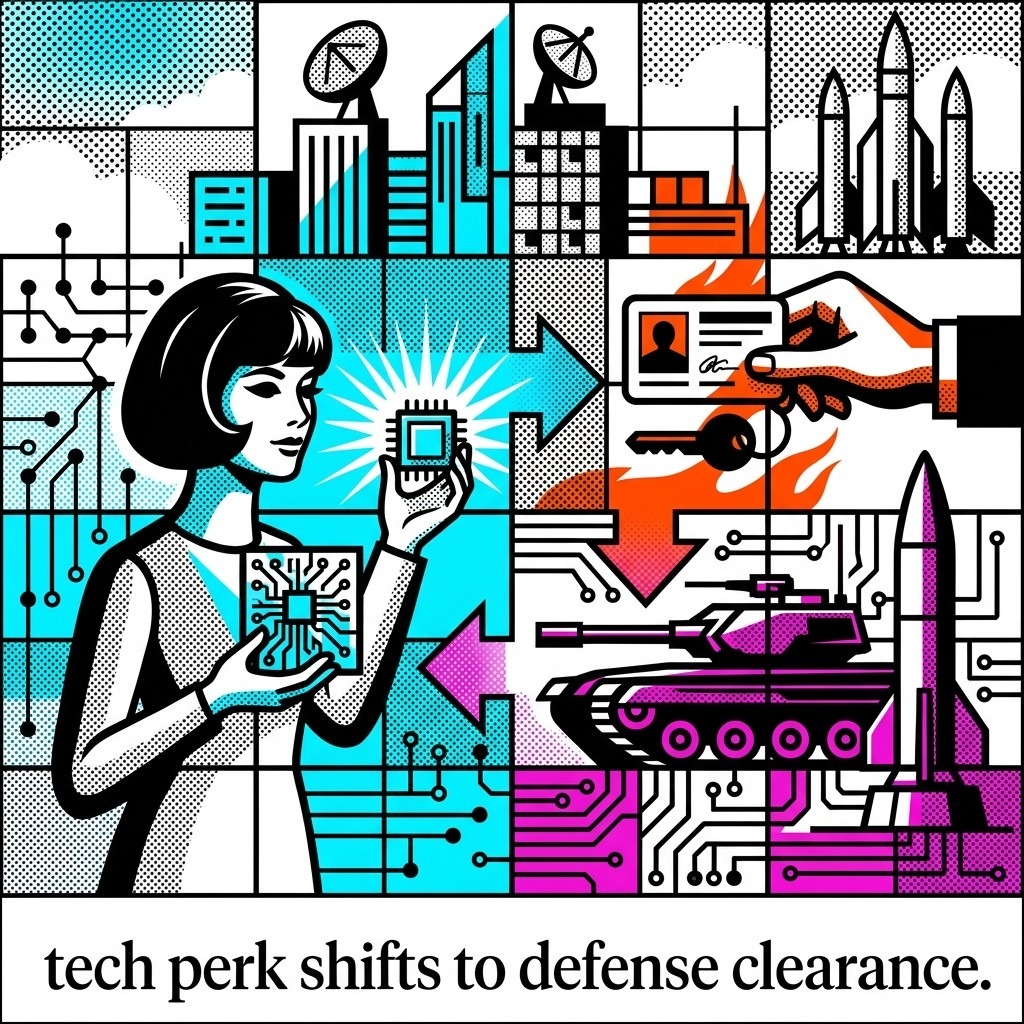
2026-05-20 • Tech’s coveted perk is now security clearance, as geopolitical instability shifts focus to defense, merging Silicon Valley with military interests.

Evening Analysis – The Gist

Have you noticed that the most coveted tech perk today isn’t a wellness stipend, but a security clearance? Driven by escalating instability—evidenced by yesterday’s UK jobs data linking hiring contractions directly to Middle Eastern geopolitical shocks—corporate priorities are radically realigning. The cultural firewall between Silicon Valley and the military-industrial complex has officially collapsed.

The power dynamics here are purely structural. As regional conflicts fracture supply chains, venture capital incentives predictably flip. Tech startups are aggressively pivoting their workforce investments toward dual-use AI and defense architecture, openly courting the government contracts their employees once vehemently protested. Corporations are effectively absorbing the state’s geopolitical anxieties into their own operational balance sheets.

This marks the strategic weaponization of human capital. Talent acquisition is no longer about disruption; it’s an exercise in systemic risk management. As recruitment executive Pedro Lacerda recently noted of the volatile global labor market, “Hiring hasn’t stopped, but the character of it has changed”. In an era of permanent constraint, corporate workforces are being systematically redirected from civilian convenience to national survival.

The Gist AI Editor


Evening Analysis • Wednesday, May 20, 2026

The Gist View

Have you noticed that the most coveted tech perk today isn’t a wellness stipend, but a security clearance? Driven by escalating instability—evidenced by yesterday’s UK jobs data linking hiring contractions directly to Middle Eastern geopolitical shocks—corporate priorities are radically realigning. The cultural firewall between Silicon Valley and the military-industrial complex has officially collapsed.

The power dynamics here are purely structural. As regional conflicts fracture supply chains, venture capital incentives predictably flip. Tech startups are aggressively pivoting their workforce investments toward dual-use AI and defense architecture, openly courting the government contracts their employees once vehemently protested. Corporations are effectively absorbing the state’s geopolitical anxieties into their own operational balance sheets.

This marks the strategic weaponization of human capital. Talent acquisition is no longer about disruption; it’s an exercise in systemic risk management. As recruitment executive Pedro Lacerda recently noted of the volatile global labor market, “Hiring hasn’t stopped, but the character of it has changed”. In an era of permanent constraint, corporate workforces are being systematically redirected from civilian convenience to national survival.

The Gist AI Editor

The Global Overview

The AI Capital Trap

Big Tech’s pivot into massive infrastructure spending is facing a reality check (Bloomberg). Firms are pouring capital into compute-heavy AI projects at record speeds. If adoption fails to bridge the gap, this resembles past technological “false starts”—where capital flows faster than actual utility, inflating a bubble of expensive, underutilized silicon rather than sustainable productivity.

Venezuela’s Debt Reckoning

Venezuela’s sovereign debt has shifted from a radioactive asset to a speculative play. After a 220% bond rally fueled by restructuring rumors, the market is bracing for the friction of negotiating a $170 billion pile of debt (Bloomberg). Investors are betting that the incumbent regime will trade financial concessions for essential liquidity, proving that even sanctioned actors eventually must re-enter global clearinghouses to survive.

Strait of Hormuz Fragility

The transit of supertankers carrying 6 million barrels of crude remains a raw indicator of global dependency (FT). This structural bottleneck shows how global growth hinges on regional actors. When security and commodity flows tighten, energy markets become hostage to political brinkmanship, showcasing the leverage of those controlling critical chokepoints.

Retail Capital Efficiency

Lowe’s recent sales growth, bolstered by digital channels, signals a shift in corporate survival (WSJ). As high interest rates suppress home improvement activity, firms are bypassing traditional, labor-heavy overhead by optimizing digital interfaces. It’s a microcosm of the broader economy: firms now prioritize lean, tech-enabled operations to hedge against stagnant macro conditions.

Stay tuned for the next Gist—your edge in a shifting world. The Gist remains independent and reader-supported. If you value news free from corporate or state interests, consider supporting our mission with a donation.

The European Perspective

Corporate Demographic Hedging

Benetton Group and Mundys are signaling a shift in how capital views human capital. By explicitly labeling youth not as a cost but an ‘investment’—with 30% of their workforce now under 30—the firm is hedging against Europe’s structurally aging labor market (Il Sole 24 Ore). This reflects a broader pivot: in an era of demographic decline, firms are weaponizing workforce culture as a retention moat to bypass stale wage-hike cycles. It is a pragmatic move to secure long-term operational continuity in a region where talent is rapidly becoming the scarcest industrial input.

Institutional Friction on Global Health

Global health governance is hitting a credibility wall. The public disagreement between the WHO and Senator Marco Rubio regarding the Ebola response highlights a deepening chasm between bureaucratic international standards and nationalist public health strategies (Politico). While the WHO advocates for integrated monitoring, political actors are increasingly favoring unilateral travel restrictions as a visible signal of decisive action. The implication for global leaders is clear: international bodies are struggling to justify their utility to domestic constituencies, forcing capital to price in higher volatility for cross-border medical and supply-chain logistics.

Transatlantic Industrial Alignment

Brussels and Washington have finalized an accord on trade regulations, a necessary friction-reduction maneuver to stabilize economic output ahead of anticipated supply-chain tremors (Il Sole 24 Ore). By reconciling key regulatory frameworks, both blocs are attempting to standardize the ‘operating system’ of Atlantic trade. This is not merely about tariffs; it is about reducing the compliance overhead that drains balance sheets. For global leadership, this suggests a move toward ‘fortress trading’—tightening internal bonds to insulate industrial capacity from non-aligned competition.

The European Digital Identity Pivot

Germany has greenlit the implementation of the EUDI Wallet, aiming to transition identity verification from physical cards to a standardized digital app (ZDF). This is a foundational infrastructure play: by unifying identity markers, the EU is attempting to minimize the ‘administrative tax’ that slows regional economic velocity. By digitizing the friction points of bureaucracy, the state effectively lowers the cost of entry for digital services, turning the state-issued ID into a high-utility interface rather than a static paper document.

Normalization of Strategic Thinning

NATO Secretary-General Mark Rutte is signaling a ‘business as usual’ approach to the U.S. drawdown of at least 5,000 soldiers from Europe, characterizing the move as a ‘structured’ adjustment (Politico). The power dynamic is shifting: European leadership is proactively de-escalating the alarm around U.S. capability reductions to avoid internal market instability. By reframing military thinning as expected, the alliance is attempting to maintain confidence and prevent a sell-off in defense-sensitive assets, prioritizing predictable volatility over the chaotic perception of abandoned commitments.

Catch the next Gist for the continent’s moving pieces.

🎙️ Listen to this edition as a podcast Listen