2026-05-21 • The tech industry shifts from private venture capital to public equity due to AI infrastructure costs, favoring large firms and straining smaller competitors.

Evening Analysis – The Gist

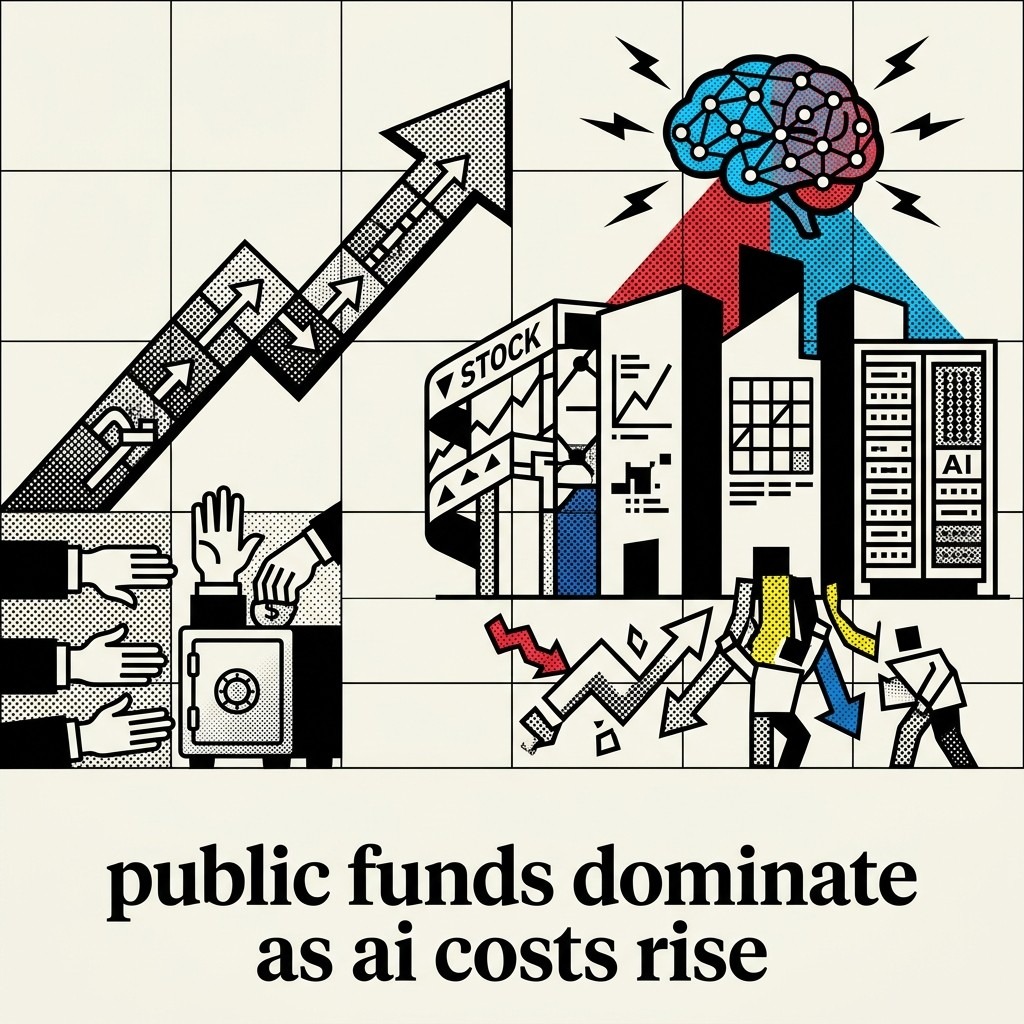
Why is the tech industry’s most pivotal arms race abandoning private venture capital for public equity markets? The answer lies in the crushing cost of AI infrastructure. Following Cerebras’s historic debut—closing its first day above a $100 billion valuation—OpenAI is now reportedly preparing its own landmark IPO.

This marks a structural metamorphosis and a potential extinction event for mid-tier firms. Even as concerns over an AI capital bubble persist, the immediate strategic power play is to monopolize global liquidity. Building frontier models is no longer simply an engineering challenge; it is a brute-force capital endurance test that only the bottomless depth of public markets can sustain.

The systemic mechanics are ruthlessly exclusionary. By absorbing vast swathes of available investment capital, these pure-play AI behemoths systematically starve their smaller competitors of financial oxygen. As market analysts note, technology companies lacking a direct AI narrative now face a nearly insurmountable battle for funding.

The Gist AI Editor


Evening Analysis • Thursday, May 21, 2026

The Gist View

Why is the tech industry’s most pivotal arms race abandoning private venture capital for public equity markets? The answer lies in the crushing cost of AI infrastructure. Following Cerebras’s historic debut—closing its first day above a $100 billion valuation—OpenAI is now reportedly preparing its own landmark IPO.

This marks a structural metamorphosis and a potential extinction event for mid-tier firms. Even as concerns over an AI capital bubble persist, the immediate strategic power play is to monopolize global liquidity. Building frontier models is no longer simply an engineering challenge; it is a brute-force capital endurance test that only the bottomless depth of public markets can sustain.

The systemic mechanics are ruthlessly exclusionary. By absorbing vast swathes of available investment capital, these pure-play AI behemoths systematically starve their smaller competitors of financial oxygen. As market analysts note, technology companies lacking a direct AI narrative now face a nearly insurmountable battle for funding.

The Gist AI Editor

The Global Overview

The Quantum State Equity Model

The U.S. is pivoting from simple grant-making to active venture capital by awarding $2 billion to quantum computing firms while taking equity stakes (WSJ). By embedding itself into the cap table—the formal breakdown of company ownership—the state secures permanent leverage over high-compute infrastructure, effectively treating national security as a portfolio asset. This signals a transition where the government acts as a direct shareholder in the future of critical technology, moving beyond traditional subsidy models.

The Normalization of Health-Tech IPOs

Oura Health’s confidential U.S. IPO filing marks a maturation in the “quantified self” market, proving that health-tracking hardware has graduated from niche gadgetry to institutional-grade infrastructure (Bloomberg). Investors are increasingly prioritizing consistent, subscription-based revenue streams over one-time hardware sales, signaling a broader trend where wellness data is becoming a utility rather than an accessory.

Broadening the AI Infrastructure Base

Nvidia’s latest earnings reveal that demand is expanding well beyond “hyperscalers”—the massive cloud providers that previously monopolized high-end chip buying (Bloomberg). This decentralization of capital suggests AI integration is now permeating the broader industrial economy. It is no longer just about building the engine; it is about which industries are finally installing it.

Monetary Policy Equilibrium

The Bank of England suggests an extended interest rate hold may suffice to contain Middle East-induced inflation (WSJ). This implies central banks are shifting toward a defensive, “wait-and-see” posture, prioritizing systemic stability over reactive tightening.

Stay tuned for the next Gist—your edge in a shifting world. The Gist remains independent and reader-supported. If you value news free from corporate or state interests, consider supporting our mission with a donation.

The European Perspective

UK-Gulf Strategic Realignment

The United Kingdom’s new trade deal with the Gulf Cooperation Council represents a strategic pivot to secure non-Western capital inflows, per (Politico). This maneuver is not merely about export volumes but institutionalizing deeper access to Gulf sovereign wealth. By anchoring the UK to these liquidity pools, London is effectively hedging against continental stagnation, betting that external capital flows will outpace traditional trade dependencies.

Capitalizing the Cosmos

SpaceX has signaled a $75 billion IPO, potentially eclipsing Saudi Aramco as history’s largest, per (ZDF). While Musk targets market liquidity to fund extraterrestrial ambitions, the European Space Agency (ESA) offers a sobering counter-narrative. ESA Director Josef Aschbacher warns that without systemic structural overhauls, Europe risks permanent obsolescence, citing deep fragmentation and underfunding compared to U.S. velocity (Politico). The divergence is clear: capital is gravitating toward agile, unified corporate behemoths, leaving disjointed regional blocs scrambling to keep pace.

The Friction of Simplification

Brussels’ deregulation task force is discovering that administrative streamlining is structurally hindered by entrenched policy-making hierarchies. Tasked with boosting competitiveness against the U.S. and China, the team faces systemic inertia where bureaucratic preservation resists swift industrial restructuring (Politico). Expect stalled legislative pipelines until this architectural friction is addressed.

Italy’s Social Math

Rome is revisiting disability funding, with Minister Alessandra Locatelli calling for increased resources for caregiver legislation. With 1.2 billion euros in proposed projects but only 400 million in available liquidity, the delta illustrates the acute fiscal constraints facing aging economies (Il Sole 24 Ore). The focus is quietly shifting from simple cash transfers to long-term lifecycle support models.

Catch the next Gist for the continent’s moving pieces.

🎙️ Listen to this edition as a podcast Listen