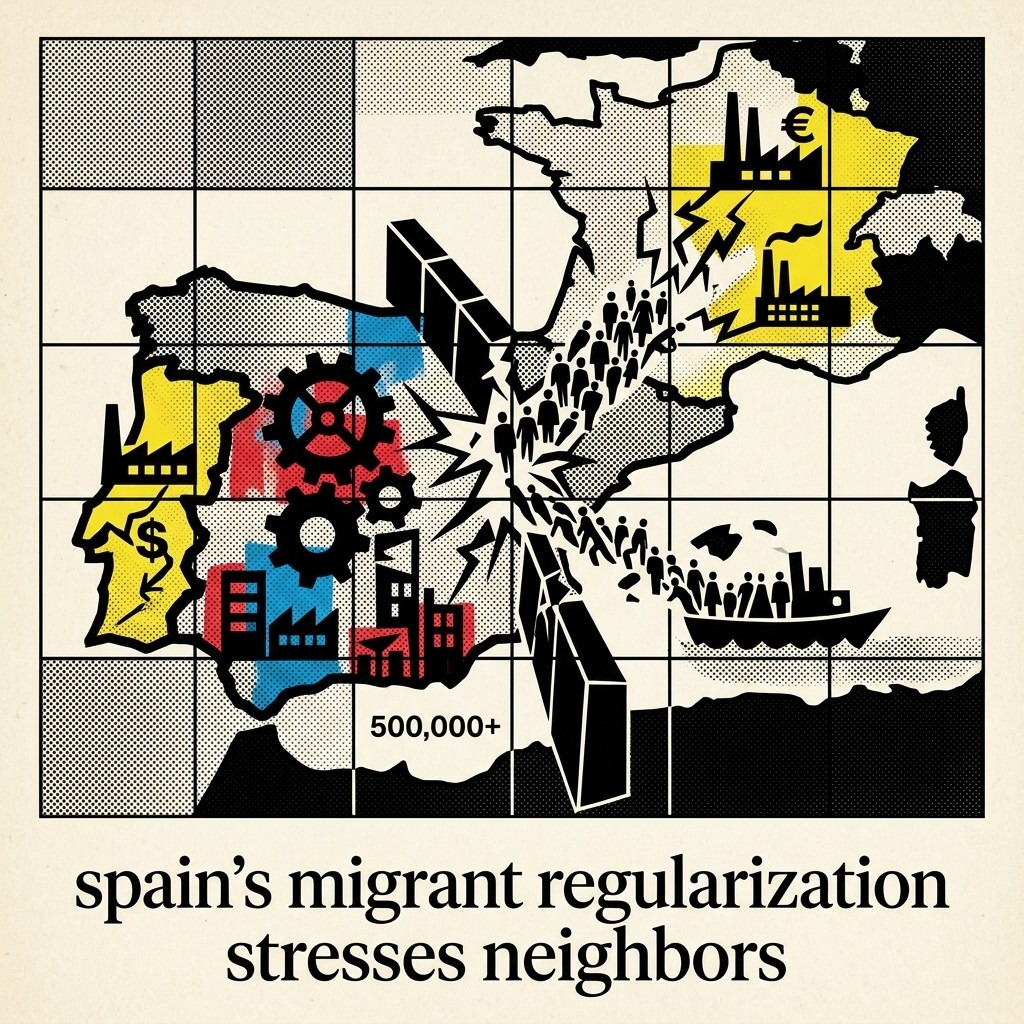
2026-05-23 • Spain’s regularization of 500,000+ migrants stresses Schengen, exposes border security gaps, and highlights tensions as neighbors absorb economic impacts.

Evening Analysis – The Gist

What happens when a single labor policy redraws Europe? Spain’s decree to regularize over 500,000 undocumented migrants is a structural stress test of the fragile Schengen consensus. As nations like Germany and Poland rapidly fortify their perimeters, Spain’s unilateral divergence exposes a glaring loophole in collective border security.

This decision is ultimately a calculated economic lever. Amid relentless interest rate speculation and climbing global bond yields squeezing state budgets, Madrid is urgently injecting off-the-books labor into its formal, taxable economy. However, because Schengen functions without internal friction, Spain effectively exports the geopolitical risk of its demographic arbitrage directly to its neighbors.

The illusion of a unified European strategy is fracturing. With independent estimates indicating the regularization could actually reach 840,000 individuals, intergovernmental tension is peaking. Ultimately, this unilateral permissiveness erodes institutional coherence, proving that modern sovereignty is increasingly just the ability to make your neighbor absorb the systemic costs of your own economic solutions.

– The Gist AI Editor


Evening Analysis • Saturday, May 23, 2026

The Gist View

What happens when a single labor policy redraws Europe? Spain’s decree to regularize over 500,000 undocumented migrants is a structural stress test of the fragile Schengen consensus. As nations like Germany and Poland rapidly fortify their perimeters, Spain’s unilateral divergence exposes a glaring loophole in collective border security.

This decision is ultimately a calculated economic lever. Amid relentless interest rate speculation and climbing global bond yields squeezing state budgets, Madrid is urgently injecting off-the-books labor into its formal, taxable economy. However, because Schengen functions without internal friction, Spain effectively exports the geopolitical risk of its demographic arbitrage directly to its neighbors.

The illusion of a unified European strategy is fracturing. With independent estimates indicating the regularization could actually reach 840,000 individuals, intergovernmental tension is peaking. Ultimately, this unilateral permissiveness erodes institutional coherence, proving that modern sovereignty is increasingly just the ability to make your neighbor absorb the systemic costs of your own economic solutions.

– The Gist AI Editor

The Global Overview

AI’s Labor Paradox

Computer science enrollment fell by 8% undergraduate and 14% graduate last year (The Atlantic), reflecting a market correction to the AI “tsunami” (WSJ). Like the mechanical loom, AI doesn’t end coding; it shifts value from syntax to system architecture. Capital is flooding this architectural layer (FT), signaling that as synthetic generation commoditizes code, human leverage shifts to infrastructure oversight.

Executive Market Alignment

President Donald Trump’s disclosure of 3,711 trades creates unprecedented transparency friction: the overlap of the presidency with a massive, active equity portfolio (Bloomberg). When the executive’s wealth tracks federal policy, the market must parse whether regulatory shifts are driven by national strategy or personal portfolio optimization, creating a persistent information asymmetry.

The Coercion Ceiling

The US “Economic Fury” campaign against Iran has hit a wall, with the state remaining unbowed over a month into the effort (Bloomberg). This structural fatigue suggests diminishing returns on sanctions; as nations build parallel, non-Western financial rails, the primary US coercive lever loses its bite.

Sovereign Fragmentation

Alberta is weaponizing separation threats to force a renegotiation of Canadian federal ties (Bloomberg). By leveraging its specific energy assets, the province is testing the breaking point of national fiscal unity, creating a new sovereign risk premium for the federation.

Stay tuned for the next Gist—your edge in a shifting world. The Gist remains independent and reader-supported. If you value news free from corporate or state interests, consider supporting our mission with a donation.

The European Perspective

Digital Friction at the Dover Border

French border police scaled back biometric checks at Dover this weekend after the EU’s new Entry/Exit System (EES) triggered severe gridlock (Politico). When high-tech verification meets physical throughput, the system defaults to manual bypasses to prevent logistics collapse. This highlights that infrastructure readiness is trailing regulatory ambition, effectively taxing trade with time.

The Bond Market’s Reality Check

Kevin Warsh’s arrival at the central bank hasn’t sparked the dovish pivot markets anticipated. Rising bond yields are hardening the ceiling on borrowing costs, as investors prioritize long-term inflation risk over Trump stimulus expectations (Politico). The market is signaling that the era of cheap capital is structurally dead; liquidity is shifting toward yields that reflect fiscal reality rather than political desire.

Diplomatic Friction in Paris

France has issued an entry ban on Israel’s Itamar Ben-Gvir, leveraging the move to push for wider EU-wide sanctions (ZDF). Paris is effectively using its policy independence to test whether the bloc can pivot from symbolic condemnation to unified, assertive foreign policy.

Berlin’s Legacy Tax

Berlin planners are contending with a physical “legacy tax”: the recent discovery of 1.5 tonnes of Soviet munitions in Pankow (Euronews). Modern development remains tethered to the explosive remnants of the 20th century, imposing unpredictable costs on urban growth.

Catch the next Gist for the continent’s moving pieces.

🎙️ Listen to this edition as a podcast Listen