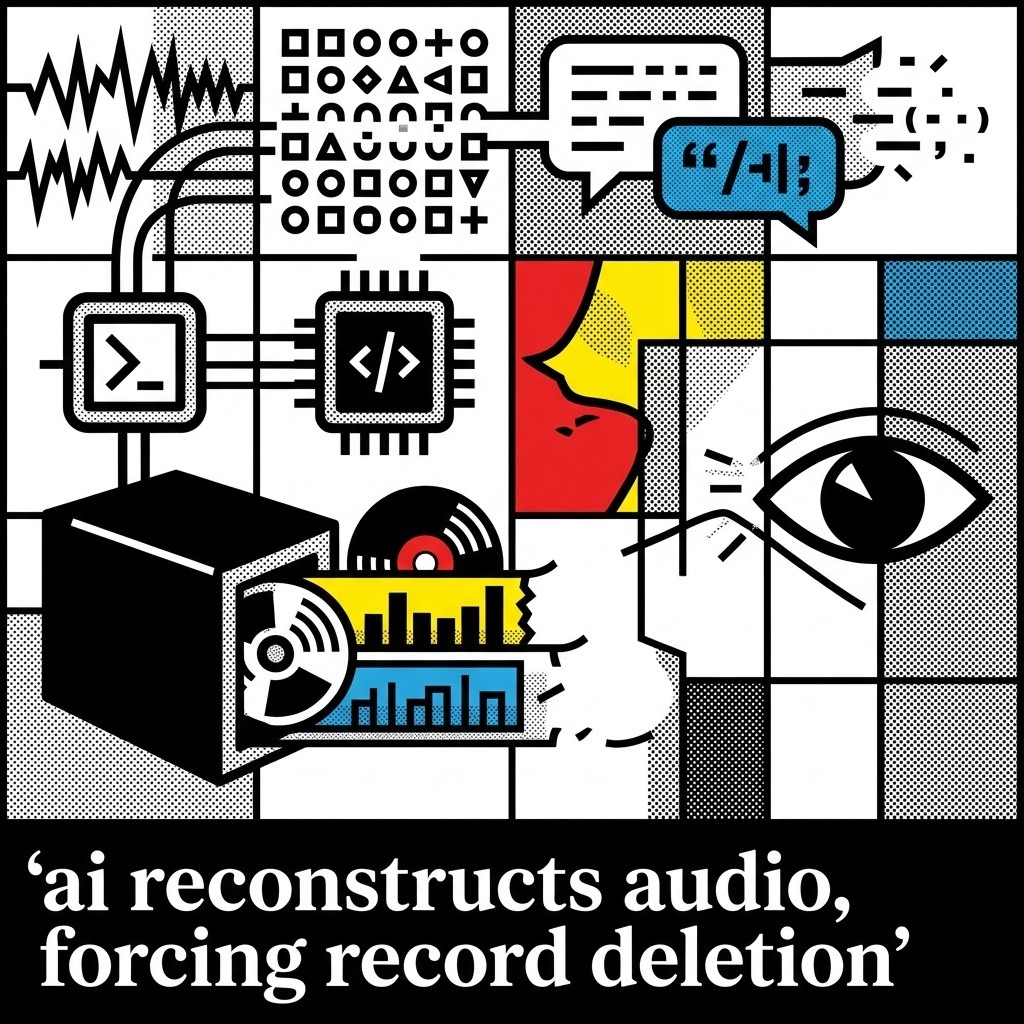
2026-06-06 • AI can reconstruct cockpit audio from spectrograms, forcing NTSB to remove records, exposing privacy flaws as AI overcomes old data safeguards.

Evening Analysis – The Gist

We are witnessing the collapse of the analog privacy firewall. The NTSB historically published visual sound-spectrograms instead of cockpit audio, relying on the biological limitation that humans simply couldn’t hear a picture. But as AI evolves beyond the recent fiscal debates we’ve tracked, its cross-modal translation capabilities have shattered this compromise. This week, independent researchers used machine learning to reverse-engineer public spectrograms back into approximate cockpit audio, forcing the NTSB to abruptly yank thousands of investigation records offline.

This exposes a critical structural obsolescence. Institutions traditionally safeguarded sensitive data by altering its format, treating conversion as a one-way street. Generative AI eliminates the technical friction agencies relied upon to obscure raw realities, proving that legacy transparency frameworks are fundamentally incompatible with neural networks.

When sanitized data is easily reconstituted into its rawest form, institutions will inevitably default to total opacity to preserve their authority. As old safeguards fail, the NTSB admits that AI can now “generate approximations of cockpit recordings from sound-spectrum imagery that previously posed little privacy risk”.

The Gist AI Editor


Evening Analysis • Saturday, June 06, 2026

The Gist View

We are witnessing the collapse of the analog privacy firewall. The NTSB historically published visual sound-spectrograms instead of cockpit audio, relying on the biological limitation that humans simply couldn’t hear a picture. But as AI evolves beyond the recent fiscal debates we’ve tracked, its cross-modal translation capabilities have shattered this compromise. This week, independent researchers used machine learning to reverse-engineer public spectrograms back into approximate cockpit audio, forcing the NTSB to abruptly yank thousands of investigation records offline.

This exposes a critical structural obsolescence. Institutions traditionally safeguarded sensitive data by altering its format, treating conversion as a one-way street. Generative AI eliminates the technical friction agencies relied upon to obscure raw realities, proving that legacy transparency frameworks are fundamentally incompatible with neural networks.

When sanitized data is easily reconstituted into its rawest form, institutions will inevitably default to total opacity to preserve their authority. As old safeguards fail, the NTSB admits that AI can now “generate approximations of cockpit recordings from sound-spectrum imagery that previously posed little privacy risk”.

The Gist AI Editor

The Global Overview

The Data-Labor Trade

We are witnessing an emerging “data-barter” economy. Firms are now trading household services—like free cleaning—for first-person video data to train robotic systems (Marginalrevolution). This shifts capital formation away from cash transactions toward asset-collection: treating your living room as a literal data mine. Think of it as “drilling” for the next industrial revolution, where your personal activity becomes the extracted resource required to build proprietary tech moats.

Mineral Wealth and Institutional Friction

Bolivia’s push to monetize vast mineral reserves is stalling due to domestic unrest (Bloomberg). The bottleneck is the inability to reconcile local instability with the long-term horizons required by foreign capital. Global investors demand legal certainty to unlock lithium and rare earths; without it, the risk premium keeps these assets in the ground. This leaves the broader energy transition, which desperately needs these inputs, to scramble for more stable supply chains.

Bureaucratic Arbitrage

FIFA’s clash with New York officials over stadium water policies reveals the friction between global mandates and local governance (Bloomberg). When international bodies enforce rigid rules on municipal turf, they invite immediate pushback. It is a microcosm of how centralized authority faces erosion when it fails to respect local regulatory sensitivities.

Update: Kinetic Stagnation

Ukrainian drone strikes on St. Petersburg and continued military action in Gaza persist, highlighting the ongoing disconnect between diplomatic ceasefire efforts and ground-level attrition (WSJ, Straits Times).

Stay tuned for the next Gist—your edge in a shifting world. The Gist remains independent and reader-supported. If you value news free from corporate or state interests, consider supporting our mission with a donation.

The European Perspective

Supersonic Commercial Viability

After 16 flights in 90 days (Euronews), NASA’s supersonic research signals a pivot in commercial aviation. The structural incentive here isn’t merely velocity; it is compressing the logistical footprint of high-value global trade. By reliably cracking the sound barrier, the industry aims to turn the “tyranny of distance” into a manageable variable for capital deployment, effectively rewriting the transit economics of executive and cargo movement.

Italy’s Digital Real Estate Surge

Italy is fast-tracking its status as a digital nexus, securing three major data center investments in just one month (Il Sole 24 Ore). This confirms that data residency is the new industrial zoning. Global capital is migrating to regions where infrastructure policy actively lowers the cost of hosting the “brains” of the digital economy, transforming geographical location into reliable, high-margin, leased utility revenue.

The Diagnostic Reliability Gap

A new Jama Network Open study reveals that mental health diagnostic interviews—the sector’s “gold standard”—lack consistent reliability (The Guardian). This creates a structural inefficiency: capital flowing into mental health “solutions,” whether pharmaceutical or digital, may be targeting inaccurate benchmarks. The industry risks misallocating massive resources meant for workforce productivity and public wellness on models that lack fundamental validation.

French Open Reset

In a sharp disruption of the expected tennis hierarchy, Mirra Andrejewa’s French Open victory injects fresh, cyclical volatility into the sport’s elite grand slam ecosystem (ZDF).

Catch the next Gist for the continent’s moving pieces.

🎙️ Listen to this edition as a podcast Listen


Comments

Leave a Reply

Your email address will not be published. Required fields are marked *

This site uses Akismet to reduce spam. Learn how your comment data is processed.