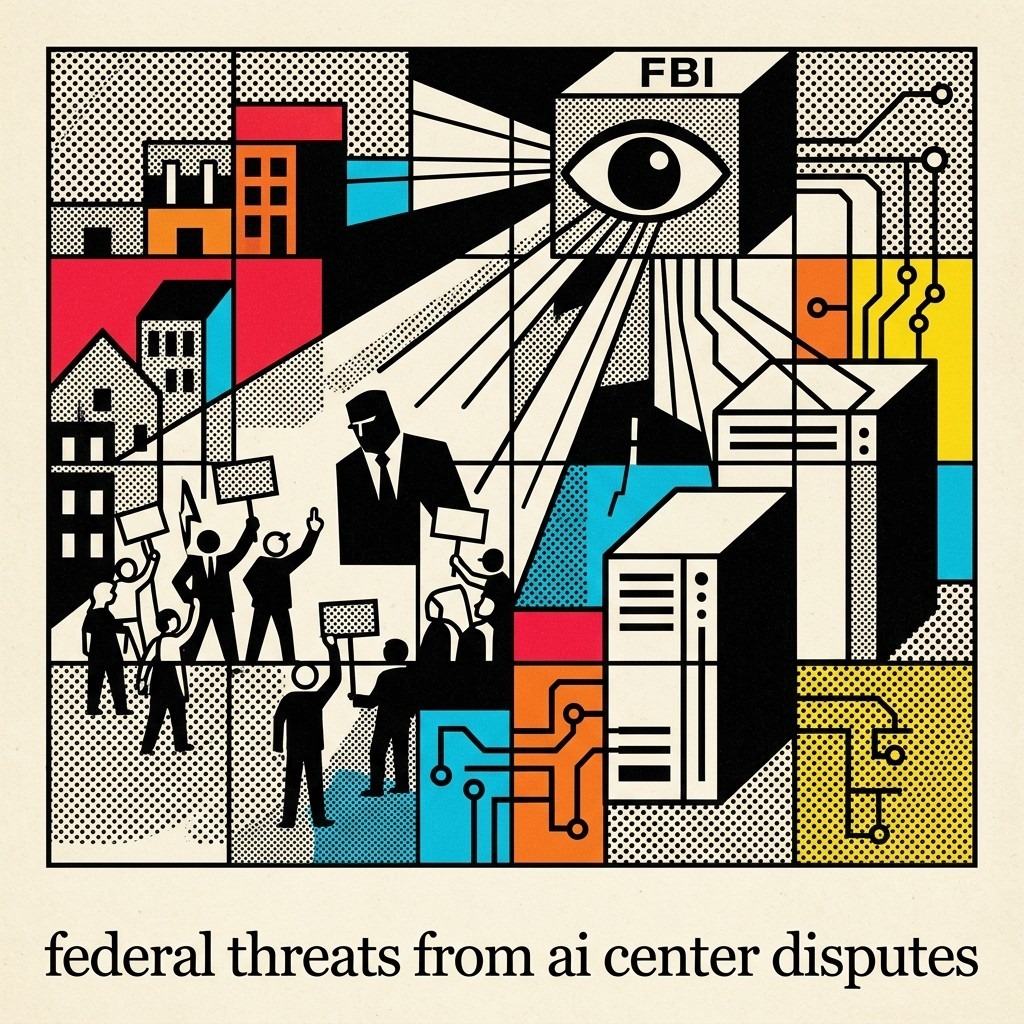
2026-06-07 • Zoning disputes over AI centers are now federal threats. The FBI labels local resistance as “anti-tech extremism,” bypassing urban governance.

Evening Analysis – The Gist

When does a zoning dispute become a federal threat? Following municipal bans on AI data centers in Seattle and California, civic friction over grid strain is being securitized. Leaked documents reveal the FBI minted a new threat category—”anti-tech violent extremism“—sweeping town hall grievances into databases.

This reclassification structurally shields infrastructure from democratic pushback. While Italy subsidizes digital hubs, the US weaponizes its security apparatus to bypass urban governance. Treating resource-based resistance as extremism signals that AI supply chains are now critical infrastructure, completely immune to local vetoes.

The cloud has a physical reality. As watchdogs warn, this dragnet ensures friction “is shifting from local zoning boards straight into federal intelligence databases”. AI’s real frontier isn’t code; it’s the utility grid.

The Gist AI Editor


Evening Analysis • Sunday, June 07, 2026

The Gist View

When does a zoning dispute become a federal threat? Following municipal bans on AI data centers in Seattle and California, civic friction over grid strain is being securitized. Leaked documents reveal the FBI minted a new threat category—”anti-tech violent extremism“—sweeping town hall grievances into databases.

This reclassification structurally shields infrastructure from democratic pushback. While Italy subsidizes digital hubs, the US weaponizes its security apparatus to bypass urban governance. Treating resource-based resistance as extremism signals that AI supply chains are now critical infrastructure, completely immune to local vetoes.

The cloud has a physical reality. As watchdogs warn, this dragnet ensures friction “is shifting from local zoning boards straight into federal intelligence databases”. AI’s real frontier isn’t code; it’s the utility grid.

The Gist AI Editor

The Global Overview

The End of the Dynasty

In France, the clash between individual liberty and entrenched social mandate has hit the boardroom. Pierre-Edouard Sterin, founder of Smartbox (€1.4 billion net worth), is publicly challenging the Napoleonic Code—a legal legacy requiring 75% of an estate to pass to children (MarginalRevolution). By attempting to disinherit his heirs to fund charity, Sterin highlights a growing systemic friction: wealthy individuals increasingly view dynastic inheritance laws as inefficiencies that impede fluid capital deployment. This is not merely a private dispute; it signals a potential shift in how Europe balances family-centric social stability against the pressures of modern, globalized capital mobility.

The New Geography of Aerospace

The Dominican Republic is pivoting toward deep-space logistics, with plans for a commercial spaceport in Oviedo (Bloomberg). This move treats spaceports as the “new railways,” using aerospace infrastructure to force rural economic development. By courting launch providers, the state seeks to pivot local labor from tourism to high-tech logistics, compelling foreign capital to build essential utility frameworks and regulatory environments in exchange for equatorial launch access.

Institutional Pressure

President Trump is escalating friction with the central bank, demanding rate cuts even as borrowing cost expectations rise (FT). This maneuver tests the limits of institutional independence, confirming that even in a digital-first era, traditional monetary levers remain the ultimate battleground for political leverage.

Stay tuned for the next Gist—your edge in a shifting world. The Gist remains independent and reader-supported. If you value news free from corporate or state interests, consider supporting our mission with a donation.

The European Perspective

The Urban Commons Friction

Berlin’s court ruling halting a €2 million plan to fence off Görlitzer Park signals a tactical defeat for authorities struggling to manage public spaces (The Guardian). This highlights a growing disconnect between top-down security measures and the “right to the city,” where citizens increasingly reject state-led physical barriers. The systemic incentive is clear: municipalities attempting to solve social decay with exclusionary architecture are now facing fierce, litigious pushback, forcing a pivot toward more resource-intensive social integration strategies rather than simplistic containment.

The Physical Risk of Digital Growth

Anti-tech extremism is escalating from abstract discourse to kinetic violence. Recent attacks on AI infrastructure and gunfire targeting data center projects illustrate a mounting “security premium” (The Guardian). Firms are no longer merely managing digital firewalls but physical threat vectors, fundamentally altering the risk calculus for the massive infrastructure expansion required by the current AI transition.

German Policy Inertia

Germany’s federal leadership faces severe domestic friction, with officials now labeling the administration a “world champion in announcing” rather than executing (ZDF). As structural solvency dominates the national agenda, the persistent gap between policy rhetoric and tangible results is visibly eroding institutional credibility.

Regional Pulse

Kosovo heads to legislative polls today amidst persistent institutional gridlock and voter fatigue (Le Monde). Conversely, Italian engineering is adapting to environmental constraints, with infrastructure projects like Trieste’s bridge accounting for tidal rhythms to manage construction (Il Sole 24 Ore).

Catch the next Gist for the continent’s moving pieces.

🎙️ Listen to this edition as a podcast Listen