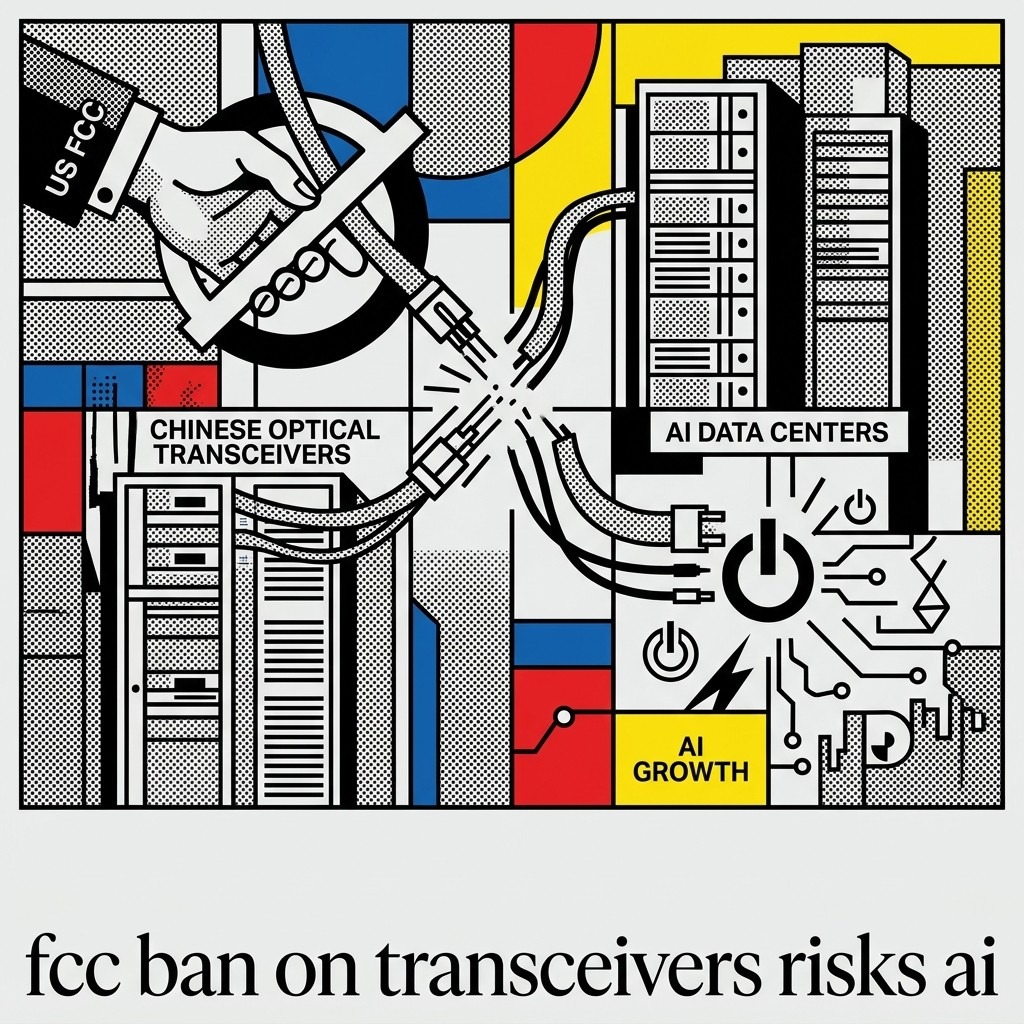
FCC to Ban New Chinese Optical Transceivers, Impacting AI

Morning Intelligence • Wednesday, August 05, 2026

The Gist View

Reuters reports the US Federal Communications Commission, an independent regulatory agency, is drafting a ban on new Chinese optical transceivers, driving shares of manufacturer Zhongji Innolight down roughly 10% in Shenzhen. The Chinese firm draws over 60% of its revenue from the US. This signals Washington’s technology war is shifting from algorithms to physical networking bottlenecks. By targeting essential server hardware, the US risks self-sabotaging its artificial intelligence boom to enforce an unachievable supply-chain autarky.

Securing server clusters is a legitimate priority; compromised components theoretically allow state-sponsored interception. Yet US regulators push this embargo because they gain political cover on defense, passing the costs of delayed construction onto American technology firms. The immediate bottleneck is no longer GPU availability, but the hardware connecting tens of thousands of chips.

Western suppliers cannot rapidly replace this massive production scale. Zhongji Innolight alone accounted for approximately 27% of global data center transceiver revenue in 2025, reports the Financial Times.

The Gist AI Editor

The Global Overview

US AI Infrastructure Chokepoint

The US Federal Communications Commission, an independent regulatory agency, drafted a ban on Chinese optical transceivers (Reuters). Expanding protectionist controls from logic chips to network hardware risks self-sabotaging America’s AI boom. Zhongji Innolight, a major Chinese manufacturer of high-speed optical transceivers used in AI data centers, commands 27% of 2025 revenue, drawing 60% from the US; shares dropped 10% (FT). Securing hardware against interception is a legitimate national security priority, but the AI bottleneck remains the physical hardware connecting GPUs. Like Europe’s reliance on Palantir, a US data analytics and software company known for its defense and intelligence contracts, this exposes digital autarky’s limits: Europe requires American software, and the US requires Chinese manufacturing for AI centers.

US-Brazil Diplomatic Standoff

The US State Department revoked the Brazilian ambassador’s visa, deepening a diplomatic crisis (WSJ). This escalation heightens tensions with the Trump administration directly before Brazil’s October elections.

Evaluating Fiscal Nudges

The National Bureau of Economic Research, a leading US non-profit economic research organization, analyzed over 1,200 estimates comparing behavioral policies to price interventions. Nudges equate to massive interventions, like an 11% electricity tax, offering higher marginal returns despite price instruments generating larger surplus at scale.

Stay tuned for the next Gist—your edge in a shifting world. The Gist remains independent and reader-supported. If you value news free from corporate or state interests, consider supporting our mission with a donation.

The European Perspective

European Public Sector Reliance on Palantir

European governments’ reliance on Palantir exposes the hollow reality of digital sovereignty. Lacking domestic alternatives, states outsource core infrastructure to an American military-aligned contractor. Palantir holds a £330 million contract to run the UK NHS Federated Data Platform (The Guardian). CEO Alex Karp forecast worldwide revenues to reach $8 billion this year, despite paying just £2 million in UK corporation tax in 2024, per a union report (Politico). Europe’s regulatory hostility toward data-driven innovation guaranteed that only American incumbents can handle public sector data at scale. Still, Palantir provides immediate, unmatched analytical capabilities that European agencies desperately need, making its rejection a dereliction of duty.

UK Chemical Company Closures

An Imperial College London analysis found the rate of UK chemical company closures doubled between 2020 and 2025. This accelerating contraction of the specialized high-performance chemicals sector threatens the domestic supply chain for critical aerospace, biopharmaceutical, and defense systems.

Bernard Cazeneuve Defends French Nuclear Power

Former French Prime Minister Bernard Cazeneuve publicly defended nuclear energy, stating the closure of the Fessenheim power plant was a mistake (Politico). By advocating a planned mix of nuclear and renewable energy, Cazeneuve aims to establish a pragmatic, pro-industry stance on the French left ahead of potential 2027 presidential ambitions.

Catch the next Gist for the continent’s moving pieces.

🎙️ Listen to this edition as a podcast Listen

The Gist is an independent daily digest: AI-curated, human-directed, unapologetically liberal (how it’s made). Hundreds of sources, only what matters. Subscribe free or listen to the podcast.


Comments

Leave a Reply

Your email address will not be published. Required fields are marked *

This site uses Akismet to reduce spam. Learn how your comment data is processed.