Fed Chair Warsh Defies Trump, Raises Rates for Stability

Evening Analysis • Friday, September 18, 2026

The Gist View

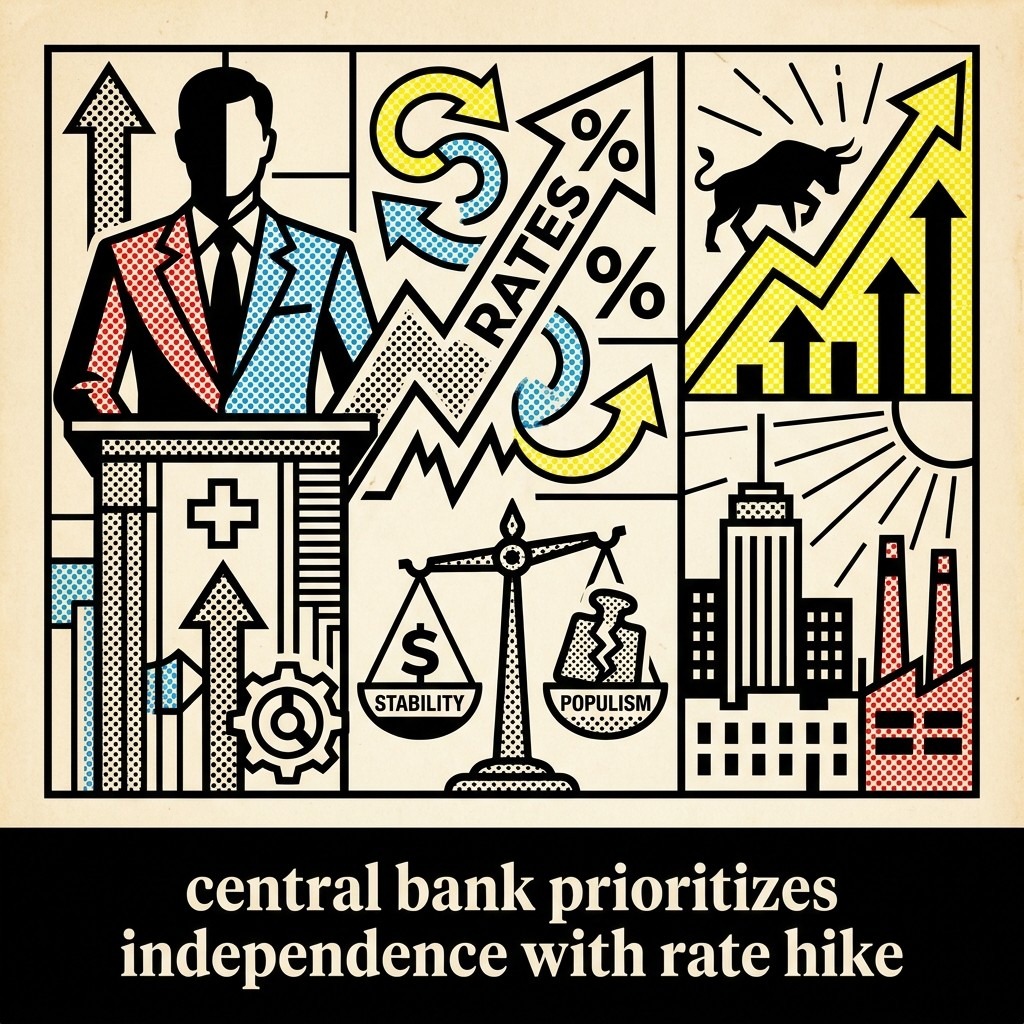
Federal Reserve Chair Kevin Warsh ignored pressure from President Donald Trump on September 16, 2026, guiding the Federal Open Market Committee—the branch determining US monetary policy—to raise interest rates by 25 basis points. This proves an independent central bank remains the strongest barrier against the politicization of capital.

Elected executives demand cheaper money because they gain immediate electoral goodwill while pushing the inflationary consequences onto future administrations. Unelected central bankers imposing higher borrowing costs on consumers during economic tightening certainly lacks democratic accountability, but markets prefer that trade-off. The two-year U.S. Treasury yield spiked to 4.744% precisely because bondholders see a bank prioritizing price stability over populist threats.

When politicians dictate the cost of capital, the currency pays the price. After President Richard Nixon successfully coerced Fed Chair Arthur Burns into keeping borrowing costs artificially low ahead of the 1972 election, US inflation soared to 11 percent by 1974 (Wall Street Journal).

The Gist AI Editor

The Global Overview

Federal Reserve Rate Hike

On September 16, 2026, the Federal Open Market Committee—the Federal Reserve branch determining US monetary policy—voted 12-0 to raise interest rates by 25 basis points (one-hundredth of one percent), targeting a 3.75%-4.00% range (CNBC). The two-year U.S. Treasury yield subsequently hit 4.744%, its highest since July 2024 (WSJ). Chair Kevin Warsh executed this hike despite President Donald Trump publicly demanding a rate cut (New York Times).

California AI Executive Order

California Governor Gavin Newsom issued a September 18, 2026, executive order accelerating third-party oversight of artificial intelligence (Politico). Experts must propose an emergency ‘kill switch’ within two months for frontier AI—large-scale models matching or exceeding currently available systems—reviving a 2024 vetoed mandate. This contradicts predictions that U.S. AI regulations would stall. Both events demonstrate that the primary battleground for managing systemic economic risk has shifted from legislative debate to a test of raw executive authority, as the central bank defends its independence against presidential pressure while California’s governor bypasses lawmakers to unilaterally govern technology.

SpaceX NASA Contract Extension

NASA awarded SpaceX three additional International Space Station missions—Crew-15, Crew-16, and Crew-17—for $946 million (NASA). This firm fixed-price modification elevates the total Commercial Crew Transportation Capability contract to $5.92 billion, securing structural launch access through 2030.

Stay tuned for the next Gist—your edge in a shifting world. The Gist remains independent and reader-supported. If you value news free from corporate or state interests, consider supporting our mission with a donation.

The European Perspective

Macron Convenes G7 Over Russian Hybrid Attacks

French President Emmanuel Macron ordered measures Friday to protect infrastructure from Moscow’s shadow operations. He will convene a Group of Seven (G7) meeting to coordinate an energy response, linking surging prices to Ukraine and ongoing Strait of Hormuz shipping disruptions (Euronews). This marks the end of the civilian peace dividend, forcing Europe to absorb the structural cost of securitizing logistics. By elevating localized sabotage, Macron aims to lock in multinational financial commitments before domestic political fatigue sets in. However, treating isolated incidents as coordinated hybrid war provides political cover for expanding state control over private utility sectors.

Ukraine Launches Carpathian Eight Alliance

On September 18, 2026, Ukrainian President Volodymyr Zelenskyy announced the Carpathian Eight (C8) to boost regional cross-border trade (ZDF). Uniting Ukraine, Romania, Serbia, Poland, Slovakia, the Czech Republic, Austria, and Hungary, the bloc targets €9.4 billion in investments to build shared infrastructure and a proposed anti-ballistic missile coalition (Euronews).

Germany Mandates Electronic Payments in Hospitality

German Finance Minister Lars Klingbeil will mandate electronic payments in the hospitality sector to combat tax evasion (ZDF). The state loses €15 to €20 billion annually to cash-only fraud. While regional polarization paralyzes state parliaments, federal actors are centralizing economic oversight by aggressively targeting this €20 billion tax gap, forcing capital flows into visible digital channels.

Catch the next Gist for the continent’s moving pieces.

🎙️ Listen to this edition as a podcast Listen

The Gist is an independent daily digest: AI-curated, human-directed, unapologetically liberal (how it’s made). Hundreds of sources, only what matters. Subscribe free or listen to the podcast.


Comments

Leave a Reply

Your email address will not be published. Required fields are marked *

This site uses Akismet to reduce spam. Learn how your comment data is processed.