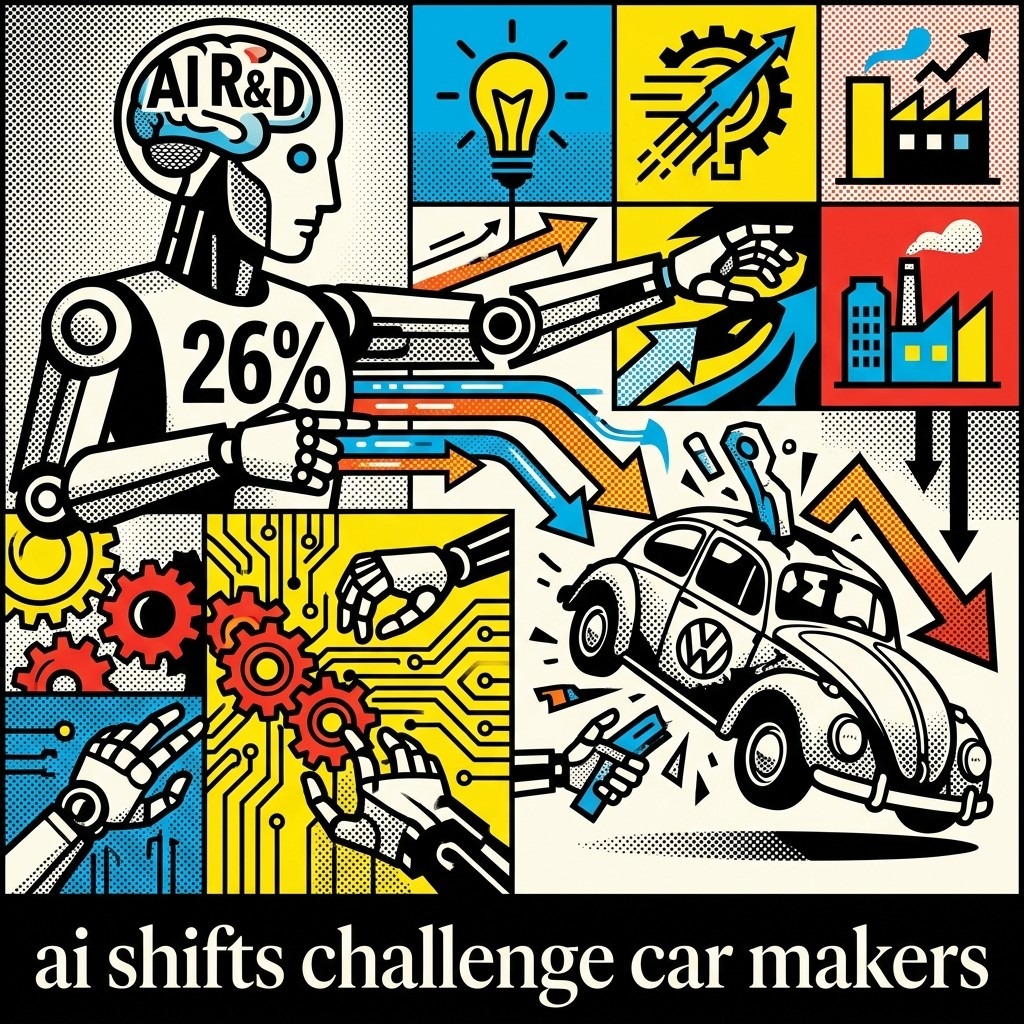
Anthropic’s Claude Chatbot Drives 26% of AI R&D

Morning Intelligence • Saturday, September 19, 2026

The Gist View

Anthropic reports its Claude chatbot now directs 26% of its own artificial intelligence research and development. As software begins independently upgrading itself, the vulnerability of legacy industrial giants like Volkswagen comes into sharp relief. Traditional manufacturers remain trapped by slow-moving regulations and multi-year supply chains, completely unequipped for competitors that improve at machine speed.

The barrier to capability is no longer human ingenuity, but physical computing power. Investors fund server facilities because they profit by controlling the final chokepoint to exponential scaling. By mobilizing a combined $25 billion, Japanese holding company SoftBank and infrastructure provider Crusoe Energy are securing the necessary electricity for frontier models. Yet this massive debt risks becoming a total misallocation of capital if algorithms exhaust available grid power sooner than projected.

The rush mirrors the 1990s telecommunications boom, when carriers spent $90 billion laying fiber-optic cable before global demand could actually fill the network, according to the Financial Times.

The Gist AI Editor

The Global Overview

Anthropic Automates R&D Amid Capital Surge
Anthropic reports its Claude chatbot now directs 26% of its artificial intelligence research and development (Bloomberg). Capital is aggressively pricing in this acceleration: SoftBank is preparing $21 billion in fresh borrowing for AI financing, and physical infrastructure provider Crusoe Energy closed $4 billion in new funding. As frontier models autonomously drive their own capability gains, legislative containment becomes obsolete. While US tech executives previously pushed for diplomatic guardrails with China, this automation confirms structural acceleration outpaces state-level regulatory frameworks.

US Executive Access and Revenue Transparency
The US State Department faces pressure to disclose exact figures regarding Venezuelan oil revenues collected and the amounts the Trump administration returned to Caracas (WSJ). Concurrently, a nonprofit tied to Robert F. Kennedy Jr., Secretary of the United States Department of Health and Human Services (HHS), solicited corporate payments in exchange for direct access to top agency officials (Bloomberg). These developments demonstrate how executive agencies dictate resource flows, commodifying institutional leverage.

Guggenheim Partners Faces Expanded Probe
Federal prosecutors secured firsthand statements from senior executives at Guggenheim Partners LLC, the investment firm controlled by billionaire Mark Walter (Bloomberg). The investigation targets internal dealings between the firm and Walter’s affiliated insurance companies, signaling heightened scrutiny on how private capital deploys captive insurance assets to fuel broader allocations.

Stay tuned for the next Gist—your edge in a shifting world. The Gist remains independent and reader-supported. If you value news free from corporate or state interests, consider supporting our mission with a donation.

The European Perspective

Volkswagen Slashes 2026 Profit Forecast

Volkswagen has lowered its 2026 profit expectations, capping projected operating margins at 1% (ZDF). Driven by a billion-euro write-down at Porsche, corporate restructuring costs, and a weakening Chinese market, the downgrade exposes a contradiction in Europe’s industrial policy: heavily mandating a capital-intensive EV transition while flagship manufacturers lose their critical revenue engine in China. The billions written off on Porsche highlight that even the luxury, high-margin segments that historically subsidized mass-market restructuring are becoming vulnerable to global headwinds. However, a significant portion of the downgrade stems from this one-off billion-euro write-down, potentially obscuring the underlying resilience of VW’s broader operational restructuring. Concurrently, the ongoing debate over East German identity fueling extremism complicates the regional political landscape just as legacy national champions like VW announce structural declines.

Russia Expropriates Auchan and Nestlé Assets

The Kremlin has formally taken control of the Russian operations of European multinational food and retail giants Auchan and Nestlé (Il Sole 24 Ore). This executes a direct transfer of physical infrastructure from European balance sheets to the Russian state, signaling immediate equity loss for foreign firms remaining in the jurisdiction.

Germany Defends F-35 Fighter Procurement

Germany received the first of 35 ordered F-35 fighter jets, with Defense Minister Boris Pistorius stating Berlin aims to be “more independent” but remains reliant on US technology (ZDF). This routes European defense capital to American industrial bases, prioritizing immediate military readiness over long-term technological sovereignty.

Catch the next Gist for the continent’s moving pieces.

🎙️ Listen to this edition as a podcast Listen

The Gist is an independent daily digest: AI-curated, human-directed, unapologetically liberal (how it’s made). Hundreds of sources, only what matters. Subscribe free or listen to the podcast.


Comments

Leave a Reply

Your email address will not be published. Required fields are marked *

This site uses Akismet to reduce spam. Learn how your comment data is processed.