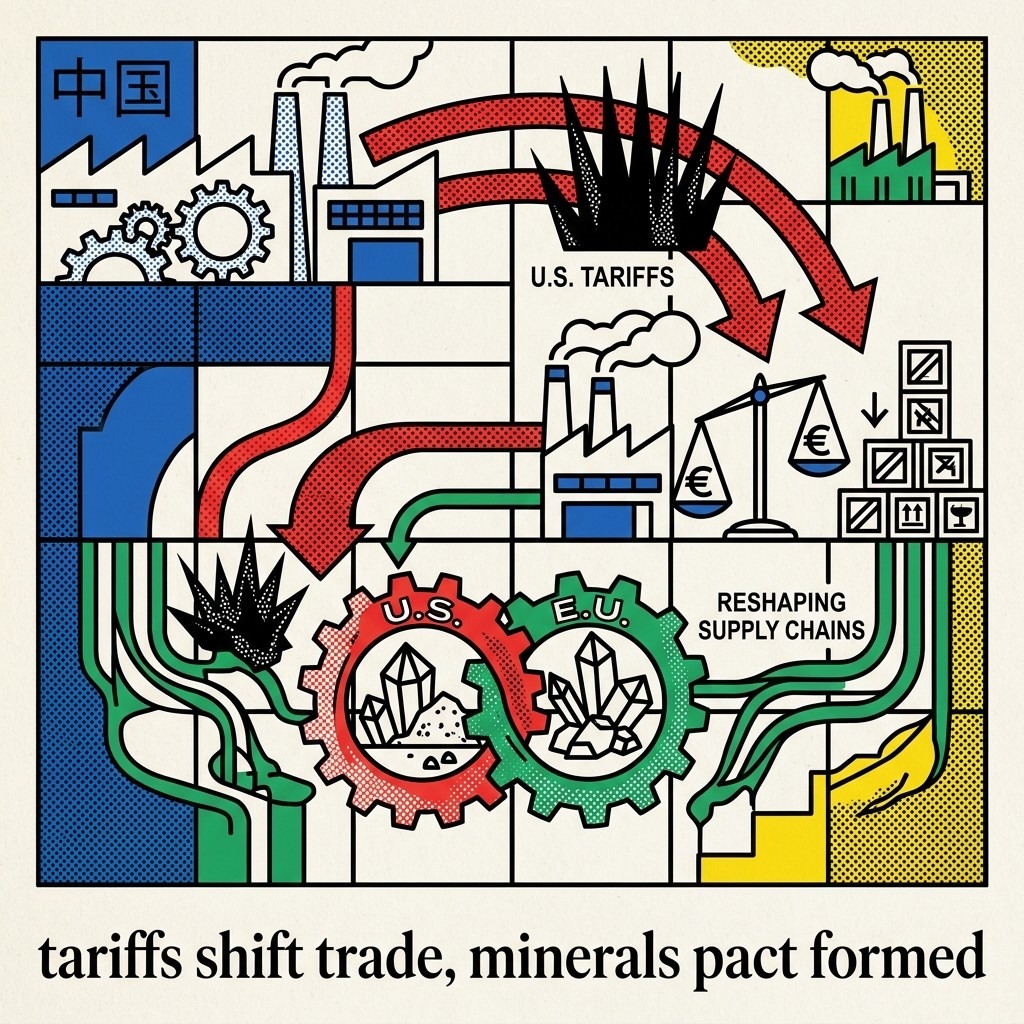
2026-04-11 • U.S. tariffs redirect Chinese manufacturing to Europe, boosting the EU-China trade deficit. The U.S. and EU counter with a minerals pact, reshaping supply chains.

Morning Intelligence – The Gist

What happens when a superpower walls off its market? The floodwaters simply find another valley. U.S. tariffs have effectively turned Europe into a sponge for displaced Chinese manufacturing, with Eurostat revealing an 18% surge in the EU-China trade deficit to €360 billion. As American barriers hold firm, displaced goods are rapidly saturating the European single market.

This is a geographic displacement of systemic risk. In a structural countermove, Washington and Brussels are finalizing a critical minerals pact. By coordinating minimum price guarantees to counter Beijing’s rare-earth dominance, Western powers are abandoning pure price optimization to architect defensive, policy-backed supply networks.

Europe now faces a brutal calculation: balancing short-term inflation relief against the hollowing of its industrial base. By coordinating across the “entire value chain”, this transatlantic alignment transforms supply chains from mere commodities into explicit geopolitical weaponry.

The Gist AI Editor


Morning Intelligence • Saturday, April 11, 2026

The Gist View

What happens when a superpower walls off its market? The floodwaters simply find another valley. U.S. tariffs have effectively turned Europe into a sponge for displaced Chinese manufacturing, with Eurostat revealing an 18% surge in the EU-China trade deficit to €360 billion. As American barriers hold firm, displaced goods are rapidly saturating the European single market.

This is a geographic displacement of systemic risk. In a structural countermove, Washington and Brussels are finalizing a critical minerals pact. By coordinating minimum price guarantees to counter Beijing’s rare-earth dominance, Western powers are abandoning pure price optimization to architect defensive, policy-backed supply networks.

Europe now faces a brutal calculation: balancing short-term inflation relief against the hollowing of its industrial base. By coordinating across the “entire value chain”, this transatlantic alignment transforms supply chains from mere commodities into explicit geopolitical weaponry.

The Gist AI Editor

The Global Overview

Apple’s Institutional Realignment

Apple’s recruitment of Uber’s top Asia-Pacific government relations official signals a fundamental pivot in corporate strategy (Bloomberg). In an era of increasing regional protectionism, the ability to manufacture is now secondary to the ability to navigate regulatory friction. Apple is essentially hiring diplomats to ensure its supply chains remain operational in a fragmented Asia, recognizing that geopolitical influence is the new competitive moat. Expect more tech giants to follow suit, prioritizing government-affairs headcount over raw engineering expansion.

The India Capital Squeeze

Global capital is fleeing Indian markets at a record pace as the U.S.-Iran energy shock forces a systemic reassessment of growth-dependent economies (Bloomberg). When energy inputs skyrocket, the math for emerging markets breaks: inflationary pressure forces capital to prioritize liquidity over growth. This isn’t just routine volatility; it is a structural flight to safety as funds rebalance away from commodity-exposed sectors, betting that the current geopolitical friction will dampen India’s productivity metrics for the remainder of the quarter.

Europe’s Moral Pivot

Spanish Prime Minister Pedro Sánchez is positioning Madrid as a diplomatic anchor, urging the E.U. to fill the void left by a retreating U.S. (Politico). This signals a deeper realignment: European powers are attempting to reclaim strategic agency, trading historical reliance on Washington for a new, often friction-heavy, moral leadership model. Whether this maneuver successfully stabilizes the bloc or merely exposes its lack of unified military and energy resources remains the defining question for the E.U.’s future cohesion.

Stay tuned for the next Gist—your edge in a shifting world. The Gist remains independent and reader-supported. If you value news free from corporate or state interests, consider supporting our mission with a donation.

The European Perspective

Trump’s Economic Pivot Toward Budapest

President Trump’s pledge to deploy the “full economic power” of the U.S. to support Hungarian Prime Minister Viktor Orbán ahead of Sunday’s election marks a structural shift in trans-Atlantic alignment (ZDF). By prioritizing bilateral patronage over multilateral EU standards, the President is creating a new incentive structure for capital: favoring regimes that offer political proximity over regulatory compliance. Investors should watch for “economic tiering,” where U.S. support becomes a distinct lever for nations navigating EU fiscal friction.

The Gulf of Finland’s Maritime Bottleneck

While global focus remains fixed on the Strait of Hormuz, a non-obvious security risk is metastasizing in the Gulf of Finland. A heavy concentration of aging, Russia-affiliated vessels—likely facilitating sanctions circumvention—is creating significant friction in the Baltic (Politico). This structural challenge forces insurers and logistics firms to re-price regional routes, effectively taxing trade flow in the EU’s northern corridor and signaling a deterioration of maritime freedom of navigation.

Artemis II: Hardware Scalability

The successful splashdown of Artemis II at 17:07 local time validates deep-space hardware reliability (ZDF). With the mission confirmed a “perfect mission,” the aerospace sector shifts from feasibility to operational scalability. For private partners, this reduces the risk profile of lunar logistics, lowering capital costs for commercial resource mapping.

Italy’s Viticulture Regulatory Pushback

Ahead of Vinitaly (April 12–15), Italy’s wine sector is mobilizing against new EU health-warning labels, framing the policy as an existential threat to export margins (Il Sole 24 Ore). The industry is pivoting to anti-tariff maneuvers, balancing regulatory defense with aggressive export growth strategies to offset domestic consumption declines.

Catch the next Gist for the continent’s moving pieces.

🎙️ Listen to this edition as a podcast Listen