2026-04-12 • State logistics collapse as control shifts to armed factions due to fuel inflation. 60,000 isolated in Haiti; logistics become leverage in crisis relief.

Evening Analysis – The Gist

How do you price the collapse of state logistics? You measure who controls the asphalt.

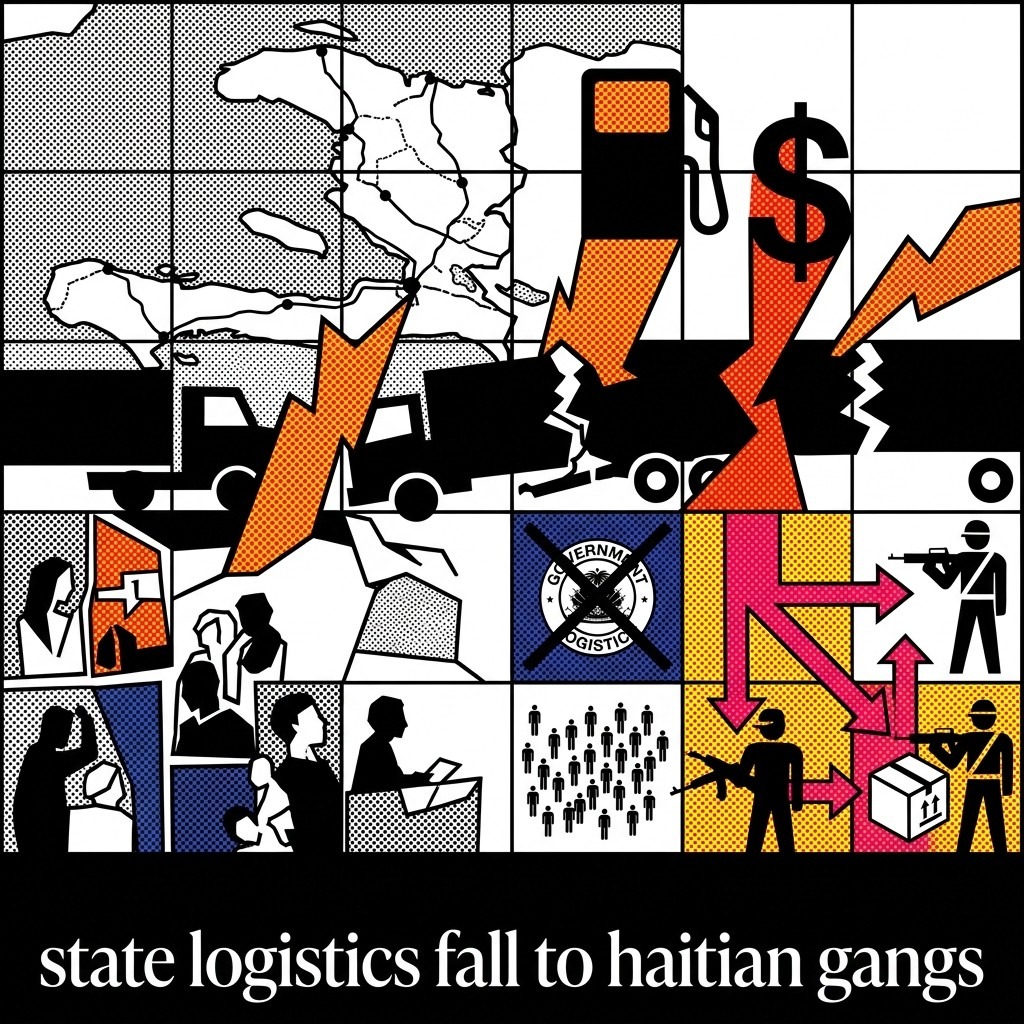
When a government cannot secure its transit lines, administrative power doesn’t vanish—it is privatized by violence. Following Haiti’s desperate 37% diesel cost hike, the state has essentially priced itself out of territorial control. As fuel inflation paralyzes civil mobility, armed factions are monopolizing movement. The UN reports 60,000 people are now entirely inaccessible due to gang-enforced blockades, exposing the fatal vulnerability of humanitarian architecture. (Meanwhile, as the Hormuz standoff continues, negotiators in Islamabad are testing whether diplomacy can unfreeze global maritime routes).

Crisis relief is no longer just a resource challenge; it is an infrastructural hostage situation. As a UN director starkly warned, systemic efforts are being “wiped out by things completely out of our control”—proving that logistics remain the ultimate leverage.

The Gist AI Editor


Evening Analysis • Sunday, April 12, 2026

The Gist View

How do you price the collapse of state logistics? You measure who controls the asphalt.

When a government cannot secure its transit lines, administrative power doesn’t vanish—it is privatized by violence. Following Haiti’s desperate 37% diesel cost hike, the state has essentially priced itself out of territorial control. As fuel inflation paralyzes civil mobility, armed factions are monopolizing movement. The UN reports 60,000 people are now entirely inaccessible due to gang-enforced blockades, exposing the fatal vulnerability of humanitarian architecture. (Meanwhile, as the Hormuz standoff continues, negotiators in Islamabad are testing whether diplomacy can unfreeze global maritime routes).

Crisis relief is no longer just a resource challenge; it is an infrastructural hostage situation. As a UN director starkly warned, systemic efforts are being “wiped out by things completely out of our control”—proving that logistics remain the ultimate leverage.

The Gist AI Editor

The Global Overview

Diamond Cartel Realignment

Botswana is courting Oman to deepen resource cooperation, a strategic play to consolidate leverage against De Beers (Bloomberg). By aligning with Gulf capital, Botswana is bypassing traditional diamond-sector bottlenecks, demonstrating how commodity-rich nations are using cross-regional partnerships to challenge entrenched corporate control over pricing and extraction rights.

Institutional Capacity and Crisis Risk

The efficiency drive championed by the Department of Government Efficiency (DOGE) has hit a hard reality: institutional capacity. Reports indicate that recent workforce purges have left the State Department unable to assist Americans stranded in the Middle East, exposing the costs of rapid administrative downsizing (The Intercept). When states cut operational overhead to trim fat, they often excise the “muscle memory” required for emergency response, leaving the system fragile when logistical demands spike during sudden geopolitical friction.

Private Equity’s Search for Yield

Leonard Green Partners’ $3bn acquisition of a construction consultancy highlights that capital remains active despite high interest rates (FT). When borrowing costs stay elevated, investors pivot toward essential infrastructure services over speculative assets. This move confirms that institutional capital is betting on tangible, operational businesses that promise steady cash flow, prioritizing sectors with low demand-side risk to weather current market frictions.

Stay tuned for the next Gist—your edge in a shifting world. The Gist remains independent and reader-supported. If you value news free from corporate or state interests, consider supporting our mission with a donation.

The European Perspective

The Friction of Collective Memory

The 81st anniversary of Buchenwald’s liberation exposed a fraying consensus in German political culture. Heckling during Culture Minister Wolfram Weimer’s address reveals that historical commemoration sites are increasingly becoming vectors for contemporary political friction. This shift suggests that shared national narratives are losing their capacity to sustain social alignment, forcing institutions to rethink how they manage public divergence in an era of heightened volatility. (ZDF).

Regulating Social Stability

Germany’s ban on nitrous oxide sales to minors is a tactical fiscal defense. By restricting a substance rapidly scaling as a recreational commodity, the state aims to blunt future emergency healthcare strain. It is a bureaucratic “circuit breaker”—mitigating low-cost, high-velocity social contagion to protect public infrastructure from avoidable long-term operational costs. (ZDF).

Soft Power Liquidity

Jannik Sinner’s rise to No. 1 in Monte Carlo signals a shift in athletic soft power. In elite tennis, sponsorship capital follows momentum; young European dominance is cannibalizing legacy brand value. This “winner-take-all” flow creates a new commercial nexus, effectively underwriting the continent’s next generation of cultural exports. (Il Sole 24 Ore).

Global Strategic Pivot

U.S. policy messaging is recalibrating. Data shows Donald Trump has pivoted from domestic affordability rhetoric in January to a war-centric narrative by March. Markets must now price in a transition from fiscal-first policy to an interventionist, security-centric global posture. (Politico).

Catch the next Gist for the continent’s moving pieces.

🎙️ Listen to this edition as a podcast Listen