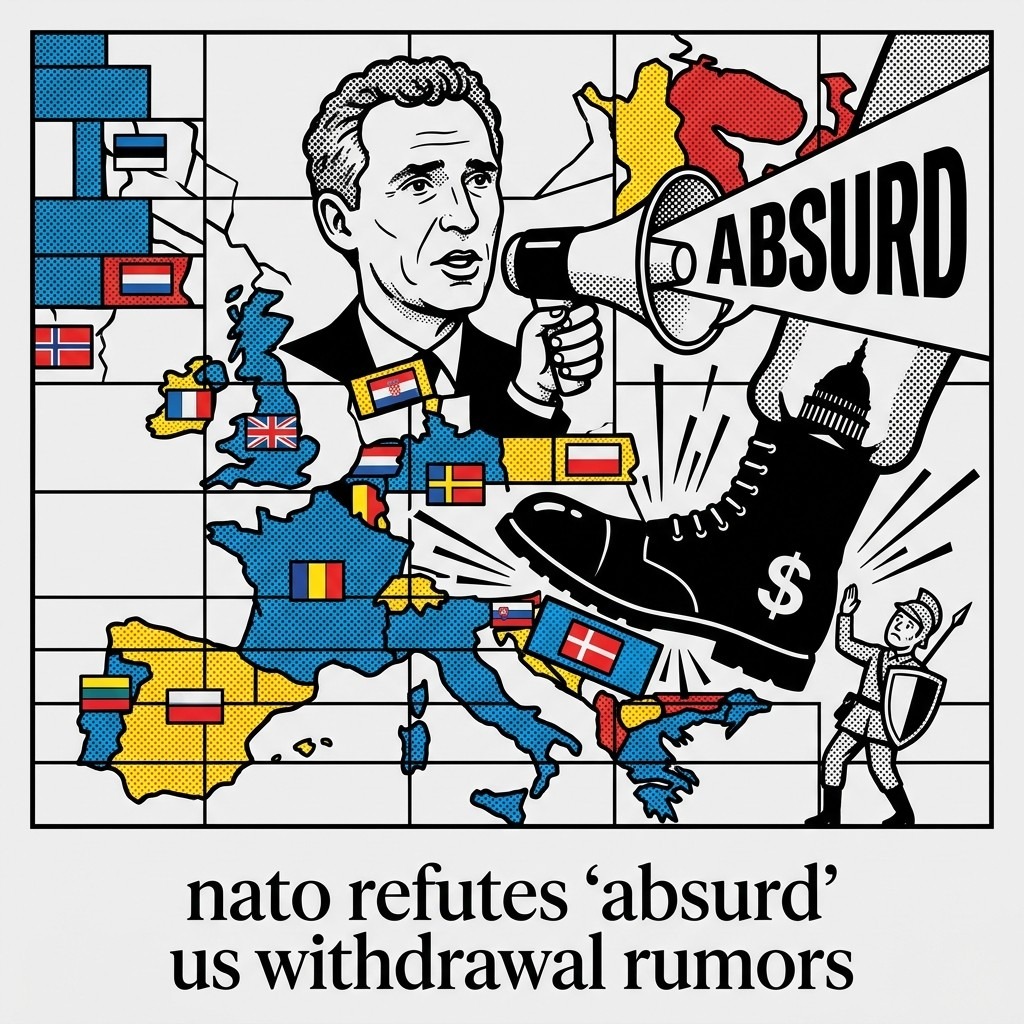
2026-04-18 • NATO’s Secretary General calls U.S. withdrawal rumors “absurd,” highlighting tensions. U.S. pressures Europe to boost defense, shifting geopolitical burdens.

Morning Intelligence – The Gist

The truest barometer of institutional anxiety is what leaders must explicitly deny in public. When NATO’s Secretary General told Welt am Sonntag today that rumors of a U.S. withdrawal are “absurd,” he exposed a structural pivot in global defense architecture. Washington’s friction over allied spending has transformed the transatlantic partnership into a highly leveraged negotiation.

This escalation of internal security tensions reveals the cold mechanics of modern alliances. Threats of U.S. realignment act as strategic coercion, forcing European capitals to rapidly scale their defense industrial bases. This purposefully redistributes the geopolitical burden amid simultaneous resource strains in the Middle East and Ukraine.

While Rutte insists the American nuclear umbrella remains Europe’s “ultimate guarantor,” the underlying math is shifting. Although officially exiting NATO requires a two-thirds U.S. Senate majority, the alliance’s future durability will be dictated by the raw arithmetic of independent industrial output, not inherited treaties.

The Gist AI Editor


Morning Intelligence • Saturday, April 18, 2026

The Gist View

The truest barometer of institutional anxiety is what leaders must explicitly deny in public. When NATO’s Secretary General told Welt am Sonntag today that rumors of a U.S. withdrawal are “absurd,” he exposed a structural pivot in global defense architecture. Washington’s friction over allied spending has transformed the transatlantic partnership into a highly leveraged negotiation.

This escalation of internal security tensions reveals the cold mechanics of modern alliances. Threats of U.S. realignment act as strategic coercion, forcing European capitals to rapidly scale their defense industrial bases. This purposefully redistributes the geopolitical burden amid simultaneous resource strains in the Middle East and Ukraine.

While Rutte insists the American nuclear umbrella remains Europe’s “ultimate guarantor,” the underlying math is shifting. Although officially exiting NATO requires a two-thirds U.S. Senate majority, the alliance’s future durability will be dictated by the raw arithmetic of independent industrial output, not inherited treaties.

The Gist AI Editor

The Global Overview

Australia-Japan Warship Deal

Australia and Japan have signed a A$10 billion ($7 billion) contract for warship production, marking Tokyo’s most significant military export since ending its 2014 ban (Straits Times). This creates a new security axis: by integrating Japan’s high-precision manufacturing into Australia’s naval supply chain, Canberra mitigates the risk of reliance on single-source, Western-centric defense pipelines. For Tokyo, this validates a pivotal shift toward active regional power projection, transforming its defense industry from a domestic protectionist asset into a critical international security pillar.

India’s North-South Federal Friction

India’s parliamentary expansion plan has sparked a structural tug-of-war. The government’s move to redistribute seats based on population shifts favors the industrial and political North, but threatens to dilute the influence of the Southern states—the engine of India’s economic development (Bloomberg). This is a classic federal bottleneck: how to align political representation with changing economic demographics without alienating the nation’s productive core. The outcome will likely dictate the next decade of fiscal allocation and internal stability.

Airbnb’s Pivot to Hotels

Airbnb is integrating hotel inventory onto its platform, signaling a retreat from its “asset-light” purity (FT). Facing regulatory headwinds and consumer fatigue in home-sharing, the company is pivoting to compete on traditional operational metrics. Airbnb is effectively conceding that the era of disruptive, unchecked growth is over, and it must now consolidate into a reliable travel utility to satisfy shareholder demands for scale and inventory density.

Fermi’s Leadership Vacuum

Shares of Fermi, the infrastructure firm spearheading massive AI data center campuses, plunged 31% following the sudden exit of CEO Toby Neugebauer (Bloomberg). In high-CAPEX sectors like AI infrastructure, capital is tethered to individual visionaries who navigate complex zoning and utility dependencies. The market’s sharp reaction confirms that for speculative, massive-scale utility projects, leadership is not just managerial—it is the primary risk-mitigation asset. When that anchor vanishes, capital flight is immediate.

Stay tuned for the next Gist—your edge in a shifting world. The Gist remains independent and reader-supported. If you value news free from corporate or state interests, consider supporting our mission with a donation.

The European Perspective

Strategic Autonomy in R&D

German research policy is pivoting toward “hard” science as a pillar of sovereignty, with Research Minister Dorothee Bär prioritizing multibillion-euro investments in nuclear fusion and lunar exploration (Politico). The systemic incentive here is clear: decoupling European technological capability from reliance on external tech stacks. By betting on high-barrier physics, Berlin is attempting to secure long-term competitive advantages that cannot be easily outsourced, effectively turning R&D into a national security asset.

Blue Economy’s Human Capital Deficit

While maritime infrastructure capitalizes on global supply chain reconfiguration, the sector faces an acute structural barrier: a 175,000-person labor gap expected over the next five years (Il Sole 24 Ore). This is not merely a hiring slump; it is a mismatch between high-tech maritime requirements and available skills. As the blue economy expands, companies that cannot automate or attract specialized talent will see margins eroded by wage inflation and operational bottlenecks.

European Construction’s Macro Shift

European construction is transitioning from economic stasis to a structural rebound, with real growth projected at 2.4% in 2026, a marked acceleration from the stagnant 0.3% recorded last year (IFO). This shift signals that capital is finally re-entering the physical infrastructure space, moving away from defensive liquidity holding toward tangible, high-value asset development. Expect this momentum to hold, with forecasts estimating continued expansion of 2.2% in 2027 and 1.9% in 2028, effectively ending the sector’s post-pandemic “idle” phase as investment flows into long-term energy grid and housing stability.

The Security-Cultural Frontier

Poland’s decision to cancel the Kanye West concert underscores a broadening definition of national security: states are now aggressively vetting “soft power” vectors—culture, entertainment, and public space availability—as potential fronts for ideological destabilization (DW). By effectively blacklisting high-profile figures on moral-ideological grounds, the Polish state is establishing a precedent where public space usage is directly contingent on alignment with national core values, marking a departure from neutral cultural exchange to state-curated public discourse.

Hormuz Security Realignment

European leaders are forging ahead with a multinational effort to secure the Strait of Hormuz, maintaining the mission despite President Trump’s explicit directive to “STAY AWAY” (Politico). This maneuver indicates a deepening strategic independence: European powers are prioritizing the security of their energy lifelines over alignment with US mandates, signaling a willingness to risk diplomatic friction to insulate domestic markets from energy supply shocks.

Catch the next Gist for the continent’s moving pieces.

🎙️ Listen to this edition as a podcast Listen