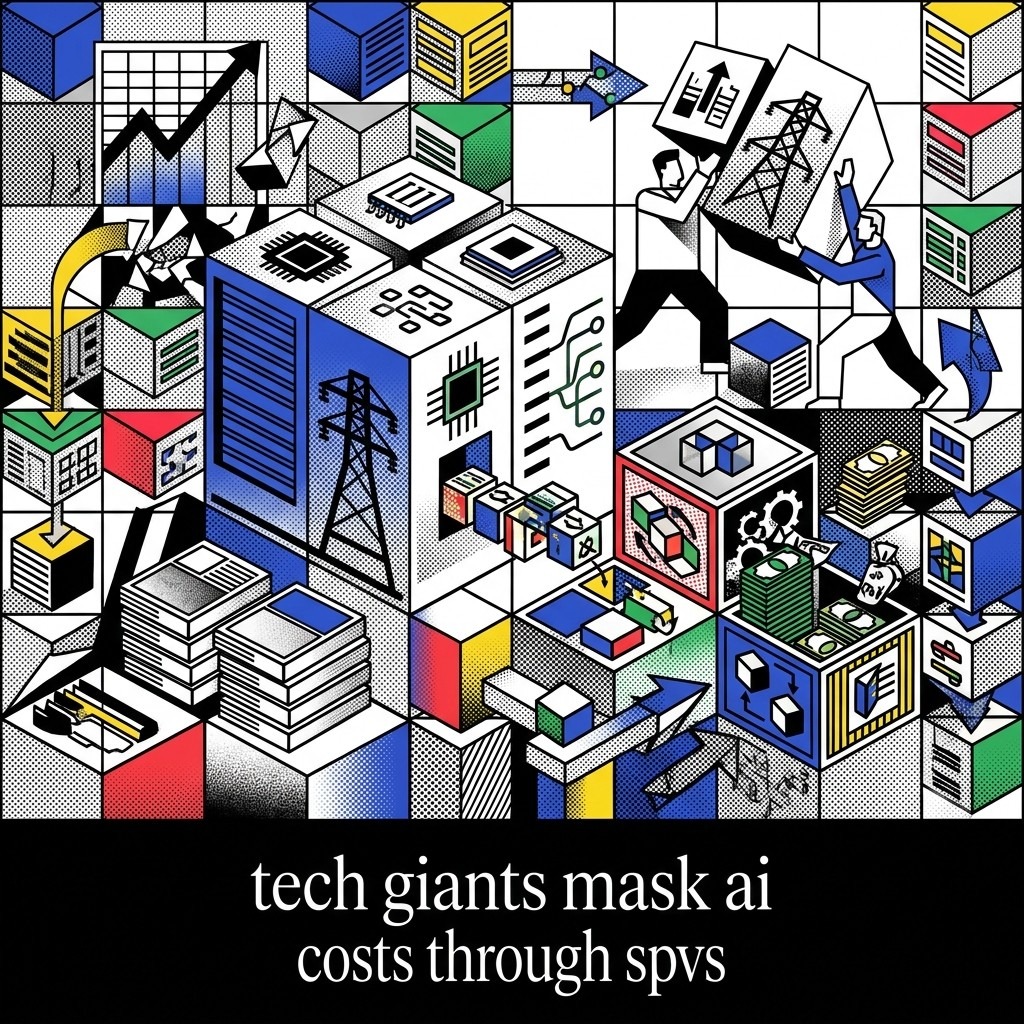
2026-04-24 • Tech giants use SPVs to hide AI infrastructure costs, keeping debt off books. Meta absorbs $6.5B, with $400B in bonds expected. Risks grow with complexity.

Evening Analysis – The Gist

When does a tech conglomerate become a high-risk real estate developer? When it needs to build a trillion-dollar infrastructure pipeline without letting Wall Street see the bill. Silicon Valley is quietly reviving the Special Purpose Vehicle (SPV) to keep explosive artificial intelligence expenditures off corporate balance sheets, insulating stock valuations from the realities of hardware debt.

The scale of this shadow-financing is staggering. Disclosures reveal Meta is absorbing $6.5 billion in premium financing costs to keep $27 billion of AI infrastructure borrowing off its books. Oracle and xAI are deploying identical structures, while Morgan Stanley estimates hyperscalers will raise $400 billion in corporate bonds this year. Shifting hardware debt into rental agreements maintains the illusion of asset-light growth.

This financial engineering masks the true leverage of the AI arms race. Big Tech is underwriting its own shadow-banking system. As analysts warn, “more debt and more complexity mean more risk”, fundamentally testing the structural limits of corporate infrastructure debt.

The Gist AI Editor


Evening Analysis • Friday, April 24, 2026

The Gist View

When does a tech conglomerate become a high-risk real estate developer? When it needs to build a trillion-dollar infrastructure pipeline without letting Wall Street see the bill. Silicon Valley is quietly reviving the Special Purpose Vehicle (SPV) to keep explosive artificial intelligence expenditures off corporate balance sheets, insulating stock valuations from the realities of hardware debt.

The scale of this shadow-financing is staggering. Disclosures reveal Meta is absorbing $6.5 billion in premium financing costs to keep $27 billion of AI infrastructure borrowing off its books. Oracle and xAI are deploying identical structures, while Morgan Stanley estimates hyperscalers will raise $400 billion in corporate bonds this year. Shifting hardware debt into rental agreements maintains the illusion of asset-light growth.

This financial engineering masks the true leverage of the AI arms race. Big Tech is underwriting its own shadow-banking system. As analysts warn, “more debt and more complexity mean more risk”, fundamentally testing the structural limits of corporate infrastructure debt.

The Gist AI Editor

The Global Overview

Big Tech’s AI Arms Race

Google’s $10 billion entry into Anthropic, at a $350 billion valuation with $30 billion more planned, mirrors an arms race for digital propellant (Bloomberg). By securing control over foundational AI architecture, Google is ensuring it dominates the utility layer—the equivalent of owning the power grid during an industrial revolution—rather than merely selling consumer applications. This is capital deployed not just for profit, but for territorial control of the next economic infrastructure.

Clearing the Fed’s Path

The DOJ’s decision to drop the probe into Fed renovation costs clears the runway for Kevin Warsh’s confirmation (Bloomberg). As gold prices climb, markets are pricing in a “Warsh Effect”: a likely shift toward rate cuts to prioritize liquidity over inflation defense. It is a systemic recalibration, moving from the current cautious, defensive posture to one of aggressive monetary accommodation to grease the gears of a slowing economy.

The Pragmatic Pivot

Lotus is hedging against EV-only mandates by pivoting to plug-in hybrids, acknowledging that infrastructure limitations are strangling premium demand (FT). Similarly, Western Union’s profit slump underscores how tightening migration policy acts as a throttle on global remittance flows (WSJ). Both reflect a systemic return to pragmatism: markets are finding workarounds where rigid policy has created friction, forcing companies to retool their strategies to survive real-world limitations.

Stay tuned for the next Gist—your edge in a shifting world. The Gist remains independent and reader-supported. If you value news free from corporate or state interests, consider supporting our mission with a donation.

The European Perspective

OpenAI’s Productivity Pivot

OpenAI has launched GPT-5.5, a model explicitly architected to dominate coding, high-level office workflows, and early-stage scientific research (Euronews). This isn’t merely a software update; it is a structural attempt to embed proprietary AI deeper into the R&D stack. By capturing the scientific and engineering workflow, OpenAI incentivizes enterprise adoption, turning a sophisticated tool into an operational necessity. The capital flow here is clear: organizations that integrate these models to automate the “intellectual heavy lifting” are positioning themselves to outpace competitors who rely on legacy human capital, effectively changing the cost-basis of innovation.

The $111 Billion Media Gatekeeper

Shareholders have greenlit the massive $111 billion Paramount takeover of Warner Bros. Discovery (Euronews). In a market fractured by streaming fatigue, this deal is an exercise in defensive consolidation. The systemic incentive is simple: scale or be marginalized. By merging two giants, the new entity creates a singular, vertical gatekeeper capable of squeezing content costs and dominating distribution channels. This is a clear move to centralize power against tech-native streaming competitors, betting that legacy IP can only survive if it becomes “too big to ignore.”

Agricultural Disruption as Economic Weapon

The war in Lebanon has triggered a catastrophic breakdown in regional stability, with $20 billion in economic damages and 80% of southern farmers forced from their land (Il_Sole_24_Ore). Beyond the immediate humanitarian cost, this represents a structural rupture in food supply chains. The abandonment of arable land signals a forced, long-term pivot toward import dependence, which will inevitably strain local trade balances and drive systemic inflationary pressure on food costs across the region.

Germany’s Political and Industrial Calculus

The European construction sector is finally exiting its period of stagnation. After a negligible 0.3% growth last year, forecasts now project a 2.4% real increase for 2026, indicating a return of capital into long-delayed infrastructure and housing (IFO). Meanwhile, the political machinery is accelerating: the race for the German presidency has intensified, with CSU leader Markus Söder backing Ilse Aigner (ZDF). This move is a distinct signal of the CSU’s intent to leverage internal party dynamics to reassert Bavarian influence over federal fiscal and political policy.

Catch the next Gist for the continent’s moving pieces.

🎙️ Listen to this edition as a podcast Listen