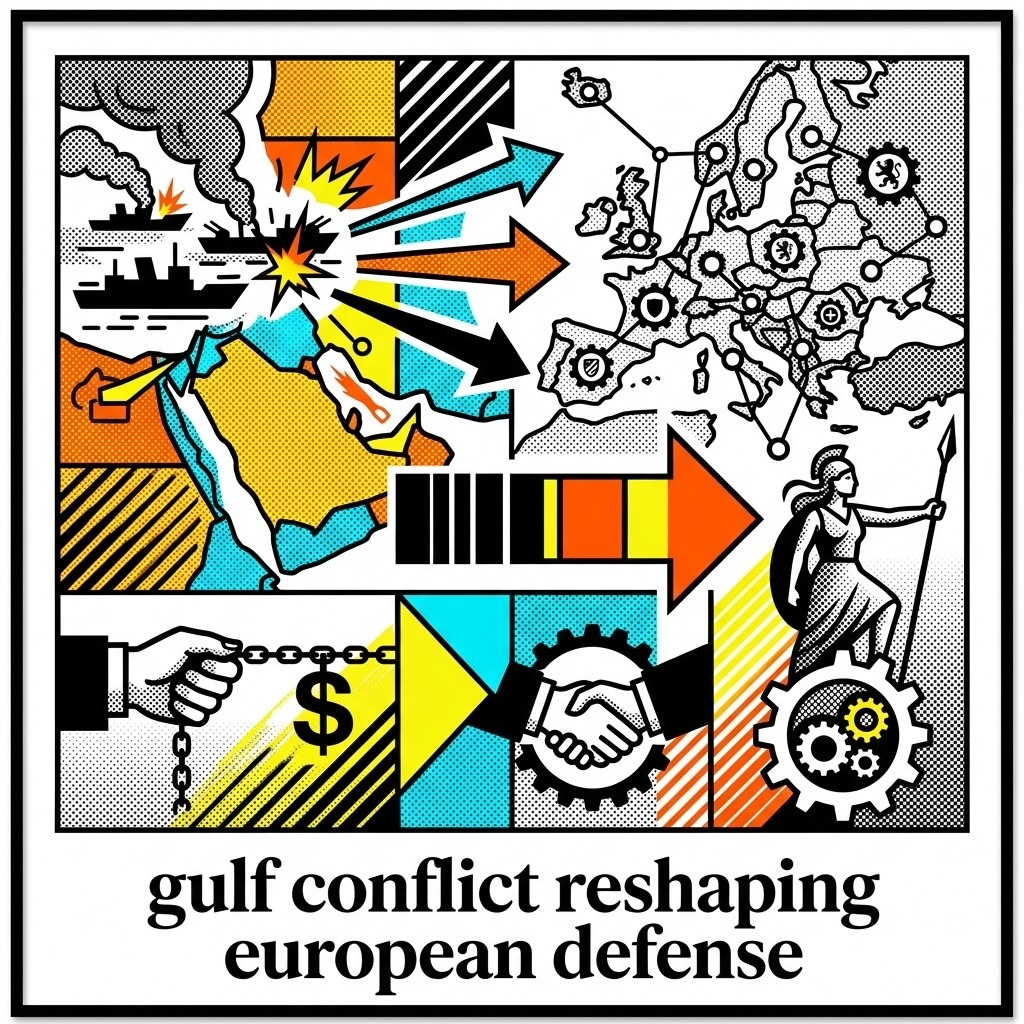
2026-04-24 • The Persian Gulf skirmish is reshaping Europe’s defense as reliance on U.S. security wanes, forcing sovereignty and economic recalibration.

Morning Intelligence – The Gist

Why is a Persian Gulf skirmish rewriting Europe’s defense architecture? Because transatlantic security math has broken. After President Trump ordered naval forces to “shoot and kill” Iranian mine-laying vessels, oil rapidly breached $100 per barrel. Consequently, the EU is urgently stress-testing its mutual defense protocols at a Cyprus summit.

As the Hormuz blockade continues, the structural reality clarifies: outsourced European security is dead. Washington’s absolute absorption in Middle Eastern conflicts forces a radical power recalculation. Even Europe’s populist right is severing ties, realizing the imported inflation of American interventions actively destabilizes domestic economies.

This is the forced recapitalization of sovereignty. Markets are pricing in this geopolitical premium, aggressively slashing Fed rate-cut bets as energy shocks loom. As Citadel Global notes, this “underscores the market’s anxiety”—proving that when America retracts its security umbrella, global capital immediately foots the bill.

The Gist AI Editor


Morning Intelligence • Friday, April 24, 2026

The Gist View

Why is a Persian Gulf skirmish rewriting Europe’s defense architecture? Because transatlantic security math has broken. After President Trump ordered naval forces to “shoot and kill” Iranian mine-laying vessels, oil rapidly breached $100 per barrel. Consequently, the EU is urgently stress-testing its mutual defense protocols at a Cyprus summit.

As the Hormuz blockade continues, the structural reality clarifies: outsourced European security is dead. Washington’s absolute absorption in Middle Eastern conflicts forces a radical power recalculation. Even Europe’s populist right is severing ties, realizing the imported inflation of American interventions actively destabilizes domestic economies.

This is the forced recapitalization of sovereignty. Markets are pricing in this geopolitical premium, aggressively slashing Fed rate-cut bets as energy shocks loom. As Citadel Global notes, this “underscores the market’s anxiety”—proving that when America retracts its security umbrella, global capital immediately foots the bill.

The Gist AI Editor

The Global Overview

The Diplomatic Pivot

President Trump’s brokered three-week ceasefire between Israel and Lebanon provides the critical decompression window needed to unwind the US-Iran conflict. Yet, this transactional diplomacy exposes a widening transatlantic rift. Polish PM Donald Tusk’s push to bolster the EU’s own mutual defence clause (Article 42.7) confirms that European leadership no longer views US security guarantees as absolute, forcing a quiet, structural decoupling in regional defense strategy (FT).

The State as Shareholder

President Trump’s suggestion that the US government could “just buy” Spirit Airlines signals a sharp pivot toward state-directed industrial policy. By floating nationalization as a stabilization tool, the administration is blurring the line between market insolvency and public utility. This forces private equity to reconsider capital allocation in “too-big-to-fail” sectors that lack a clear path to federal backstops, fundamentally altering the risk-reward calculus for transport and logistics (WSJ).

The Private Credit Trap

Investors are exploiting valuation gaps in private credit, where loans use “marked-to-model” pricing—valuing assets based on internal estimates rather than current cash trades—to mask liquidity issues. This arbitrage allows savvy players to extract value while funds struggle with redemption bottlenecks. It is akin to musical chairs where the music stopped, but participants continue to move to avoid realizing losses; a friction point that risks wider contagion (WSJ).

Silicon Sovereignty

Taiwan’s decision to lift investment limits on single-stock holdings is a calculated move to concentrate capital in TSMC. By removing the ceiling on institutional exposure, regulators are forcing fund managers to consolidate bets on the world’s most critical contract chipmaker. This prioritizes industrial efficiency over risk diversification, ensuring Taiwan’s semiconductor champion remains flush with the liquidity required to maintain its technological edge amid global supply chain hardening (WSJ).

Stay tuned for the next Gist—your edge in a shifting world. The Gist remains independent and reader-supported. If you value news free from corporate or state interests, consider supporting our mission with a donation.

The European Perspective

The G20 Gambit

President Trump’s signal that inviting Vladimir Putin to December’s Miami G20 summit could be “helpful” marks a critical inflection point for global markets. Investors are interpreting this as a potential transactional pivot: prioritizing a tactical energy-security detente to reopen supply lines—stalled by the ongoing Hormuz blockade—over sustained containment. For capital, this introduces a new risk premium. Markets are pricing this against the reality of current energy-sector volatility; if the White House shifts from conflict-containment to diplomatic-negotiation, expect defensive energy positions to reprice rapidly (ZDF).

Fiscal Shifts in Health

MEPs are pushing for a €20 billion expansion in the EU budget dedicated to health. The non-obvious angle here is the reallocation of capital: this is not merely for public welfare, but a strategic infusion into pharma, digital infrastructure, and military health systems. The bloc is structurally pivoting health spending from a social expense into a pillar of industrial sovereignty and supply-chain hardening. Investors should view this as a durable shift toward state-backed bio-security, insulating these sectors from broader economic cycles (Politico).

The Post-Orbán Pivot

With the ouster of Viktor Orbán, European leadership is entering a transition phase. As the Council moves toward António Costa’s informal, consensus-driven style, the structural vacuum left by populist obstructionism is rapidly filling with a push for deeper fiscal integration. This shift fundamentally alters the internal mechanics of the EU, effectively lowering the “political risk premium” that historically hindered long-term legislative agendas (Guardian, Politico).

Tactical Resilience

Stuttgart’s VfB secured a 2-1 win over Freiburg in the DFB-Pokal, setting up a final clash against Bayern Munich. A masterclass in grinding out results under high-pressure conditions (ZDF).

Catch the next Gist for the continent’s moving pieces.

🎙️ Listen to this edition as a podcast Listen