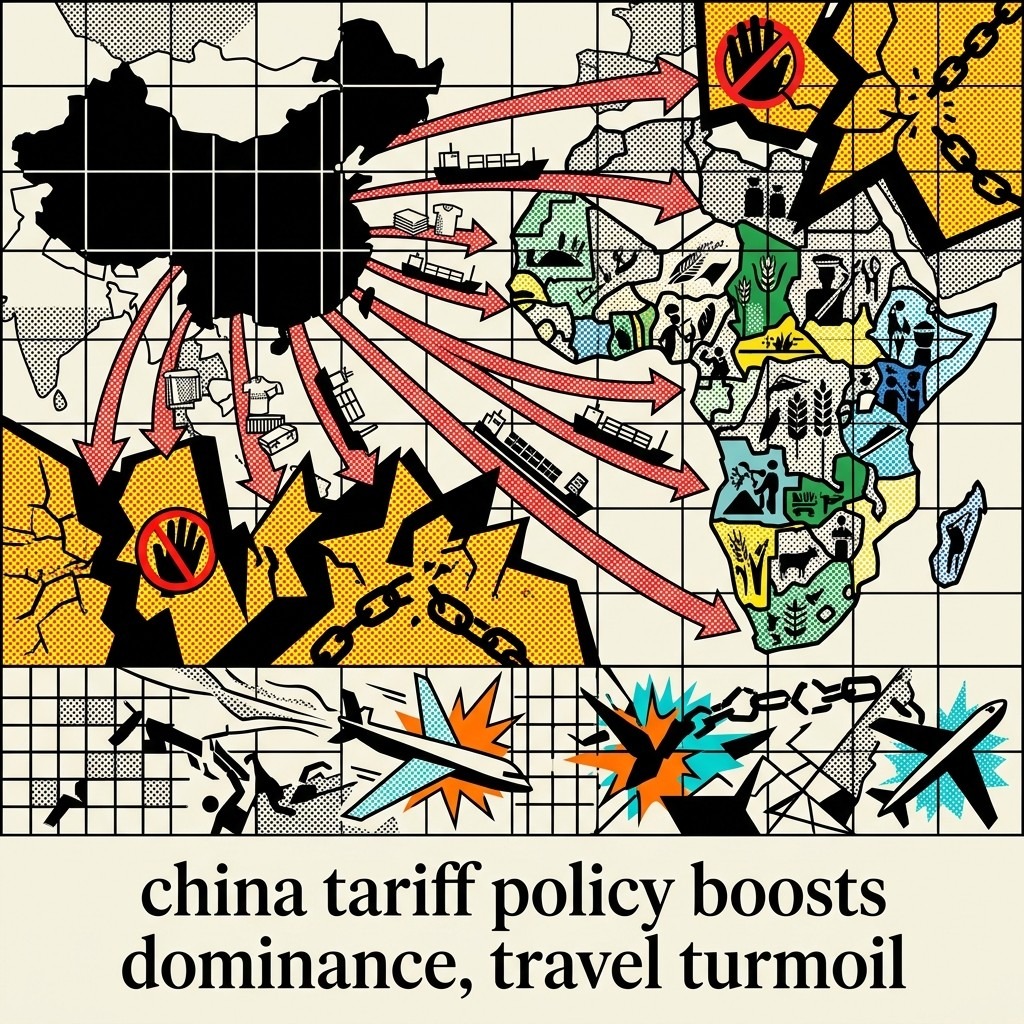
2026-05-01 • China’s zero-tariff policy for 53 African nations counters Western protectionism, boosting its trade dominance. Meanwhile, global travel faces turmoil.

Evening Analysis – The Gist

While the West erects tariff walls, Beijing is quietly buying the moat. At midnight, China’s sweeping zero-tariff policy for 53 African nations took effect. This isn’t benevolence; it’s a structural power play. By absorbing imports like today’s inaugural 24-ton South African shipment, Beijing weaponizes a record $348 billion trade ecosystem, locking the Global South into its architecture just as Western markets embrace protectionism.

Simultaneously, global mobility is violently unwinding. As the U.S. airline nationalization saga continues, the broader international sector is fracturing under the Hormuz-induced jet-fuel squeeze. With carriers like Lufthansa preemptively slashing 20,000 flights and budget airlines facing liquidation, cheap travel’s peacetime energy subsidy has expired.

Market access is returning to a premium asset. As aviation analyst Dan Akins observes regarding this consolidation, dominant giants will now “leverage non-price factors to tighten their grip”.

The Gist AI Editor


Evening Analysis • Friday, May 01, 2026

The Gist View

While the West erects tariff walls, Beijing is quietly buying the moat. At midnight, China’s sweeping zero-tariff policy for 53 African nations took effect. This isn’t benevolence; it’s a structural power play. By absorbing imports like today’s inaugural 24-ton South African shipment, Beijing weaponizes a record $348 billion trade ecosystem, locking the Global South into its architecture just as Western markets embrace protectionism.

Simultaneously, global mobility is violently unwinding. As the U.S. airline nationalization saga continues, the broader international sector is fracturing under the Hormuz-induced jet-fuel squeeze. With carriers like Lufthansa preemptively slashing 20,000 flights and budget airlines facing liquidation, cheap travel’s peacetime energy subsidy has expired.

Market access is returning to a premium asset. As aviation analyst Dan Akins observes regarding this consolidation, dominant giants will now “leverage non-price factors to tighten their grip”.

The Gist AI Editor

The Global Overview

The Auto Industry’s New Border Tax

President Trump is mandating a 25% tariff on European vehicles exported to the U.S., effective “next week” (FT). The mechanism is simple: force foreign capital to onshore manufacturing or be taxed out of the American consumer base. It is a blunt instrument that transforms supply chains into political leverage, signaling the end of the era of globalized cost-efficiency in favor of a “localize-or-pay” industrial policy.

Airline Turbulence and Capital Discipline

The collapse of a proposed $500 million government bailout for Spirit Airlines underscores a hardening of systemic tolerance for corporate inefficiency (WSJ). As bondholders retreat and rescue deals vaporize, the industry faces a sharp survival-of-the-fittest cycle. Unlike the blanket support of previous years, this indicates that financial assistance is increasingly reserved for firms with critical strategic utility, rather than those relying purely on market scale.

Space Narratives and Economic Divergence

While NASA’s Artemis II crew rang the Nasdaq closing bell (NASA), the optimism of the space economy contrasts sharply with the austerity hitting commercial aviation. Capital is clearly being funneled into defense-adjacent, high-tech sectors, while traditional industries face punitive tariffs and funding droughts. It is a clear allocation signal: in the current system, the future is subsidized, while the past is left to market fate.

Stay tuned for the next Gist—your edge in a shifting world. The Gist remains independent and reader-supported. If you value news free from corporate or state interests, consider supporting our mission with a donation.

The European Perspective

The Capitalist Realignment

The formal transfer of RadiciGroup’s specialty chemical and polymer assets to US ownership on April 30 underscores a deepening industrial migration (Il Sole 24 Ore). This shift reflects a form of defensive trade protectionism: as energy-intensive manufacturing struggles under European overhead, capital flows to US balance sheets, where fiscal resilience is prioritized. The system is incentivizing a hollow-out of regional industrial capacity in favor of cross-Atlantic consolidation.

Aviation’s Fiscal Gravity

Airline instability remains a structural pressure point. As carriers contend with volatile fuel and labor demands, the ‘Activist Capital Shift’ (Day 4) is forcing a rethink of industrial ownership under President Trump. Markets are no longer pricing solely on operational efficiency; they are calculating the probability of state intervention. The incentive is binary: carriers must deleverage rapidly or risk becoming conduits for government-led industrial policy.

The Management Algorithm

AI is encroaching on corporate middle management, where the ‘space of judgment’ is rapidly shrinking (Le Monde). By digitizing executive discretion, firms risk replacing institutional intuition with rigid throughput. This trade-off prioritizes short-term efficiency but erodes the long-term adaptability essential for complex firm management.

The Orbital Monopoly

SpaceX’s $15 billion Starship investment is rewriting orbital economics (Il Sole 24 Ore). By commoditizing low-earth orbit access, private capital is creating a moat around global infrastructure that traditional state-led launch providers struggle to bridge.

Catch the next Gist for the continent’s moving pieces.

🎙️ Listen to this edition as a podcast Listen