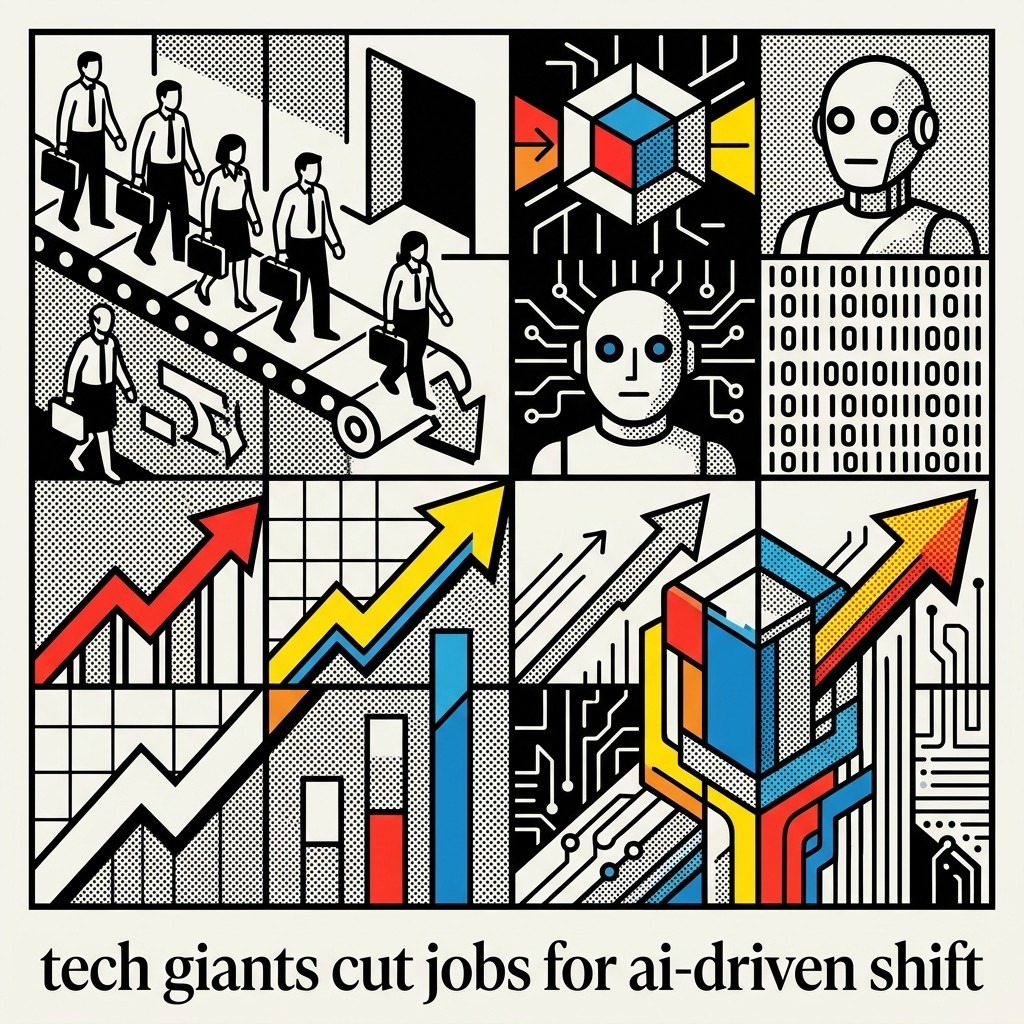
2026-05-02 • Tech giants are cutting jobs, reallocating resources from human to AI capital, despite high revenues, signaling a shift to AI-driven models.

Evening Analysis – The Gist

Why are the world’s most cash-rich tech giants suddenly cannibalizing their own workforces? Building on this week’s ongoing debate over AI’s strategic trajectory, we are witnessing a systemic substitution of human capital for compute capital. This isn’t a sign of corporate distress; it is a deliberate, structural reallocation of global resources.

Meta just confirmed plans to slash 8,000 jobs—10% of its workforce—beginning May 20. Concurrently, Oracle is eliminating up to 30,000 roles worldwide. Despite reporting record revenues, the technology sector has already shed over 95,000 jobs in 2026. Legacy operational budgets are rapidly being liquidated to fund billions in specialized AI infrastructure.

This systemic contraction reveals the underlying mechanics of a new AI-native operating model. As industry analysis points out, the tech sector isn’t shrinking; it is simply swapping carbon for silicon, proving that “the job description for a tech worker is being rewritten by the very algorithms they helped build”.

The Gist AI Editor


Evening Analysis • Saturday, May 02, 2026

The Gist View

Why are the world’s most cash-rich tech giants suddenly cannibalizing their own workforces? Building on this week’s ongoing debate over AI’s strategic trajectory, we are witnessing a systemic substitution of human capital for compute capital. This isn’t a sign of corporate distress; it is a deliberate, structural reallocation of global resources.

Meta just confirmed plans to slash 8,000 jobs—10% of its workforce—beginning May 20. Concurrently, Oracle is eliminating up to 30,000 roles worldwide. Despite reporting record revenues, the technology sector has already shed over 95,000 jobs in 2026. Legacy operational budgets are rapidly being liquidated to fund billions in specialized AI infrastructure.

This systemic contraction reveals the underlying mechanics of a new AI-native operating model. As industry analysis points out, the tech sector isn’t shrinking; it is simply swapping carbon for silicon, proving that “the job description for a tech worker is being rewritten by the very algorithms they helped build”.

The Gist AI Editor

The Global Overview

The Spirit Collapse and Market Consolidation

The collapse of Spirit Airlines (Bloomberg) serves as a stark case study in structural fragility. When an ultra-low-cost carrier, built on razor-thin margins, encounters a systemic shock, it does not simply fold; it triggers an immediate competitive reallocation of assets. Larger, better-capitalized rivals are already pivoting to inherit the stranded market share and airport gate capacity, effectively accelerating industry concentration. The systemic lesson here is simple: without a financial buffer, niche business models inevitably succumb to the market’s gravity toward scale.

Geopolitical Sovereignty and Aerial Blockades

Taiwan’s President Lai Ching-te’s arrival in Eswatini (Bloomberg) confirms that international travel is no longer mere logistics—it is active power projection. With several China-aligned nations effectively closing their airspace, Lai’s successful rerouting illustrates how Beijing is weaponizing bureaucratic bottlenecks to assert control. This is the emerging reality of global order: airspace is increasingly serving as a direct extension of territorial leverage, forcing leaders to treat routine travel as a complex, high-stakes military maneuver.

The Regulatory Vacuum in Digital Childhood

Global moves to restrict children’s digital access (Marginal Revolution) create a profound, unintended trade-off: the erosion of independent cognitive development. By prioritizing institutional “safety” and banning social media accounts, governments are effectively pushing youth into state-sanctioned digital boxes. We are stripping the next generation of digital autonomy, transforming the internet from an open frontier into a fenced, monitored park.

Systemic Resilience of Russian Energy

Russian oil exports remain largely unaffected by Ukrainian strikes (WSJ), demonstrating that capital flows consistently bypass geopolitical friction. Global markets prioritize supply continuity, and the “shadow fleet” ensures energy reaches buyers regardless of military or sanction-based interference. Until alternative energy capacity scales significantly, Moscow retains the financial leverage to maintain its current strategic posture.

Stay tuned for the next Gist—your edge in a shifting world. The Gist remains independent and reader-supported. If you value news free from corporate or state interests, consider supporting our mission with a donation.

The European Perspective

The Human-AI Boundary Hardens

The Academy of Motion Picture Arts and Sciences has drawn a red line: for the 99th Oscars, nominations require proof of human performance. This is a structural move to protect creative labor value against algorithmic substitution. Simultaneously, political friction is intensifying; despite administration mandates to deregulate, 75% of Trump voters now support government oversight of AI (Politico). This creates a distinct regulatory arbitrage: while tech capital aggressively funds automation, democratic institutions and consumer preference are coalescing around “human veto” structures to preserve market legitimacy and prevent widespread creative devaluation.

Pharma’s Pediatric Pivot

The WHO’s approval of Coartem Baby marks a significant shift in global health economics. Historically, newborns were excluded from standard malaria treatments, leaving the most vulnerable untreated. By creating a standardized, safe dosing pathway for infants, the pharmaceutical sector—led by Novartis—is unlocking a critical, previously unaddressed market segment (Guardian). With malaria responsible for 610,000 deaths in 2024, this move illustrates a structural transition: precision medicine is now the primary mechanism for both improving humanitarian outcomes and expanding addressable patient bases in emerging economies.

Biology as Software

Biologist Denis Duboule’s work in “evo-devo”—evolutionary developmental biology—is quietly recalibrating biotech strategy (Le Monde). By decoding how identical genetic “bricks” construct diverse life forms, the field is transitioning from descriptive observation to predictive architecture. Capital is shifting away from blunt gene editing toward the regulatory “software” that governs biological development, signaling a future where synthetic biology competes on engineering precision rather than raw material access.

Catch the next Gist for the continent’s moving pieces.

🎙️ Listen to this edition as a podcast Listen