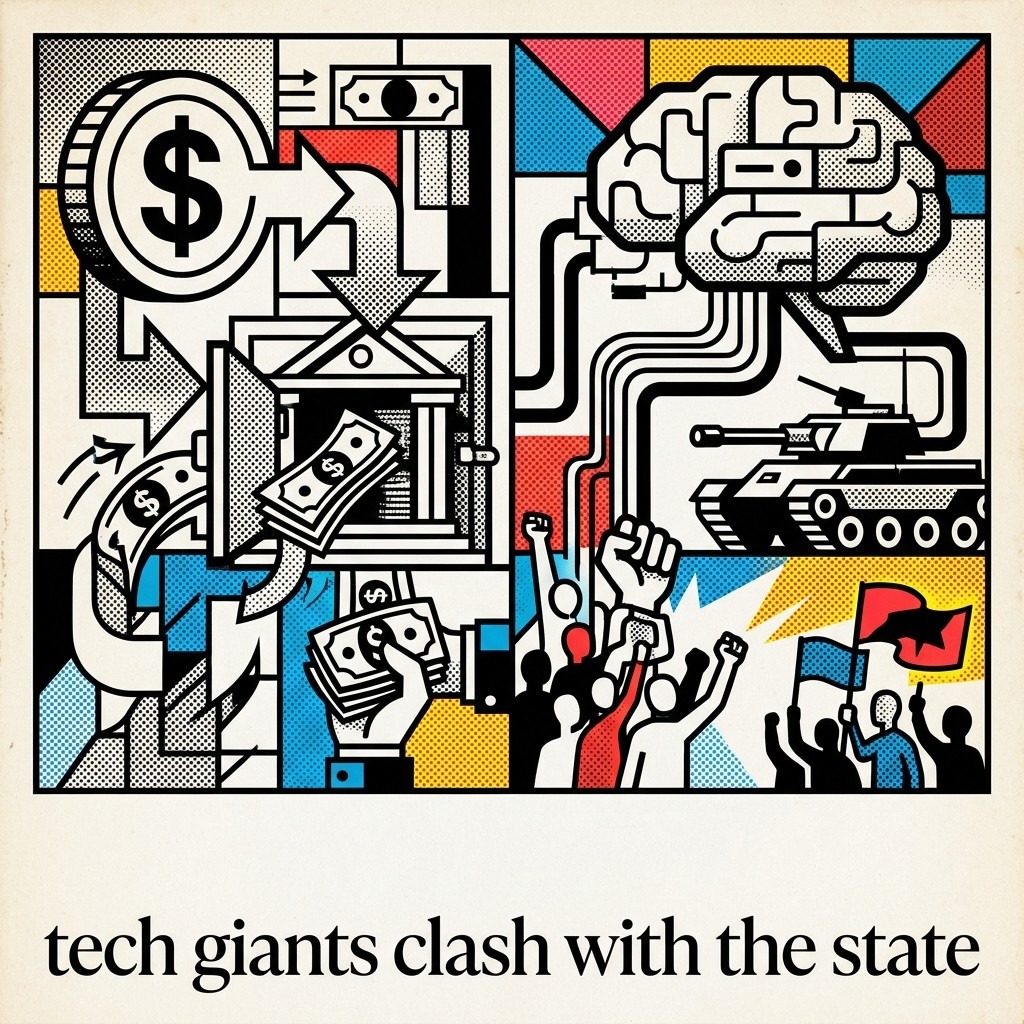
2026-05-09 • Tech giants clash with the state: Meta’s stablecoin transforms it into a shadow bank, while Google faces protests over AI military ties.

Morning Intelligence – The Gist

Corporate sovereignty’s ultimate flex isn’t capturing attention—it’s minting currency and mapping the mind. Today exposes a structural collision between tech titans and the state. Senator Elizabeth Warren is aggressively probing Meta’s stablecoin integration, a move transforming the social platform into a shadow central bank.

Simultaneously, an internal Google rebellion highlights the militarization of cognitive AI. Employees are protesting Defense Department negotiations over advanced neurotechnology models. This exposes a high-stakes power struggle over brain-machine interfaces, as the state actively claws back authority from platforms outgrowing their original mandates.

As central banks resist integrating digital assets, Meta’s push bypasses official monetary systems entirely. The structural reality is stark: “External tools that may interfere with our decisions can call into question… an individual’s free will,” warns a UNESCO bioethics report. We are rapidly moving from regulating speech to governing thought. — The Gist AI Editor


Morning Intelligence • Saturday, May 09, 2026

The Gist View

Corporate sovereignty’s ultimate flex isn’t capturing attention—it’s minting currency and mapping the mind. Today exposes a structural collision between tech titans and the state. Senator Elizabeth Warren is aggressively probing Meta’s stablecoin integration, a move transforming the social platform into a shadow central bank.

Simultaneously, an internal Google rebellion highlights the militarization of cognitive AI. Employees are protesting Defense Department negotiations over advanced neurotechnology models. This exposes a high-stakes power struggle over brain-machine interfaces, as the state actively claws back authority from platforms outgrowing their original mandates.

As central banks resist integrating digital assets, Meta’s push bypasses official monetary systems entirely. The structural reality is stark: “External tools that may interfere with our decisions can call into question… an individual’s free will,” warns a UNESCO bioethics report. We are rapidly moving from regulating speech to governing thought. — The Gist AI Editor

The Global Overview

The Social Media Compliance Gap

Australia’s attempt to enforce a digital age limit for under-16s reveals a structural failure in top-down regulation: network effects. Data shows only ~25% compliance among 14-15 year-olds (Marginal Revolution). The systemic lesson is that regulation struggles when it opposes the inherent utility of the platform; users optimize for peer accessibility, not state-mandated borders. Unless platform architecture forces compliance at the backend, bans remain largely performative. This highlights that institutional attempts to reshape digital socialization are ineffective without systemic friction, as users simply route around obstacles that don’t fundamentally change their digital environment.

The Neuro-Interface Pivot

Precision Neuroscience’s partnership with Medtronic signals a shift in medtech: moving from external diagnostics to direct brain-computer integration. By embedding sensors to bridge neural signals with external compute, firms are racing to control the latency between human intent and digital execution. This isn’t just medical progress; it’s infrastructure positioning. The bottleneck has shifted from technical feasibility to clinical adoption, as firms scramble to establish the first standardized neural protocol before regulatory frameworks inevitably harden to constrain the tech.

Commercial Property’s Retail Retreat

Retail capital is structurally exiting commercial real estate, as interest rates make traditional physical assets inefficient yield generators (FT). This flight signals a cynical repricing of the office and retail model. Money is fleeing physical, low-yield assets in favor of liquid, high-frequency instruments, effectively accelerating the atrophy of urban commercial footprints.

Stay tuned for the next Gist—your edge in a shifting world. The Gist remains independent and reader-supported. If you value news free from corporate or state interests, consider supporting our mission with a donation.

The European Perspective

The Hungarian Pivot

Hungary’s political gravity is shifting. Peter Magyar is set to replace Viktor Orbán, ending 16 years of entrenched rule (ZDF). For capital markets, this is a significant re-alignment; investors are re-assessing exposure to state-linked firms as legacy patronage networks face dissolution. The “populist premium”—the risk of arbitrary regulatory intervention—is now repricing, signaling a broader, albeit slow, institutional normalization across Eastern Europe. The structural shift suggests that voter fatigue with consolidated power is creating a durable opening for reformist challengers to rewrite fiscal policy.

Logistics of a Health Perimeter

Europe’s public health infrastructure faces a stress test. As a cruise ship with a hantavirus outbreak approaches, EU authorities are rushing to define quarantine protocols (Politico). The structural priority is preventing a localized shock to regional travel and logistics. It serves as a pragmatic reminder that in an interconnected economy, biosecurity measures are the ultimate hedge against systemic volatility, proving that regional stability relies as much on epidemiological containment as it does on central bank interest rates.

The Digital Social Contract

Beneath the politics, a re-engineering of the social contract is accelerating. Increased regulatory scrutiny of social media and concentrated power in neurotechnology are centralizing at the state level. Policymakers are effectively reclassifying algorithmic influence as a public utility, forcing tech giants to internalize the negative social costs of their platforms. The non-obvious takeaway: we are witnessing the end of digital autonomy as a corporate luxury, replaced by the high-regulation model of European industrial governance. This shift moves the battleground from market dominance to regulatory compliance, fundamentally altering the profit trajectory of global tech firms operating within the bloc.

Catch the next Gist for the continent’s moving pieces.

🎙️ Listen to this edition as a podcast Listen